Develop addition skills Math Worksheets for Ages 3-9
5 filtered results
-
From - To
Unlock your child’s mathematical potential with our "Develop Addition Skills Math Worksheets" tailored for ages 3-9. Our expertly designed activities make learning addition enjoyable and engaging, fostering foundational math skills through diverse, interactive exercises. Perfect for home or classroom use, these worksheets cater to various learning styles, ensuring a personalized experience for each young learner. From visual cues to fun themes, our resources build confidence and proficiency in addition, setting the stage for future math success. Help your child master essential math concepts with Kids Academy’s engaging and educational worksheets, uniquely crafted to make addition fun and intuitive.
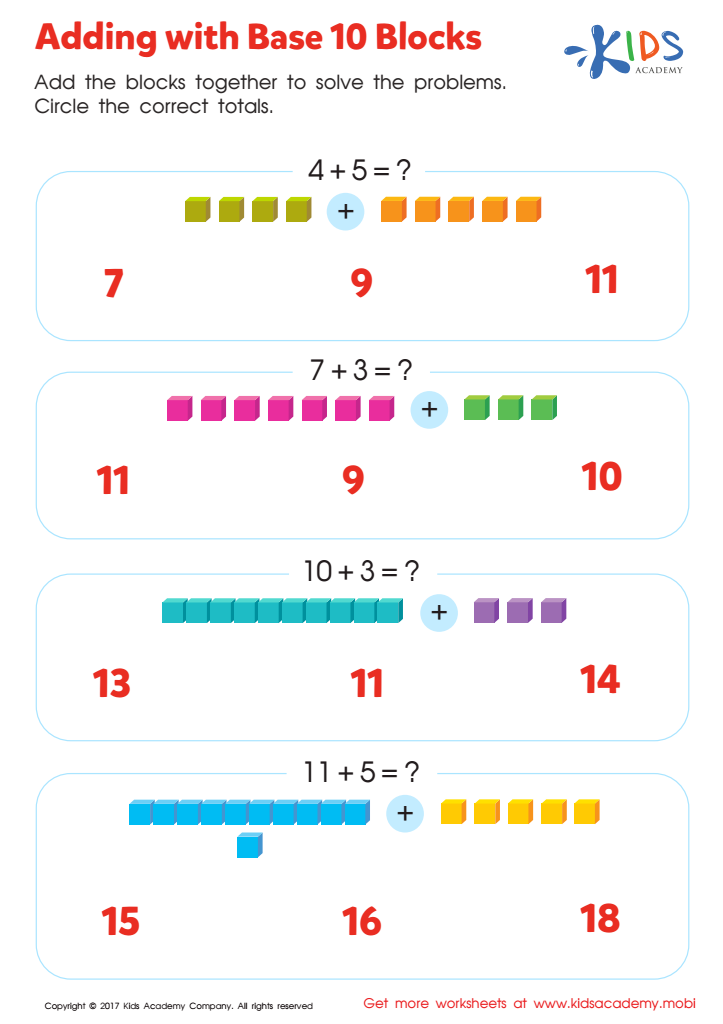
Adding with Base Ten Blocks Worksheet
 Assign to My Students








Developing addition skills in children ages 3-9 is crucial for several reasons. First, mastering addition lays the foundation for all other mathematical concepts, including subtraction, multiplication, and division. This knowledge builds numerical literacy, which is vital for problem-solving in everyday life.
Early proficiency in addition contributes to cognitive development. It enhances logical thinking, memory capacity, and the ability to recognize patterns—all essential skills beyond the classroom. Being comfortable with basic math also boosts a child's confidence. Successfully solving addition problems provides a sense of achievement, encouraging a positive attitude toward learning more complex topics in the future.
Moreover, math skills are strongly linked to academic success in other subjects like science and technology. Early familiarity with addition and other math basics correlates with better performance in standardized tests and later academic achievements.
Socially and emotionally, sharing educational activities around math strengthens the bond between parents, teachers, and children. Activities like counting games, using everyday objects for sums, and practicing simple math functioning incorporate fun and learning seamlessly, making learning an enjoyable experience rather than a chore.
Summing up, focusing on developing addition skills in young children fosters essential academic development and equips them with important life skills early on.








