Fine motor skills (drawing lines) Math Worksheets for Ages 3-9
7 filtered results
-
From - To
Introducing our Fine Motor Skills (Drawing Lines) Math Worksheets for Ages 3-9! These expertly designed worksheets combine fun and learning to strengthen your child's fine motor skills while mastering essential math concepts. Perfect for young learners, each activity encourages precision and control, helping develop hand-eye coordination. Our worksheets cater to different difficulty levels, ensuring consistent progress and confidence building in young mathematicians. Make learning interactive and enjoyable with engaging exercises suitable for ages 3-9. Give your child the foundation they need today with our enriching resources. Explore our collection and enhance your child's academic journey!

Count and Match Vegetables 1 – 7 Math Worksheet
 Assign to My Students

Counting Eggs Worksheet

Count and Match Vegetables 2 – 8 Math Worksheet
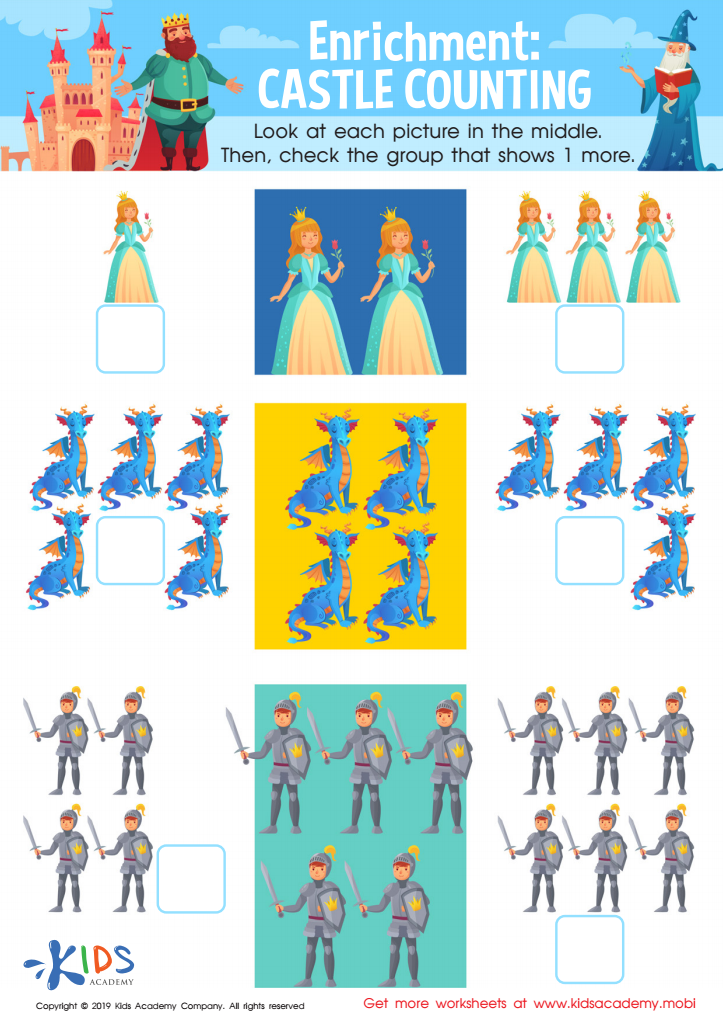
Enrichment: Castle Counting Worksheet








Fine motor skills are crucial for children aged 3-9 as they form the foundation for many daily activities and educational tasks. One key aspect of these skills is the ability to draw lines accurately, which directly relates to mathematical learning. When children practice drawing lines, they are not just honing their physical dexterity but also developing spatial awareness and an understanding of geometry.
Mastering fine motor skills allows children to efficiently use tools such as pencils and scissors, enabling them to perform tasks like writing numbers and letters and cutting out shapes. This ability to engage with math content through hands-on activities makes learning more concrete and less abstract. For instance, when children draw straight lines to connect dots or outline shapes, they are indirectly learning about measurement, symmetry, and basic geometric concepts.
These skills also contribute to improved hand-eye coordination, which is essential for problem-solving and completing complex tasks. Furthermore, the confidence gained from successfully manipulating objects and drawing accurately boosts a child's overall self-esteem, encouraging a positive attitude towards learning.
Parents and teachers should thus prioritize the development of fine motor skills to ensure that children are set up for academic success and daily life independence, building a solid foundation for more advanced mathematical concepts down the line.








