Improve counting skills Math Worksheets for Ages 3-9 - Page 3
53 filtered results
-
From - To
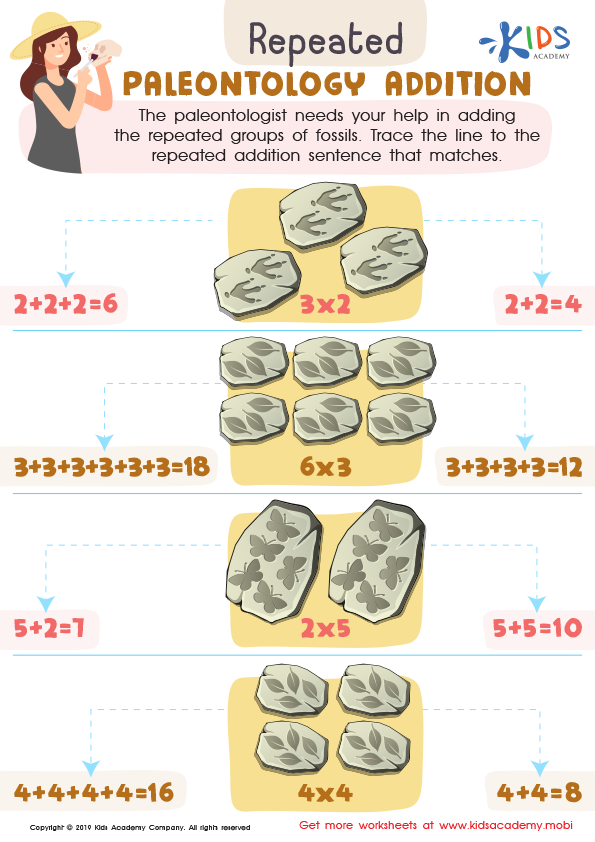
Repeated Archaeology Addition Worksheet
 Assign to My Students





.jpg)

Counting skills are foundational to a child's ability to understand and succeed in mathematics, making them critically important for children aged 3-9. Early proficiency in counting goes beyond just reciting numbers; it encompasses understanding number concepts, quantity recognition, and performing basic arithmetic operations that scaffold more complex mathematical thinking.
Parents and teachers should prioritize improving these skills because they lay the groundwork for future success in more advanced mathematics and related subjects such as science, technology, and engineering. Instilling strong counting abilities fosters logical thinking, problem-solving, and analytical skills. For instance, when a child learns to count objects, they begin to grasp one-to-one correspondence, which is crucial for understanding addition, subtraction, and later, multiplication and division.
Moreover, strong early counting skills boost overall academic confidence and can ignite a passion for learning. Children who master these basics are likely to enjoy math classes more and perform better, reducing anxiety and the risk of math-related difficulties later on.
In addition to academic benefits, counting skills have practical day-to-day applications. From understanding money and time to measuring ingredients while cooking, numeracy is pervasive in everyday life. Ignoring this foundational skill can limit a child's ability to engage fully with the world around them. Therefore, parents and teachers should nurture and enhance these essential skills early on to build a solid educational foundation and ensure comprehensive cognitive development.








