Numerical reasoning Math Worksheets for Ages 3-9
3 filtered results
-
From - To
Our "Numerical Reasoning Math Worksheets for Ages 3-9" empower young learners with essential problem-solving and critical-thinking skills. Designed for preschool to early elementary levels, these engaging worksheets cover number recognition, counting, patterns, arithmetic, and logic puzzles. Each activity is crafted to make learning fun, boost confidence, and enhance mathematical fluency. Perfect for classroom or home learning, our printable resources support parents and teachers in cultivating a solid mathematical foundation. Foster a love of math in your child with our comprehensive and dynamic numerical reasoning worksheets, ensuring educational growth and success.
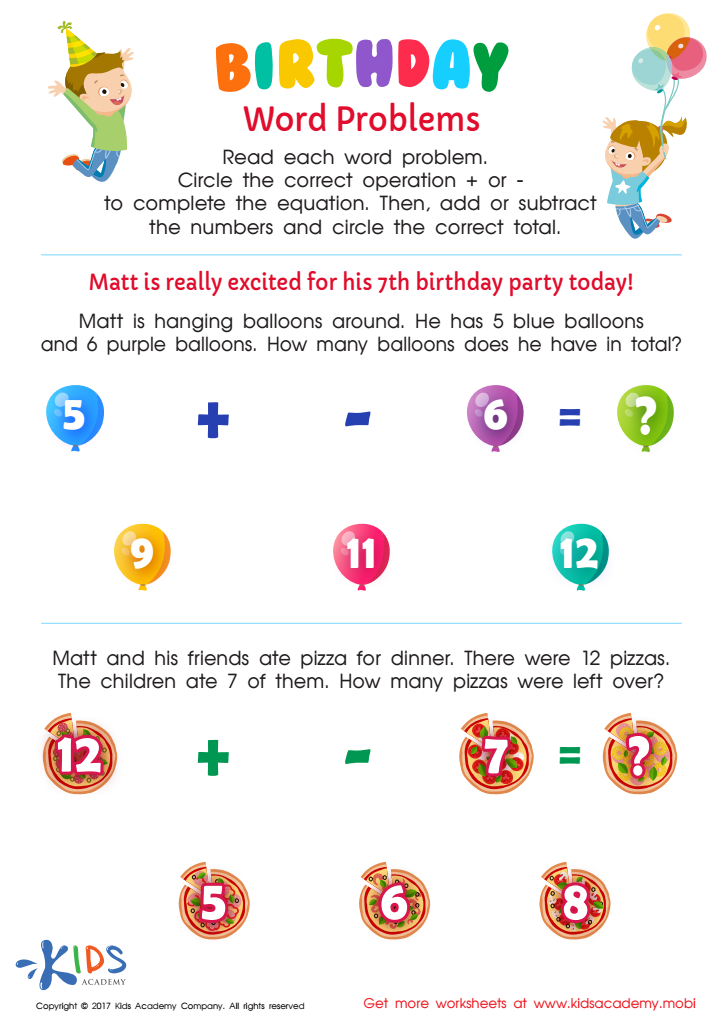
Birthday Word Problems Substraction Worksheet
 Assign to My Students







Numerical reasoning forms a crucial part of early childhood education, and parents or teachers should prioritize it for children aged 3-9. During these formative years, children's cognitive and brain development occur rapidly, and mathematical skills are foundational for future academic success. Engaging in numerical reasoning helps build critical thinking, problem-solving, and logical reasoning abilities that are applicable across all subjects.
At ages 3 to 9, children start to understand basic concepts of numbers, patterns, and relationships. Introducing numerical reasoning at this stage helps them develop a more intuitive grasp of counting, addition, subtraction, and other arithmetic operations. These skills are not only essential for succeeding in higher-level math but are also practical in everyday life—such as telling time, handling money, and even in play activities that involve measurements or spatial awareness.
Furthermore, early exposure to math fosters a positive attitude towards the subject, reducing math anxiety later in life. Interactive and hands-on activities designed for numerical reasoning can make learning fun and engaging, igniting a child’s natural curiosity.
Parents and teachers play a pivotal role in guiding these experiences. By encouraging and supporting numerical reasoning from an early age, they lay a strong foundation for academic achievement and equip children with essential tools for problem-solving and logical thinking.








