Telling time Math Worksheets for Ages 3-9
4 filtered results
-
From - To
Discover a fun way to teach kids to tell time with our Telling Time Math Worksheets designed for ages 3-9! Perfect for both classroom and home use, these worksheets offer engaging exercises that simplify learning to read both analog and digital clocks. From basic hour and minute recognition to more advanced concepts, our printables cater to different skill levels, ensuring a comprehensive grasp of telling time. Enhance your child's mathematical skills with our expertly crafted worksheets, making time-telling an exciting and educational adventure. Explore now to provide a strong foundation in essential time concepts for your young learner!
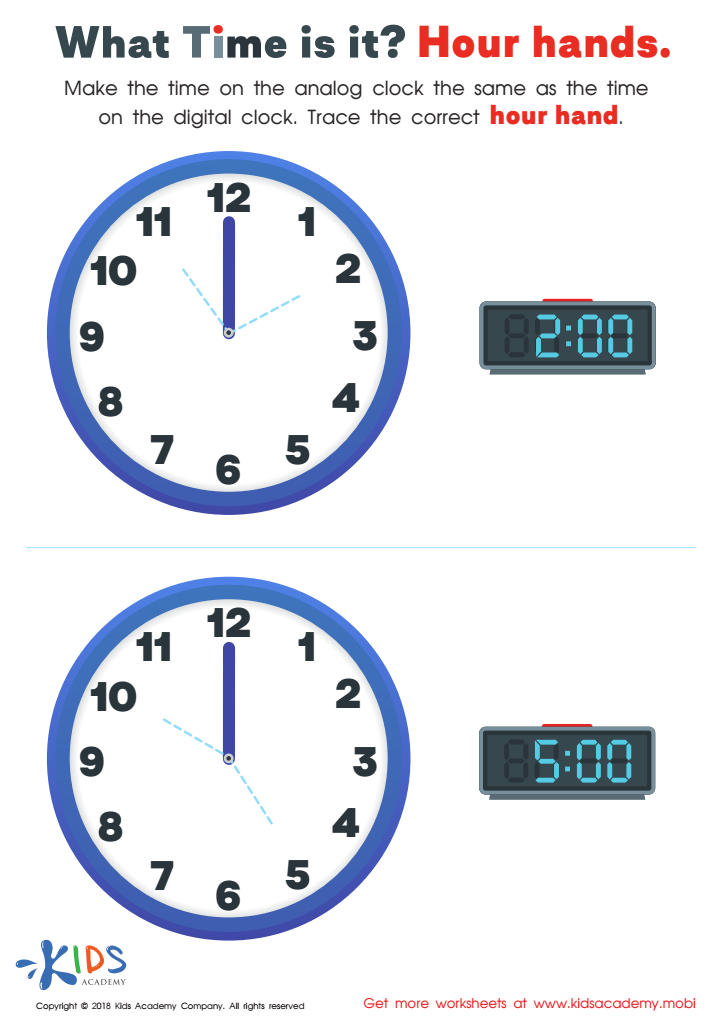
What Time Is it? Hour Hands Worksheet
 Assign to My Students





.jpg)

Understanding how to tell time is a fundamental life skill that children aged 3-9 should learn. For one, it encourages mathematical thinking, as children need to recognize numbers, count by fives, and understand concepts of fractions and intervals. Time-telling can enhance their cognitive development by improving sequencing skills and the ability to comprehend the passage of time.
From a practical standpoint, knowing how to tell time aids children in developing a sense of routine and time management. This is crucial in helping them become more self-sufficient, whether it's following a schedule, completing tasks on time, or understanding the duration of activities. Good time management skills foster responsibility and independence.
Moreover, telling time introduces young children to the world of adult tasks, making them feel more included and capable. This can boost their self-confidence and provide them a comfort level with more complex tasks later on.
Finally, learning to tell time has social benefits. Children gain an orientation to community life by understanding concepts such as "after school" or "bedtime." They can thrive in both academic and extracurricular settings by knowing when it's time to move from one activity to another, reducing anxiety and making transitions smoother. Hence, early mastery of telling time serves as a building block for more advanced academic concepts and essential life skills.








