Understanding more/less concept Math Worksheets for Ages 3-9
3 filtered results
-
From - To
Our "Understanding More/Less Concept" math worksheets are designed for children ages 3-9, to enhance their quantitative reasoning skills in a fun and interactive way. Through engaging activities, kids learn to compare quantities, fostering a solid foundation in early math concepts. These worksheets feature colorful illustrations and relatable scenarios perfect for young learners. Whether your child is just beginning to explore numbers or getting ready for more advanced math, these printables support cognitive development and math proficiency. Visit Kids Academy to find age-appropriate worksheets that simplify the learning process and spark a love for mathematics.
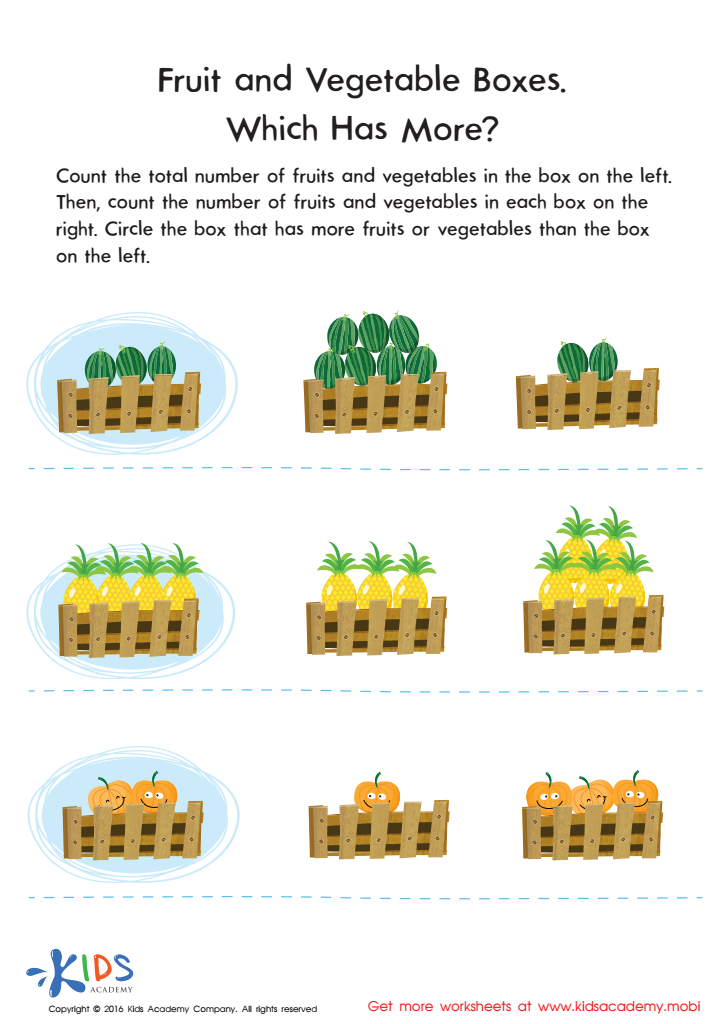
Which Has More? Size Worksheet
 Assign to My Students
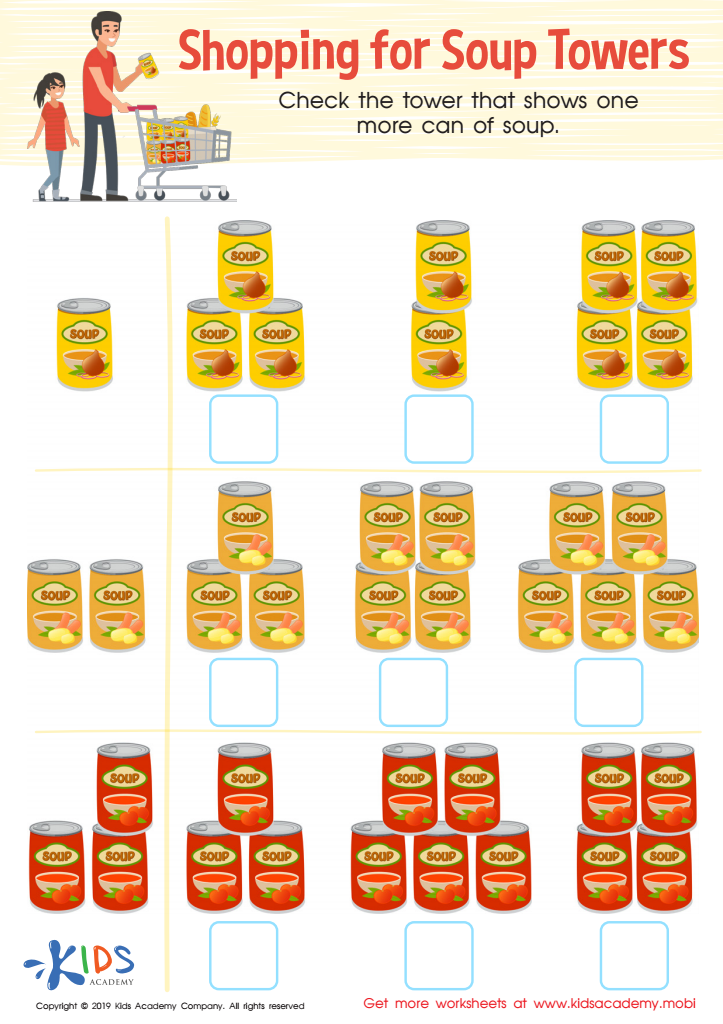
Soup Towers Worksheet







Understanding the concepts of more and less is foundational in early childhood mathematics and crucial for ages 3-9. These concepts form the basis for number sense, which is the ability to understand, relate, and connect numbers. When children can comprehend more and less, they are better prepared to understand addition and subtraction, laying the groundwork for more complex mathematical operations.
Early mastery of more and less boosts logical thinking, problem-solving skills, and decision-making abilities. For instance, if a child can recognize that 5 is more than 2 and less than 9, they can start to make predictions, compare quantities, and solve simple problems independently. This understanding is also reinforced in everyday activities—like dividing snacks or measuring the ingredients while cooking—which makes learning practical and contextual.
For parents and teachers, encouraging proficiency in these concepts helps to identify and bridge learning gaps early. It ensures that children aren't just memorizing numbers, but actually comprehending their values and relationships. This promotes confidence, fosters a positive attitude toward math, and builds a strong academic foundation for future learning. Conclusively, focusing on the more and less concept nurtures essential cognitive development and helps children thrive academically and in everyday life.








