Understanding symmetry Math Worksheets for Ages 3-9 - Page 2
30 filtered results
-
From - To
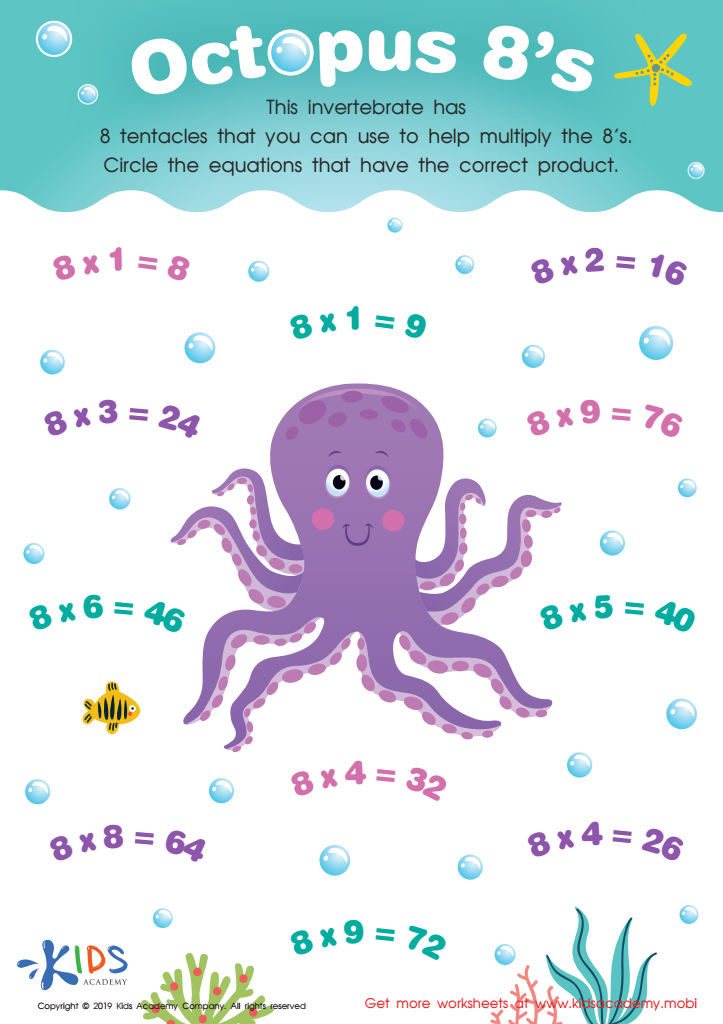
Octopus 8’s Worksheet
 Assign to My Students







Understanding symmetry in mathematics for young children, ages 3-9, is fundamental for various reasons. Firstly, symmetry forms a foundational part of geometry, which helps enhance spatial awareness in children. When kids recognize and understand symmetrical shapes, they develop essential visuospatial skills, leading to better problem-solving abilities and mathematical reasoning.
Secondly, engaging with symmetry fosters creativity and appreciation for aesthetics. Children exposed to symmetrical patterns often show increased interest in art, nature, and design — areas enriched by symmetrical elements. By recognizing symmetry in their environment, they nurture their observational skills and the ability to identify patterns, which is crucial in subjects like math and science.
Thirdly, early understanding of symmetry contributes to cognitive development. Working with symmetrical objects requires mental processes such as reflection, balancing, and often incorporates basic arithmetic concepts, reinforcing the brain's logical processing capability. These interactions also help children develop early algebraic thinking by recognizing and predicting patterns.
Lastly, incorporating symmetry into education aligns with diverse learning styles as it often involves hands-on activities, visual aids, and interactive play. This amplifies engagement and retention, making learning fun and more effective. Thus, parents and teachers should prioritize teaching symmetry, creating a strong, enjoyable foundation for future mathematical education and beyond.








