
Understanding measurement units Math Worksheets for 3-Year-Olds
3 filtered results
Difficulty Level
Grade
Age
-
From - To
Subject
Activity
Standards
Introduce your child to the fascinating world of measurement with our "Understanding Measurement Units Math Worksheets" designed for 3-year-olds. These engaging printables help young learners grasp basic concepts of size, length, weight, and volume through playful activities. Perfectly curated to combine fun with learning, these worksheets employ vibrant illustrations, simple tasks, and everyday objects to spark curiosity and build foundational math skills. Start your child's educational journey on the right foot and foster a love for learning with our expertly crafted resources. Visit Kids Academy to download and print for endless educational fun!
Favorites
With answer key
Interactive
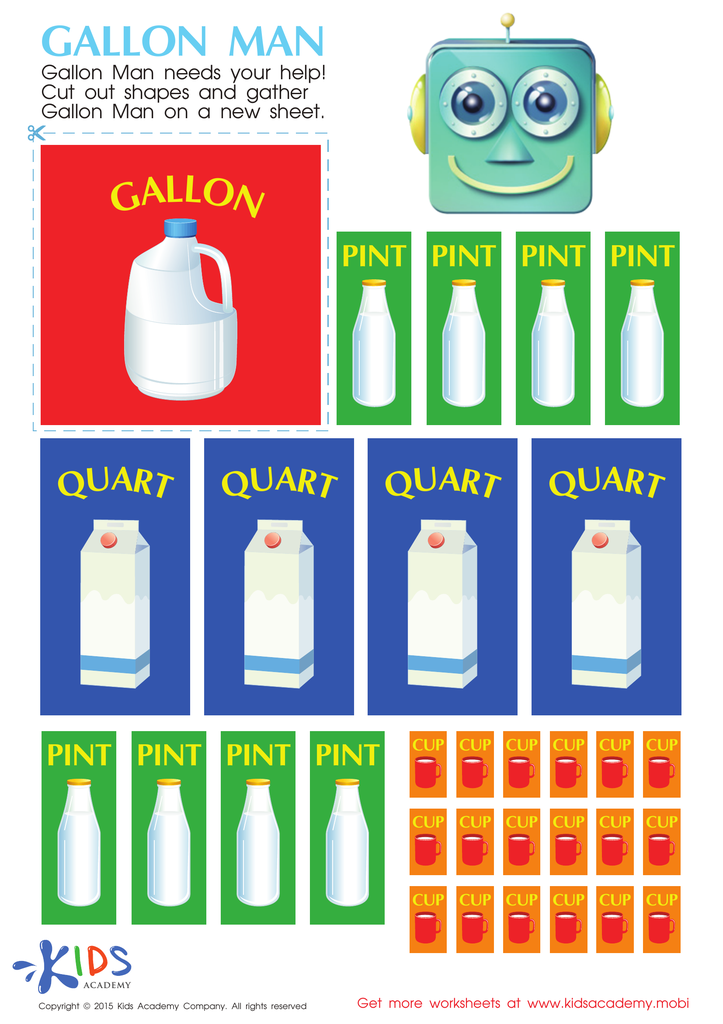
Cups, Pints and Quarts With Gallon Man Worksheet
Measurement in cups, pints, quarts and gallons has never been this fun!
Cups, Pints and Quarts With Gallon Man Worksheet
Worksheet
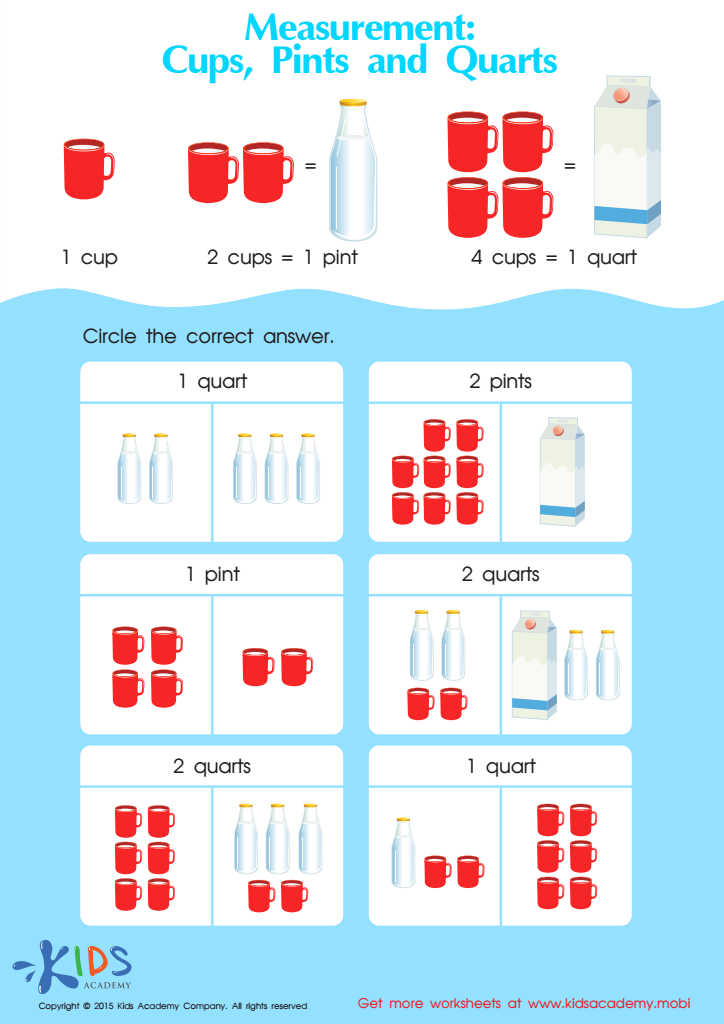
Cups, Pints and Quarts Worksheet
Let your kids explore the world of math with our worksheet! Have them count cups, pints and quarts in pictures and circle the right answer. Get even more free printable math worksheets for kindergarten on our website. Come on, join the adventure!
 Assign to My Students
Cups, Pints and Quarts Worksheet
Worksheet
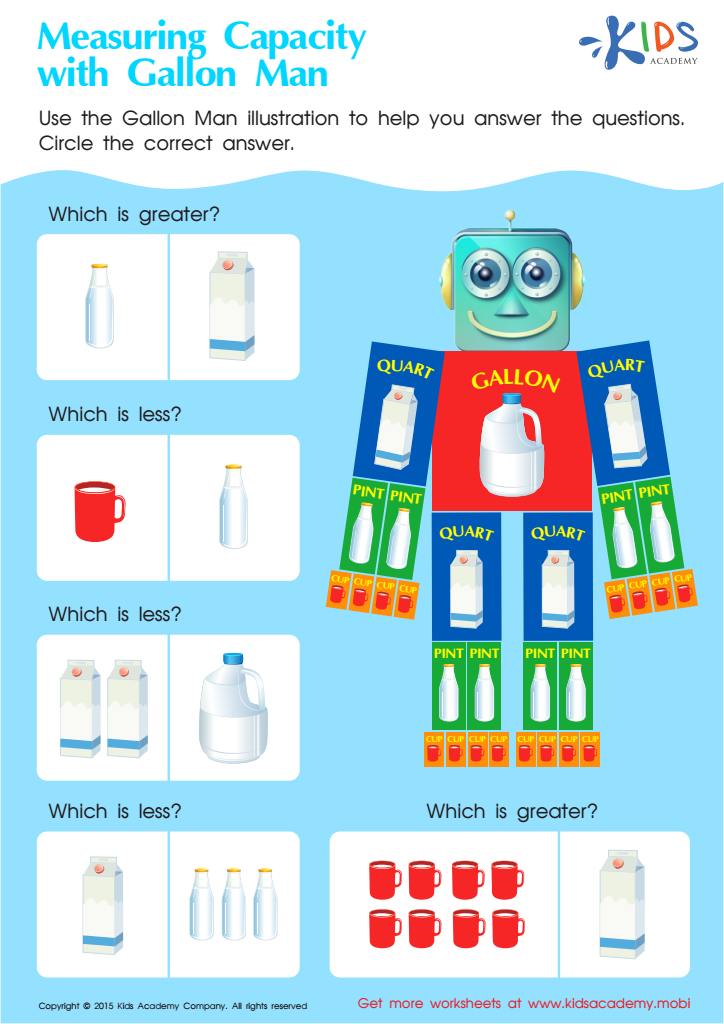
Measurement: Measuring Capacity with Gallon Man Worksheet
Check out Gallon Man to practice measuring capacity with cups, pints, quarts, and gallons. Our worksheet has questions with answers checked against Gallon Man. For more practice, visit our site for free printable math worksheets for kindergarten and learn math with fun!
Measurement: Measuring Capacity with Gallon Man Worksheet
Worksheet
Join Kids Academy for Free
Who is primarily going to use this learning content?





Introducing measurement units to 3-year-olds lays a critical foundation for their cognitive development and future academic success. At this tender age, children are naturally curious about the world around them. Capitalizing on this curiosity by teaching measurement concepts helps them make sense of their environment in quantifiable terms. When parents or teachers engage young children with activities that involve comparing lengths, weights, and volumes, it nurtures their innate curiosity and supports the development of critical thinking and problem-solving skills.
Understanding basic measurement units forms the basis for more complex mathematical concepts that children will encounter later in their educational journey. Measuring objects and comparing sizes can be seamlessly integrated into play-based learning, making it a fun and engaging process. This way, math is not presented as an abstract, daunting subject but as a practical, enjoyable part of daily life.
Moreover, these early experiences with measurement help children develop important life skills like estimation, spatial awareness, and precision. Parents and teachers who invest time in teaching these concepts provide children with the tools they need for scientific thinking and real-world problem-solving. Thus, focusing on measurement units at this young age sets the stage for future academic achievement and lifelong learning. This foundational knowledge also boosts children’s confidence, enabling them to tackle more complex subjects with ease as they grow.








