
Enhance fine motor skills Worksheets for Ages 4-6
3 filtered results
Difficulty Level
Grade
Age
-
From - To
Subject
Activity
Standards
Discover a collection of engaging worksheets designed to enhance fine motor skills for children aged 4-6! Our fun and interactive activities are tailored to promote hand-eye coordination, dexterity, and precision. From tracing and cutting to coloring and shaping, these worksheets empower young learners to develop essential skills for writing and everyday tasks. Perfect for both classroom and home use, each activity is designed to keep kids entertained while they learn. Download our fine motor skills worksheets today and watch your child’s confidence and abilities flourish as they master these crucial developmental skills! Let's make learning a delightful experience!
Favorites
With answer key
Interactive
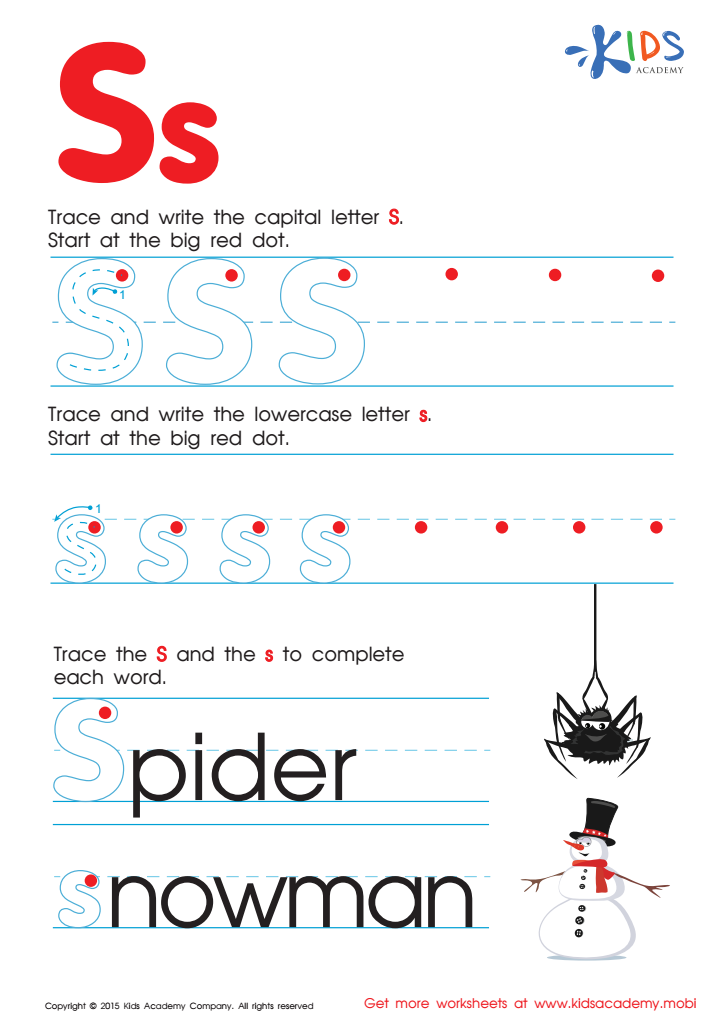
Letter S Tracing Page
Trace and write the capital and lowercase "S" on this ABC worksheet for kindergarten. Start with the big red dot and be careful. When you finish, help the spider and snowman in the pictures restore their words with the capital and lowercase letters. Continue learning the alphabet with Kids Academy.
 Assign to My Students
Letter S Tracing Page
Worksheet

Join Kids Academy for Free
Who is primarily going to use this learning content?








Enhancing fine motor skills in children aged 4-6 is crucial for their overall development and preparation for future learning. During this foundational stage, children's hand-eye coordination and dexterity are rapidly developing, which supports various essential activities such as writing, drawing, and self-care tasks like buttoning clothes or using utensils.
Investing in fine motor skill activities helps improve their ability to manipulate objects, leading to better control over writing instruments and tools. This can significantly boost their academic confidence as they enter formal education, making it easier for them to engage in literacy and numeracy activities. Furthermore, fine motor skills foster cognitive development as children learn through play and hands-on experiences.
By enhancing these skills, parents and teachers can promote greater independence in everyday tasks, encouraging a sense of accomplishment. Socially, children with developed fine motor skills may be more inclined to participate in group activities, enhancing their teamwork and communication skills. Ultimately, investing time in fine motor skill development not only enriches a child's play but also lays the groundwork for lifelong learning and self-sufficiency.








