
Phonics comprehension Worksheets for Ages 4-6
3 filtered results
Difficulty Level
Grade
Age
-
From - To
Subject
Activity
Standards
Discover our engaging Phonics Comprehension Worksheets designed specifically for children ages 4-6. These interactive resources enhance early literacy skills by helping young learners connect sounds with letters and improve their reading comprehension. Each worksheet features fun illustrations and age-appropriate activities that make phonics learning enjoyable. Your child will enhance their word recognition abilities, boost vocabulary, and develop essential decoding skills, all while having fun! Perfect for home or classroom use, our worksheets promote active learning and ensure that foundational reading skills are mastered. Unlock your child's potential and make reading exciting with our phonics comprehension worksheets today!
Favorites
With answer key
Interactive
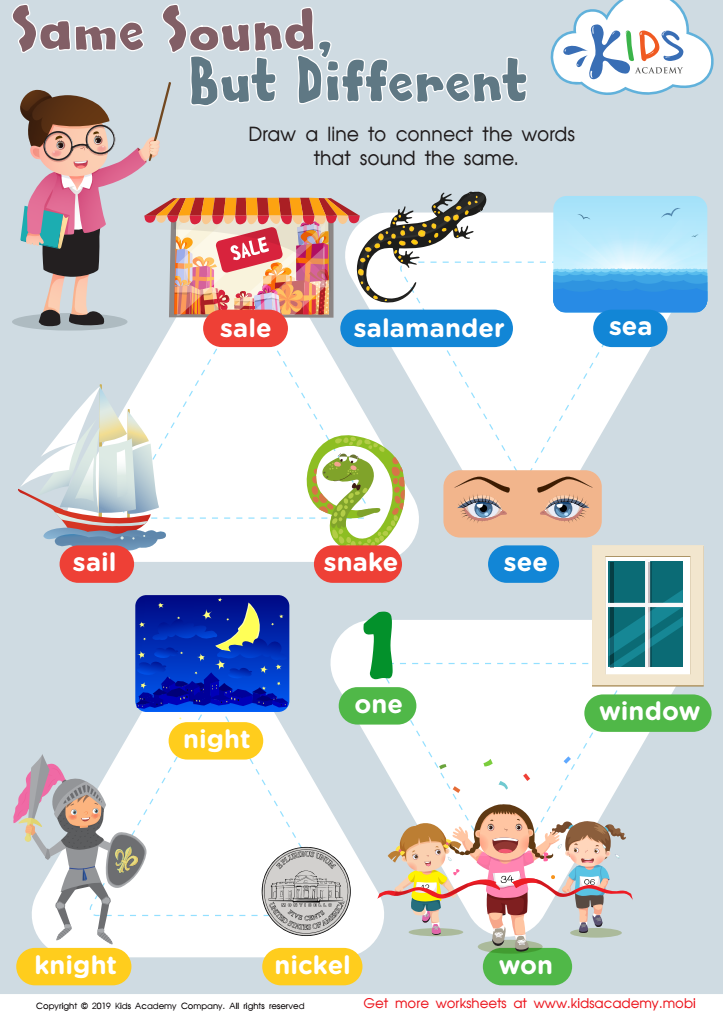
Sound Different Worksheet
Homophones can be tricky for new readers and writers. This PDF worksheet helps kids understand the differences using pictures. It asks them to draw lines to connect the homophones and provides concrete imagery for reference. It's a great way to learn the right definition and spelling of words that sound the same.
 Assign to My Students
Sound Different Worksheet
Worksheet
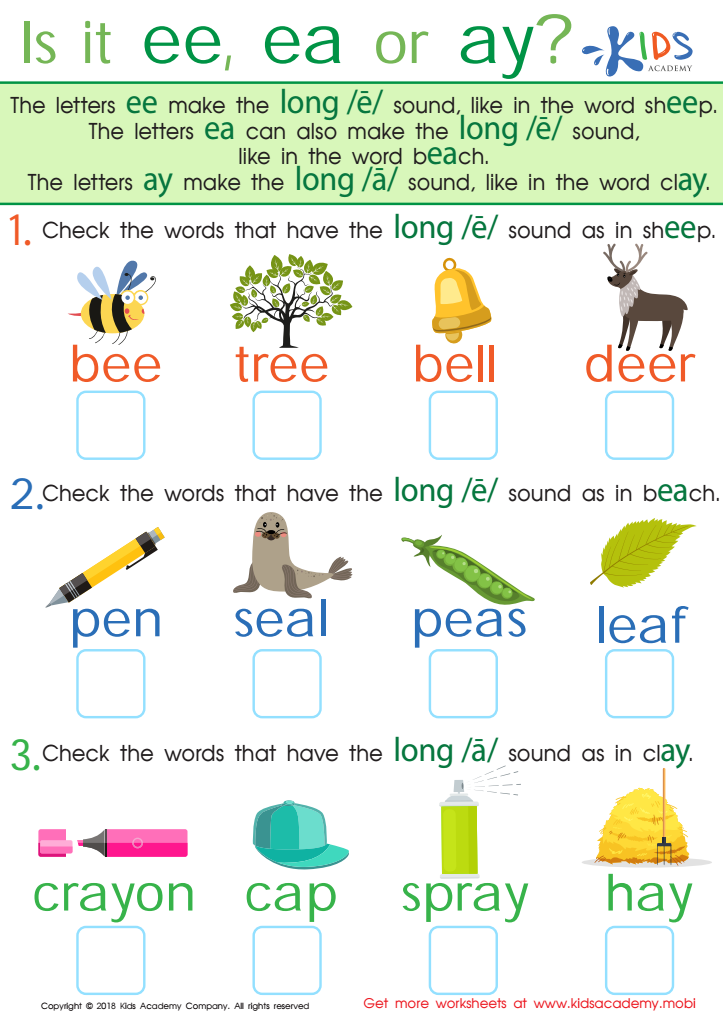
Is It EE, EA, or AY? Worksheet
When 'ee', 'ea' and 'ay' are in words, they usually make the long /e/ and /a/ sounds. Examples of words with 'ee' are "sheep", 'beach' and 'seat' with 'ea', and 'clay' and 'play' with 'ay'. Check this colourful worksheet with your kids; help them find the words that make the long /e/ sound like 'sheep'.
Is It EE, EA, or AY? Worksheet
Worksheet
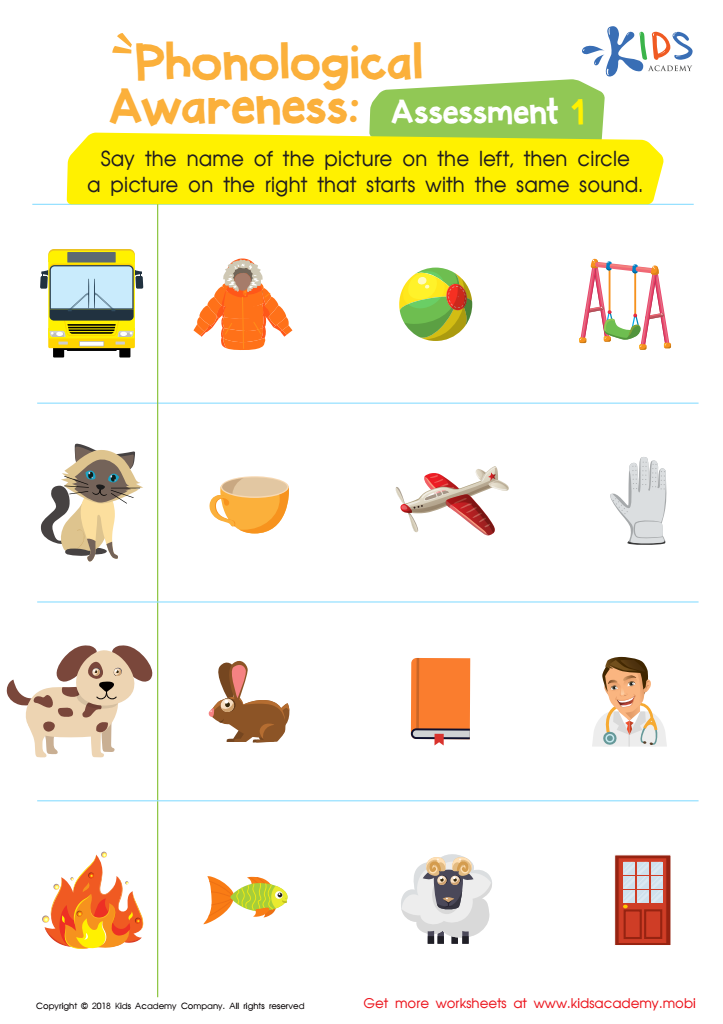
Phonological Awareness: Assessment 1 Worksheet
This worksheet helps kids build key phonics skills for pre-reading. They say each picture name aloud, focusing on the starting sound. Then, they match the sound with an image in the same row. Use as a checkpoint for kindergarten or grade 1 phonics readiness.
Phonological Awareness: Assessment 1 Worksheet
Worksheet
Join Kids Academy for Free
Who is primarily going to use this learning content?







Phonics comprehension is crucial for children aged 4-6 as it lays the foundation for reading and writing skills. During these early developmental years, children begin to decode words by understanding the relationship between sounds and letters. This skill not only aids in their ability to read but also enhances their vocabulary and comprehension, fostering a love for literacy.
Parents and teachers should care about phonics because effective reading is fundamental to overall academic success. A strong grasp of phonics equips children to tackle more complex texts in later grades, promoting confidence and independence in their learning journey. Children who struggle with phonics may face challenges that can lead to frustration and a negative attitude towards reading.
Moreover, phonics instruction promotes critical thinking skills as children learn to analyze and manipulate sounds. It encourages engagement through playful activities and phonics games, making learning enjoyable. Additionally, early proficiency in reading opens up opportunities across all subjects, making it essential for comprehensive educational development.
By prioritizing phonics comprehension, parents and teachers can ensure that children develop essential literacy skills that impact their future learning and life opportunities. This early investment in reading will set the stage for lifelong readers and learners.








