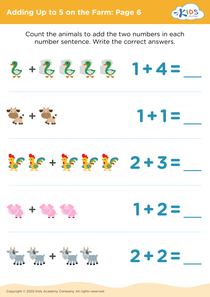
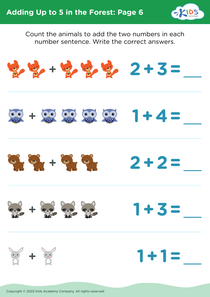
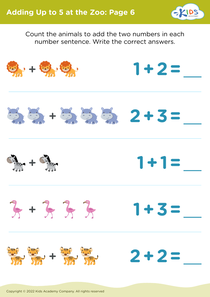
Basic addition practice Adding in the Sea Worksheets for Ages 4-6
3 filtered results
-
From - To
Dive into an ocean of fun with our "Adding in the Sea" worksheets, designed for young learners aged 4-6! These engaging printables offer a delightful way for children to practice basic addition skills while exploring an underwater theme. With colorful illustrations and enjoyable exercises, kids will strengthen their mathematical foundation through counting sea creatures and solving quirky addition problems. Perfect for homeschoolers or as supplemental material in the classroom, these worksheets foster early math skills, boost confidence, and make learning enjoyable. Swim into learning today and make math less of a chore and more of an adventure with "Adding in the Sea"!
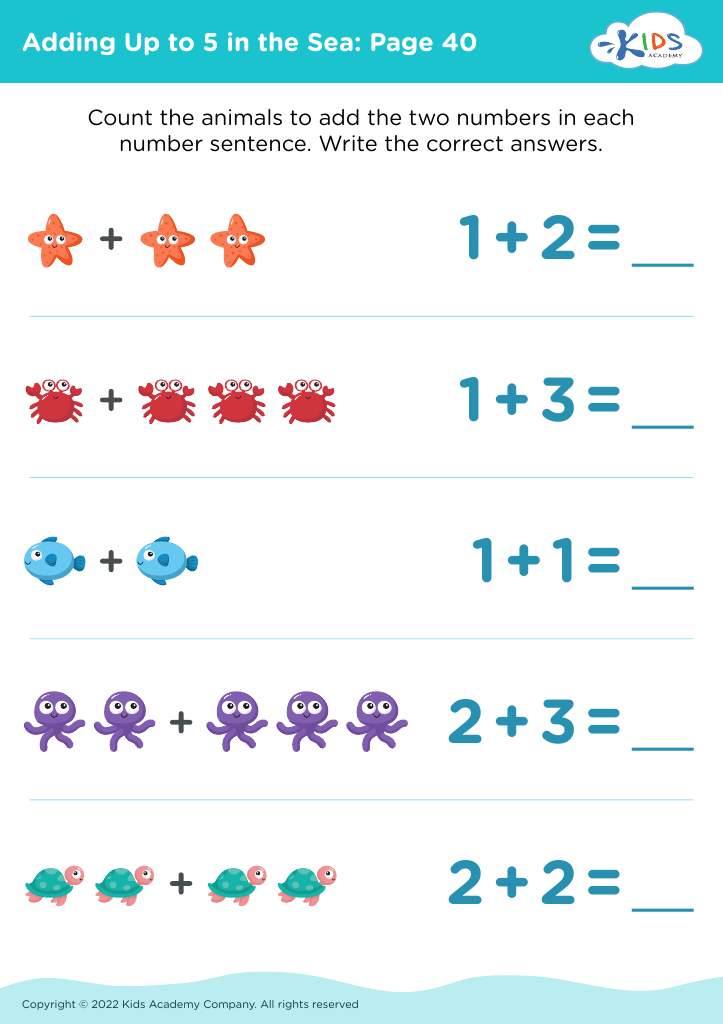
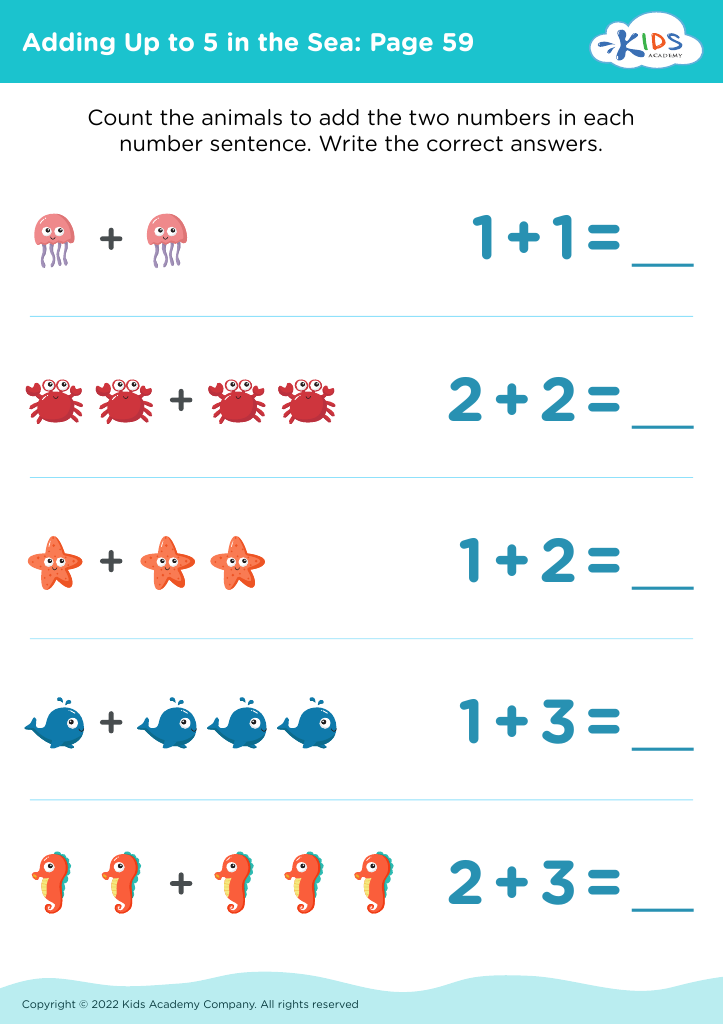
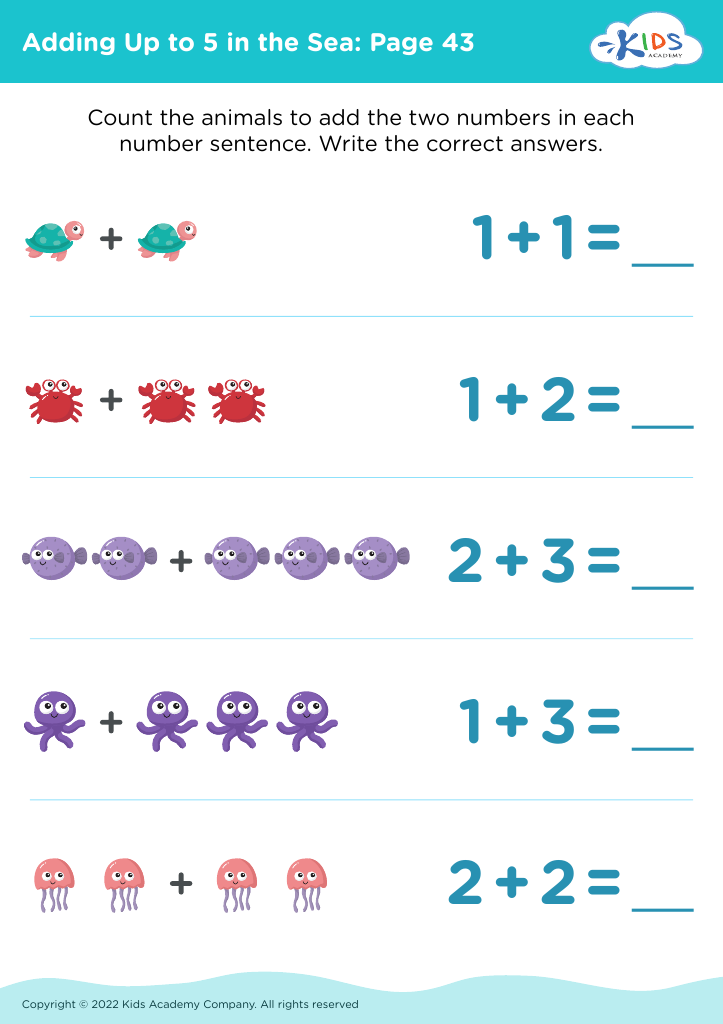



Basic addition practice, such as the "Adding in the Sea" activity, is crucial for young learners aged 4-6. This foundation in mathematics helps children develop critical cognitive skills, enhances their problem-solving abilities, and builds a strong arithmetic foundation that supports future learning.
Engaging activities like "Adding in the Sea" make learning fun and interactive. They draw children into an imaginative context where they can visualize numbers and understand quantities through colorful imagery and relatable scenarios, such as counting marine creatures. This method taps into children’s innate curiosity, encouraging them to explore and engage actively, which can significantly boost retention and comprehension.
Moreover, mastering basic addition at an early age fosters confidence in young learners. As children successfully tackle simple math problems, they develop a belief in their abilities, making them more likely to embrace future mathematical challenges. It also prepares them for more complex concepts like subtraction and eventually arithmetic operations when they progress in their education.
Lastly, practicing addition supports critical life skills such as reasoning and logical thinking. By incorporating enjoyable activities like "Adding in the Sea," teachers and parents ultimately nurture their children’s mathematical understanding, helping them become well-rounded learners.