
Observational skills Addition & Subtraction Worksheets for Ages 4-6
3 filtered results
Difficulty Level
Grade
Age
-
From - To
Subject
Activity
Standards
Enhance your child's understanding of addition and subtraction with our engaging Observational Skills Worksheets, designed for ages 4-6. These printable resources encourage young learners to develop critical thinking and problem-solving abilities through fun, interactive activities. Focusing on observational skills, children will identify patterns, compare quantities, and draw connections between objects, all while practicing fundamental math concepts. Our colorful and thoughtfully designed worksheets make learning exciting and accessible, ensuring your preschooler builds a strong mathematical foundation. Perfect for home or classroom use, these worksheets will inspire a love for math and a deeper understanding of basic operations. Start fostering essential skills today!
Favorites
With answer key
Interactive
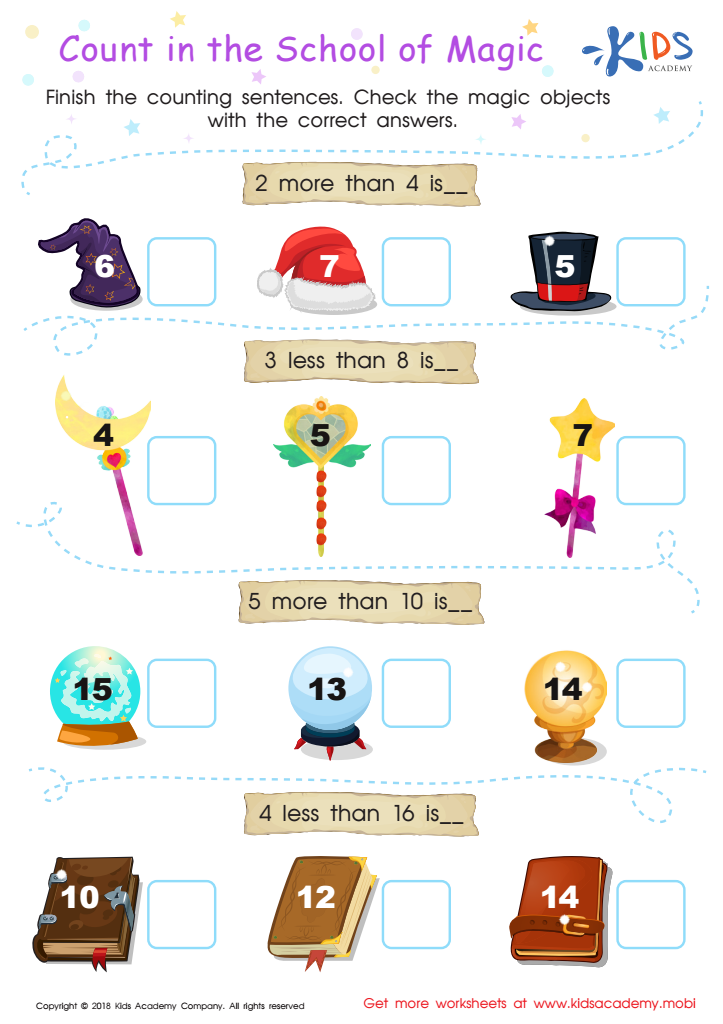
Count in the School of Magic Worksheet
Your math learners can explore the School of Magic with this worksheet. They'll read equations with addition and subtraction numbers under 20, count back and forth to find the answer, then complete the counting sentences. Fun pictures and easy accuracy make it an enjoyable and successful learning experience.
 Assign to My Students
Count in the School of Magic Worksheet
Worksheet
Join Kids Academy for Free
Who is primarily going to use this learning content?








Observational skills in addition and subtraction are crucial for children aged 4-6 as they form the foundation for mathematical understanding and problem-solving abilities. During these early years, children are naturally curious, and developing their observational skills can enhance their learning experience. Parents and teachers who foster these skills help children learn to think critically and analyze the world around them.
Teaching addition and subtraction through observation encourages children to recognize patterns, understand quantities, and relate them to real-world scenarios, such as counting objects or sharing snacks. Observational learning enables them to grasp basic mathematical concepts in a meaningful context, rather than rote memorization. It cultivates a sense of inquiry and promotes cognitive development.
Furthermore, strong observational skills can lead to greater engagement and enthusiasm for learning. Children are more likely to enjoy math and find it relevant when they can see connections in their everyday life. For parents and teachers, fostering these skills helps set a positive tone for future learning, builds confidence, and prepares children for more complex mathematical concepts as they progress in their education. Involvement in nurturing these skills ultimately supports a child’s holistic growth and confidence in their abilities.








