
Observational skills Addition Worksheets for Ages 4-6
3 filtered results
Difficulty Level
Grade
Age
-
From - To
Subject
Activity
Standards
Enhance your child's early math experience with our Observational Skills Addition Worksheets, designed specifically for ages 4-6. These engaging worksheets incorporate fun activities that help young learners develop their observation skills while mastering basic addition concepts. Children will identify patterns, count objects, and solve interactive problems that foster critical thinking. Tailored for preschool and kindergarten readiness, these worksheets promote essential cognitive skills in a playful manner. With vibrant visuals and age-appropriate challenges, your child will enjoy learning nestled within a supportive environment. Perfect for both classroom and home use, our resources ensure that foundational math skills are learned effectively and joyfully.
Favorites
With answer key
Interactive
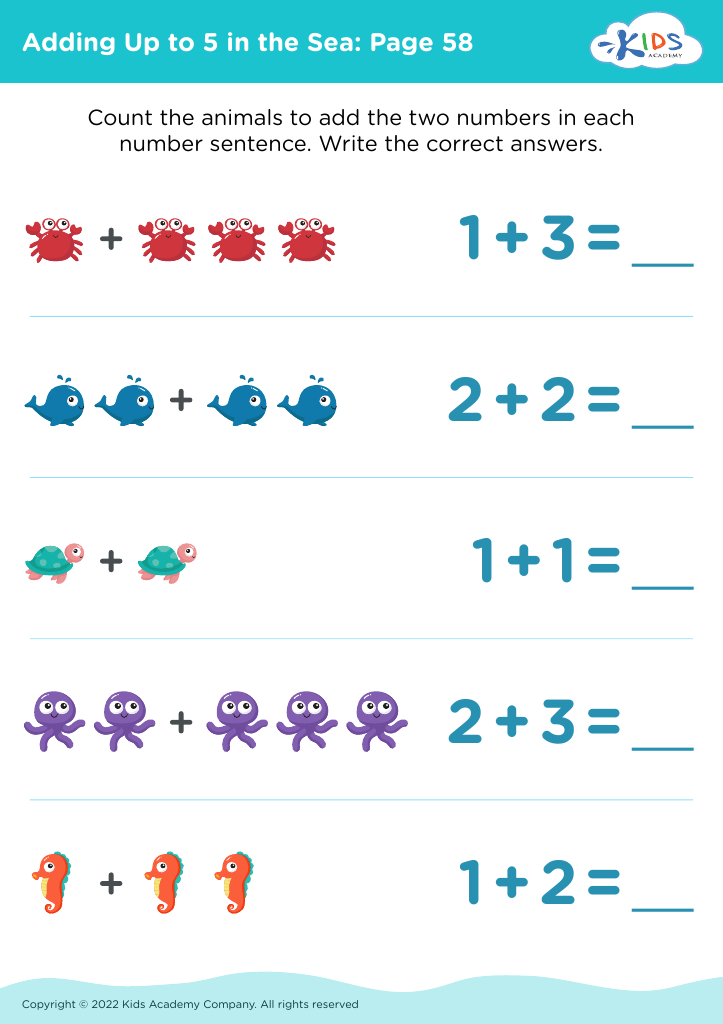
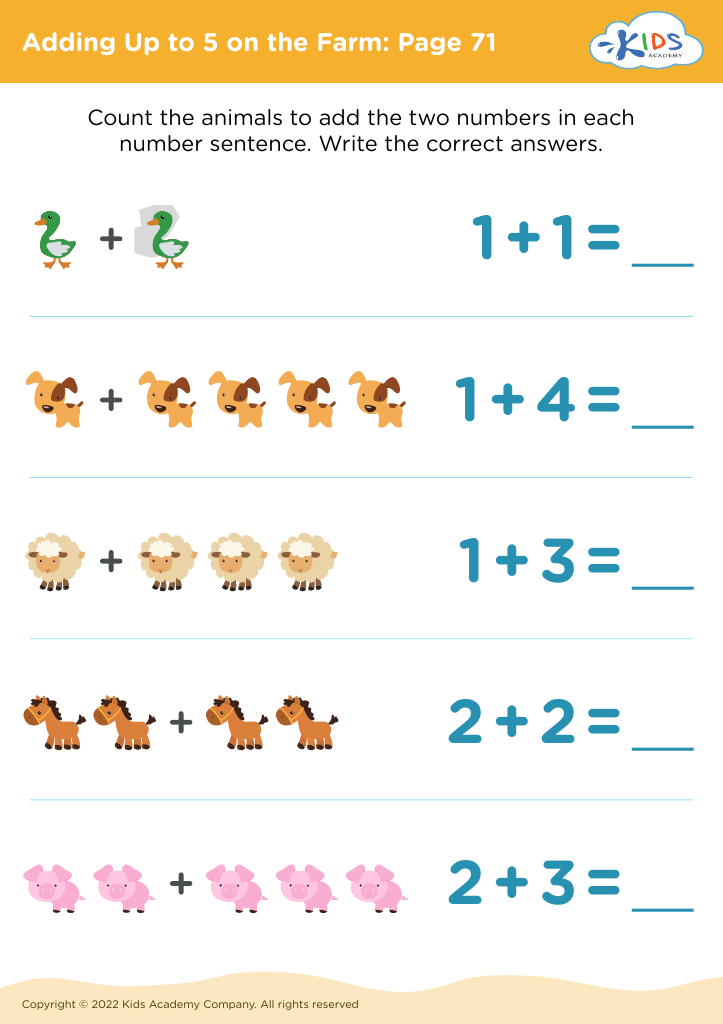
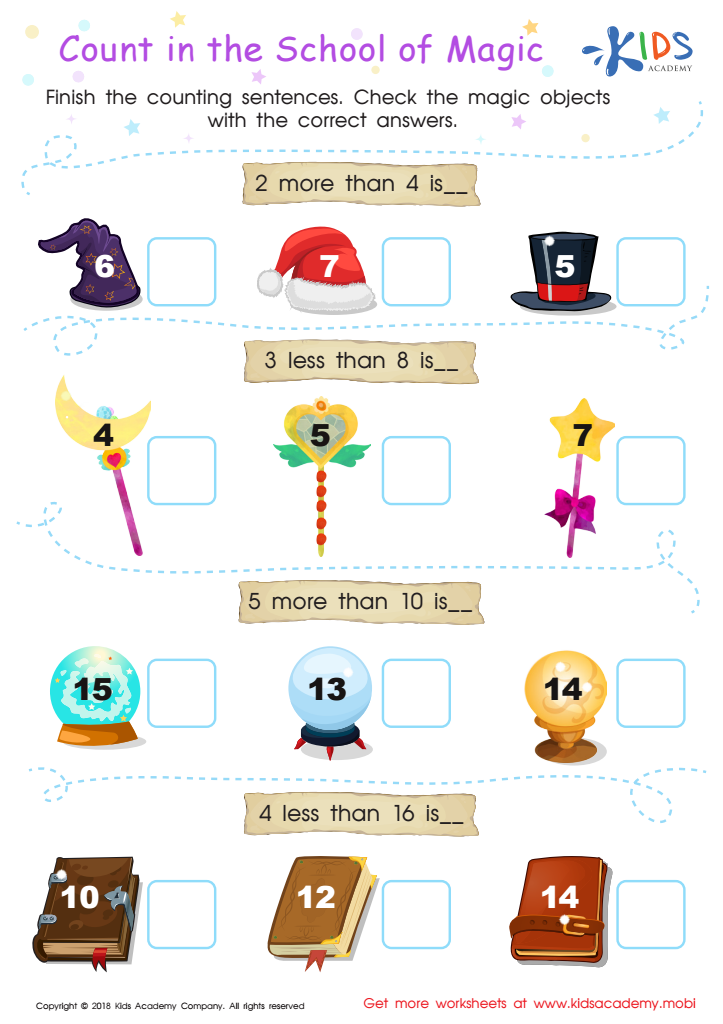
Count in the School of Magic Worksheet
Your math learners can explore the School of Magic with this worksheet. They'll read equations with addition and subtraction numbers under 20, count back and forth to find the answer, then complete the counting sentences. Fun pictures and easy accuracy make it an enjoyable and successful learning experience.
 Assign to My Students
Count in the School of Magic Worksheet
Worksheet
Join Kids Academy for Free
Who is primarily going to use this learning content?








Observational skills are foundational for young learners, especially in the context of addition for ages 4-6. Parents and teachers should prioritize these skills as they are crucial for fostering a child’s cognitive development and mathematical understanding.
At this age, children are naturally curious, often exploring their surroundings. By honing their observational skills, children develop the ability to recognize patterns, relationships, and changes in their environment, which forms the basis for mathematical reasoning. When they become adept at observing their surroundings, they can identify groups of objects and comprehend the concept of quantity, providing a practical introduction to addition.
Furthermore, observational skills encourage critical thinking, enabling children to analyze and interpret information more effectively. Teachers and parents can create engaging learning environments where children can make observations, such as counting toys or grouping items by attributes. This hands-on approach makes learning more relatable and enjoyable, nurturing a positive attitude toward mathematics.
Additionally, strengthening observational skills aids in the development of early literacy, social skills, and attention to detail, which are all vital for holistic development. Thus, by focusing on these skills, parents and teachers set a solid foundation for children’s future learning and help cultivate a lifelong love for numbers and critical thinking.








