
Comparing heights Worksheets for Ages 4-7
3 filtered results
Difficulty Level
Grade
Age
-
From - To
Subject
Activity
Standards
Discover our engaging comparing heights worksheets tailored for children ages 4-7! Designed to develop early math and critical thinking skills, these worksheets offer fun activities that teach children how to compare and measure objects' heights. Featuring vibrant illustrations and interactive exercises, young learners can explore concepts such as taller, shorter, and equal heights in an exciting way. Perfect for at-home learning or classroom use, these worksheets encourage your child to enhance their observational skills and boost their confidence in mathematical vocabulary. Explore our collection now and watch your little ones become experts at comparing heights as they learn through play!
Favorites
With answer key
Interactive
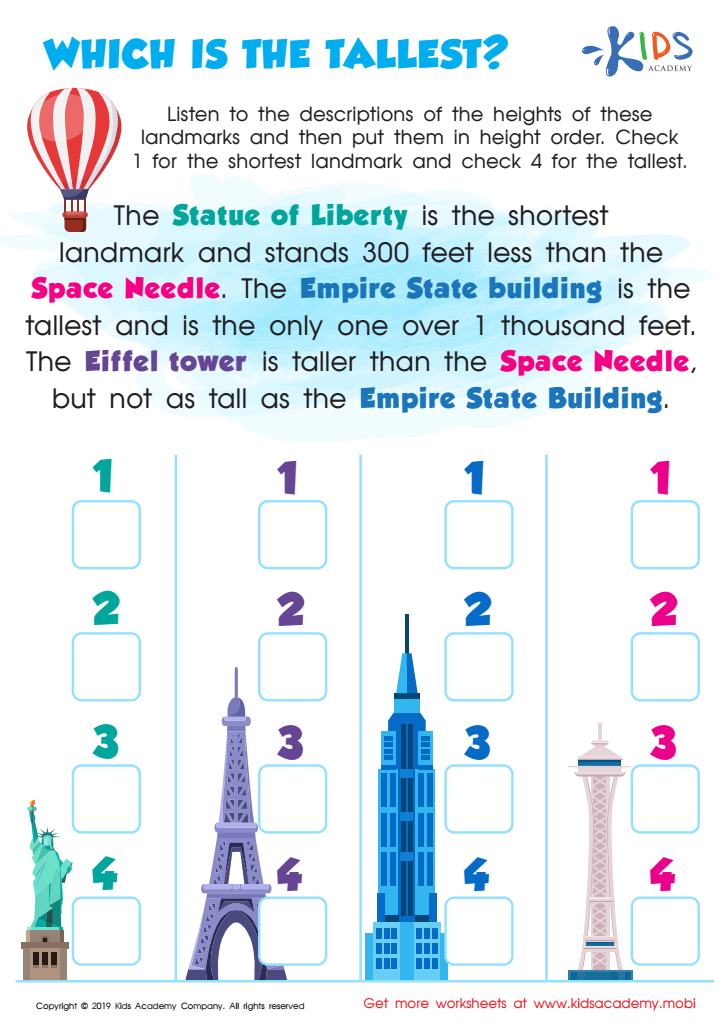
Which is the Tallest? Worksheet
Help your kids arrange the buildings in order of height: highest (4) to lowest (1). Ask them if they can think of other ways things can be measured. Read the texts describing the buildings and check 4 for the tallest and 1 for the shortest.
 Assign to My Students
Which is the Tallest? Worksheet
Worksheet
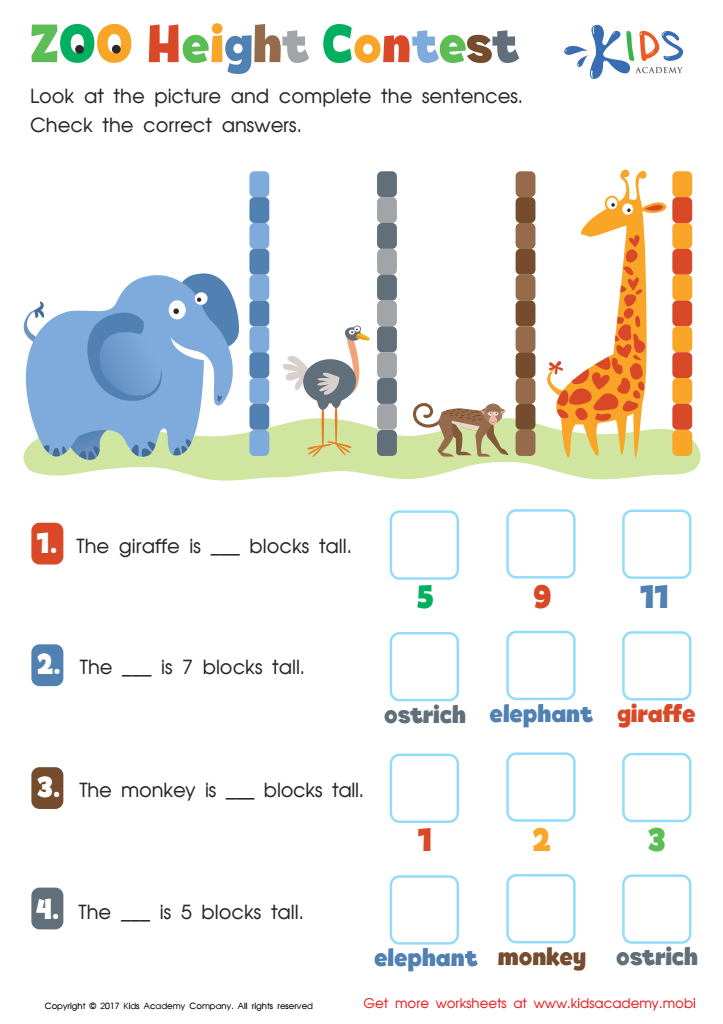
Zoo Height Contest Worksheet
Let's head to the zoo and use colorful blocks to measure your child's favorite animals! With this Kids Academy worksheet, help them practice and prepare for learning measurement. Guide them in looking at the zoo animals and counting blocks to find the height. Then, read the questions and check the box next to the correct answer.
Zoo Height Contest Worksheet
Worksheet
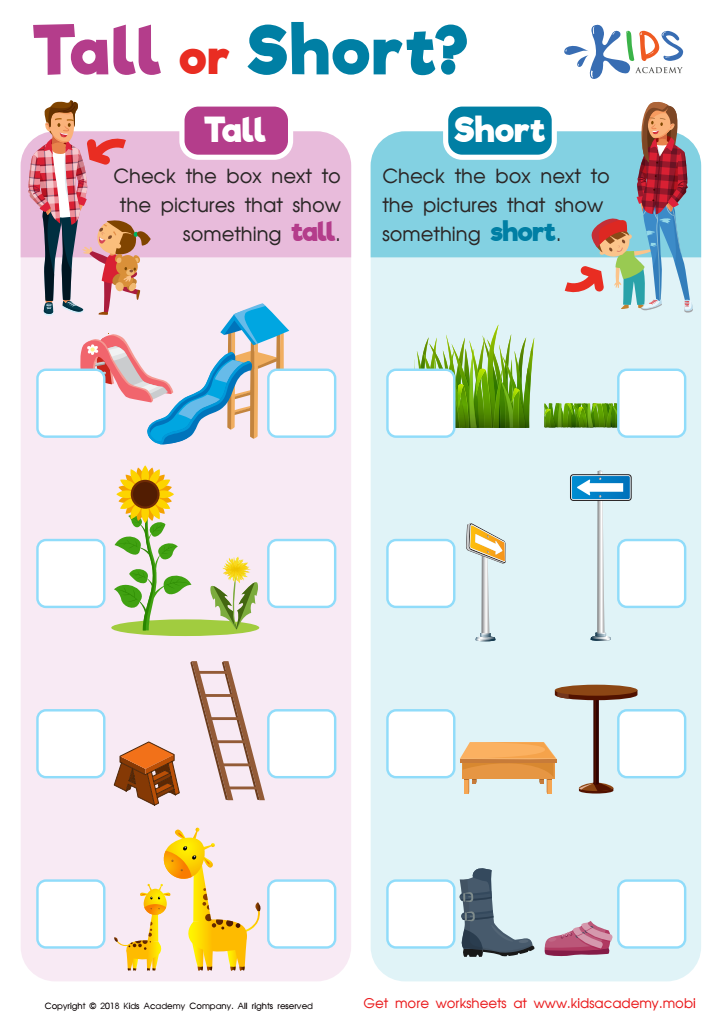
Tall or Short? Worksheet
Comparing tall and short objects is an early math skill. Our free worksheet uses fun colors and pictures to help kids practice. This will give them a head start for higher-level measurement skills, and they'll remember tangible objects for comparison.
Tall or Short? Worksheet
Worksheet
Join Kids Academy for Free
Who is primarily going to use this learning content?







Comparing heights in children aged 4-7 can provide valuable insights for both parents and teachers regarding growth and development. At this early age, physical growth is a significant indicator of overall health, nutritional status, and genetic factors. Monitoring height can help identify any potential growth issues early, enabling timely intervention and support, if necessary.
In an educational setting, comparisons of height can also foster inclusion and help children understand and appreciate diversity. Height variations among peers create opportunities for discussions about differences that promote social-emotional learning and empathy. Activities like height charts or classroom discussions can empower children to respect and accept physical differences among their classmates.
Additionally, tracking height not only assists in health monitoring but can also be an engaging way for children to learn about measurement, mathematics, and science. Integrating such comparisons into everyday activities nurtures curiosity and foundational skills.
Ultimately, by caring about height comparisons, parents and teachers foster a supportive environment that prioritizes health, boosts self-esteem, encourages active participation, and provides a wholesome foundation for lifelong learning.








