
Fraction Addition Worksheets for Ages 4-7
19 filtered results
Difficulty Level
Grade
Age
-
From - To
Subject
Activity
Standards
Discover our engaging Fraction Addition Worksheets designed specifically for children aged 4 to 7. These worksheets provide a fun and interactive way to introduce young learners to the concept of fractions and how to add them together. Each worksheet features vibrant illustrations and simple exercises that promote essential math skills, ensuring that children grasp the fundamentals of fraction addition with ease. As kids complete the activities, they will build confidence in their mathematical abilities while honing their problem-solving skills. Perfect for at-home practice or in the classroom, our worksheets make learning math enjoyable and effective for early learners!
Favorites
With answer key
Interactive
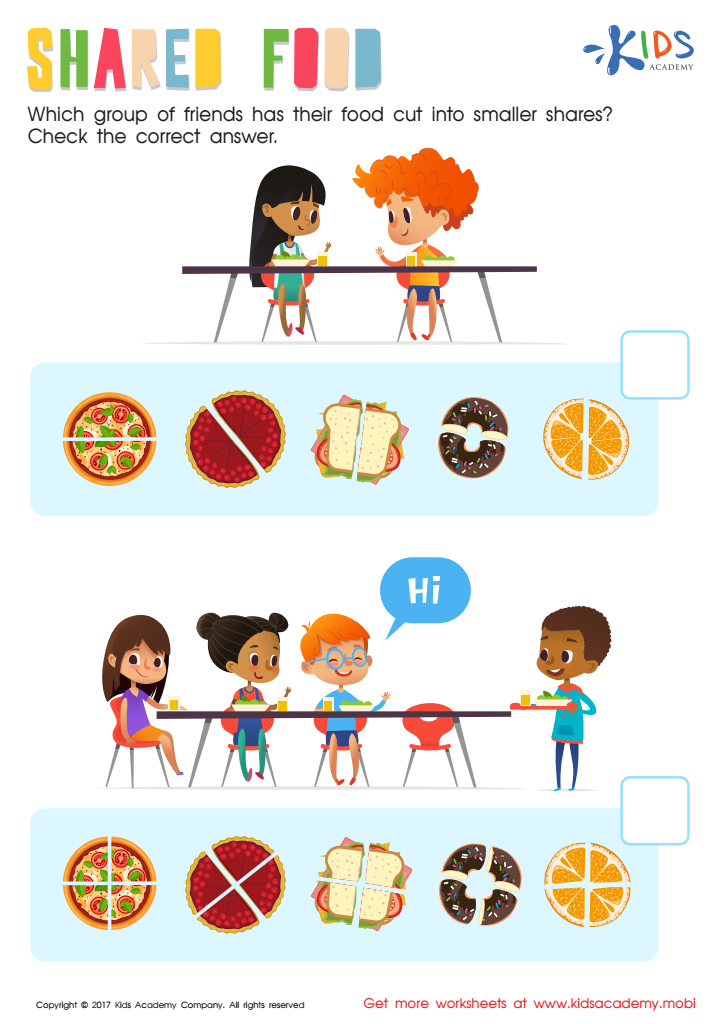
Shared Food Worksheet
In this worksheet, kids learn about sharing and cutting shapes into equal parts. There are two groups of friends: one with two, the other with four. Ask your child which group has their food cut into smaller shares, and help them find the right answer.
 Assign to My Students
Shared Food Worksheet
Worksheet
Join Kids Academy for Free
Who is primarily going to use this learning content?








Understanding fraction addition is crucial for children aged 4-7, as it lays the groundwork for their mathematical development. At this age, learners are beginning to grasp the concept of part-whole relationships, which are the building blocks of more complex mathematical concepts. Introducing fraction addition helps children recognize that fractions represent parts of a whole and fosters their ability to visualize and manipulate quantities.
Parents and teachers should care about this topic because early exposure to fractions encourages critical thinking and problem-solving skills. Engaging activities, such as using real-life examples like sharing food or drawing shapes, allows children to connect fractions to their everyday experiences, making learning both fun and relevant. Moreover, a solid understanding of fraction addition prepares children for future math challenges, instilling confidence and a positive attitude towards mathematics.
Additionally, teaching fractions promotes teamwork and communication as children learn to collaborate in identifying, comparing, and adding fractions. By implementing supportive teaching methods and reinforcing these concepts in everyday situations, caregivers can nurture a love for math and help young learners build a strong foundation for lifelong learning. Recognizing the importance of fraction addition early on greatly contributes to children's overall academic success.








