Identify shapes Worksheets for Ages 4-7
13 filtered results
-
From - To
Welcome to our "Identify Shapes Worksheets for Ages 4-7" page! Designed to engage young learners, these fun and interactive worksheets help children recognize and understand various shapes, including circles, squares, triangles, and more. Tailored for preschool and early elementary students, our resources encourage shape identification through colorful illustrations and playful activities. Each worksheet includes a variety of exercises that promote critical thinking and fine motor skills, making learning a joyful experience. Whether in the classroom or at home, our shape worksheets are perfect for helping kids build a strong foundation in geometry while keeping their creativity in spark! Start exploring now!
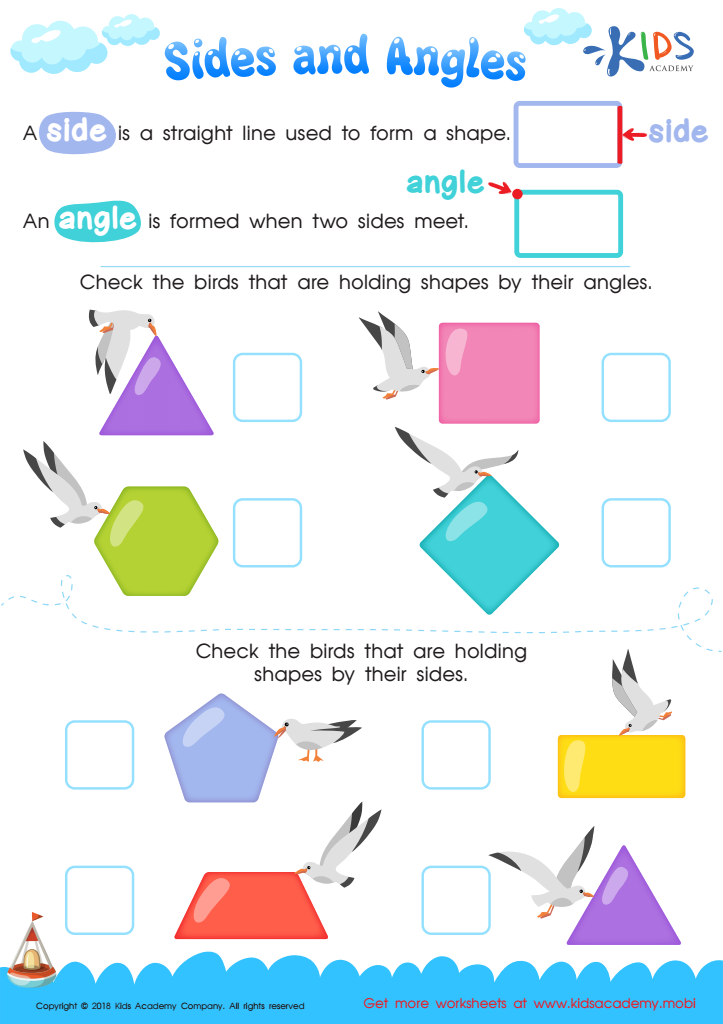
Sides and Angles Worksheet
 Assign to My Students







Identifying shapes is a fundamental skill for children aged 4-7, laying the groundwork for critical thinking and problem-solving abilities. At this age, children are naturally curious and eager to understand the world around them. Recognizing shapes fosters their spatial awareness, helping them to comprehend important concepts in mathematics and geometry later in their education.
Additionally, shape identification enhances fine motor skills through activities like drawing, cutting, and crafting. By engaging in these hands-on experiences, children develop coordination and dexterity. Learning shapes also aids in language development as children learn to describe shapes and their attributes, enriching their vocabulary.
Moreover, shape recognition connects to real-world applications. Identifying common shapes enables children to navigate their environment, understand patterns, and engage with visual arts. This skill also encourages logical reasoning; as young learners classify and sort different shapes, they practice making connections and drawing conclusions.
When parents and teachers prioritize shape identification, they support a well-rounded learning experience that integrates mathematics, art, and language, consequently fostering a love of learning. Overall, understanding shapes is crucial as it prepares children for more complex concepts and promotes a holistic approach to their early education.








