Number sequence learning Worksheets for Ages 4-7
3 filtered results
-
From - To
Number Sequence Learning Worksheets for Ages 4-7 offer engaging and educational activities designed to enhance young learners' numerical skills. Perfect for preschool and early elementary students, these worksheets help children recognize patterns and practice counting in sequence. Through fun, hands-on exercises, kids will boost their confidence in number order, develop critical thinking, and improve mathematical abilities. Kids Academy's expertly crafted resources support parent and teacher efforts in providing quality education. Ideal for both classroom environments and at-home learning, these worksheets make mastering number sequences an enjoyable and rewarding journey for all young math enthusiasts!
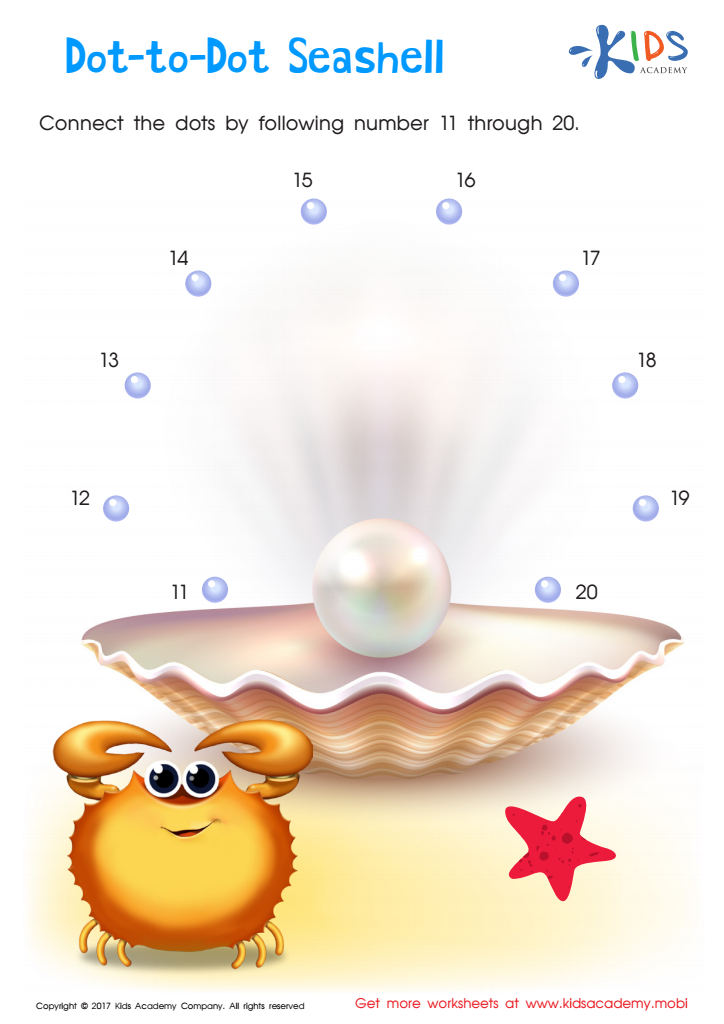
Ordering 11–20: Dot–to–dot Seashell Printable
 Assign to My Students

Counting on the City Skyline: Dot-to-Dot Worksheet




.jpg)


Understanding number sequences is crucial for children aged 4-7 years as it lays the foundation for essential mathematical skills. During these formative years, children's brains are highly receptive to learning patterns, sequences, and structures, which are intrinsic to mathematics. Mastering number sequences helps youngsters develop numerical fluency, an important skill that goes beyond simple counting.
It prepares them for more advanced mathematical concepts such as addition, subtraction, multiplication, and division. When children can recognize and predict number sequences, they gain an ability to understand the logical progression of numbers, enhancing their problem-solving abilities.
Moreover, a firm grasp of number sequences fosters confidence and a positive attitude towards math. This is critical in an area often associated with anxiety and challenges. Teachers and parents should seize the opportunity to cultivate an enjoyable and encouraging learning environment during these early stages of cognitive development.
The benefits extend beyond mathematics as number sequences bolster cognitive skills such as memory, analytical thinking, and concentration, critical components of overall academic success. By integrating number sequence activities in playful and engaging manners, parents and teachers can provide children with a solid mathematics foundation that will support future learning across various subjects.








