Understand number relationships Worksheets for Ages 4-7
4 filtered results
-
From - To
Unlock the world of numbers for your young learners with our "Understand Number Relationships" worksheets, specially designed for ages 4-7. These engaging activities help children grasp essential mathematical concepts, including comparing numbers, identifying patterns, and understanding basic arithmetic. Each worksheet is crafted to enhance kids' critical thinking and problem-solving skills through fun exercises. Built on proven educational methods, these printable resources offer vibrant illustrations and step-by-step guidance to make learning enjoyable and accessible. Empower your child’s early math journey with tailored worksheets that transform number learning into an adventure!
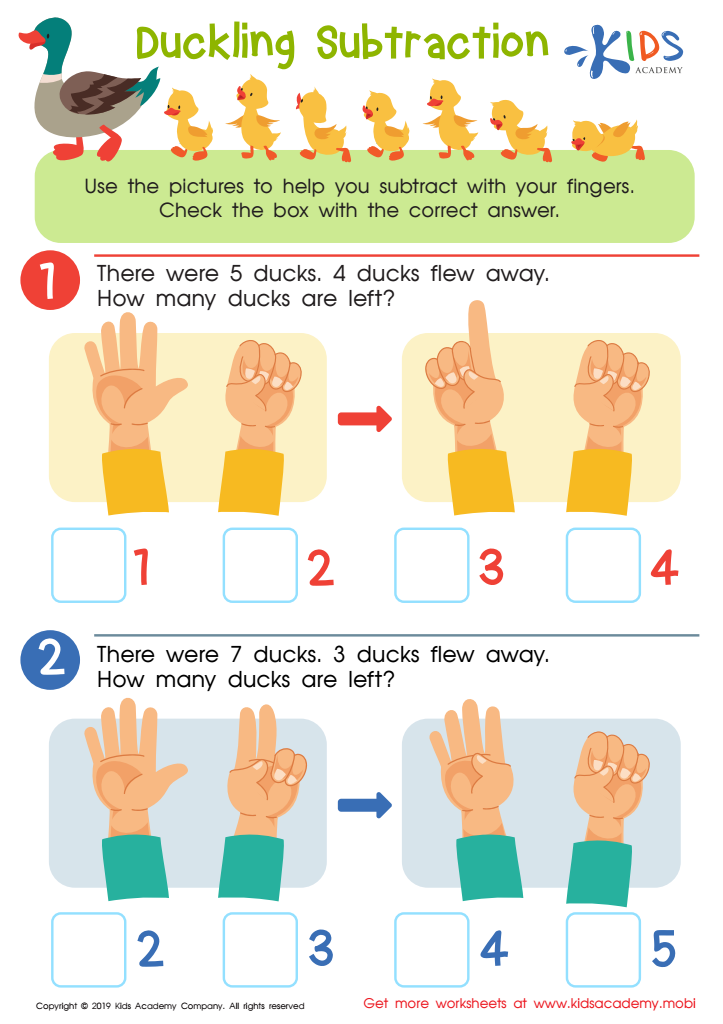
Duckling Subtraction Worksheet
 Assign to My Students







Understanding number relationships is fundamental for children ages 4-7 because it lays the groundwork for all future math learning and cognitive development. At this critical stage, children begin to grasp the concepts of counting, addition, subtraction, and comparative analysis of quantities. When parents or teachers emphasize number relationships, they are essentially helping children build a framework for mathematical thinking and problem-solving.
Number relationships go beyond rote counting; they help children understand the "why" behind mathematical operations. For example, identifying that five is more than four but less than six enables a child to comprehend sequencing and the relative value of numbers. This understanding is crucial when they progress to more complex mathematical tasks, such as understanding place value or engaging in multi-digit arithmetic.
Moreover, as children start school, a solid grasp of number relationships directly impacts their confidence and success in the classroom. Early math skills contribute not only to math-related subjects but also enhance logical thinking and reasoning abilities fundamental in subjects like science, technology, and even literacy.
In addition, fostering an early interest and proficiency in math through number relationships can aid in diminishing math anxiety. By making math a fun and integral part of their daily routine, parents and teachers can help build a positive attitude toward the subject, paving the way for lifelong numeracy skills.








