
Understanding equivalence Worksheets for Ages 4-7
3 filtered results
Difficulty Level
Grade
Age
-
From - To
Subject
Activity
Standards
Unlock your child's potential with our "Understanding Equivalence" worksheets, designed specifically for ages 4-7. These engaging activities help young learners grasp the concept of equivalence through fun visuals and interactive exercises. Tailored to foster critical thinking, our worksheets support foundational math skills by illustrating how different quantities can represent the same value. With a blend of creative and cognitive challenges, children will gain confidence in their problem-solving abilities while enjoying colorful designs. Perfect for home or classroom use, our worksheets are a great resource to enhance your child's early mathematical understanding and set the stage for future success in learning!
Favorites
With answer key
Interactive
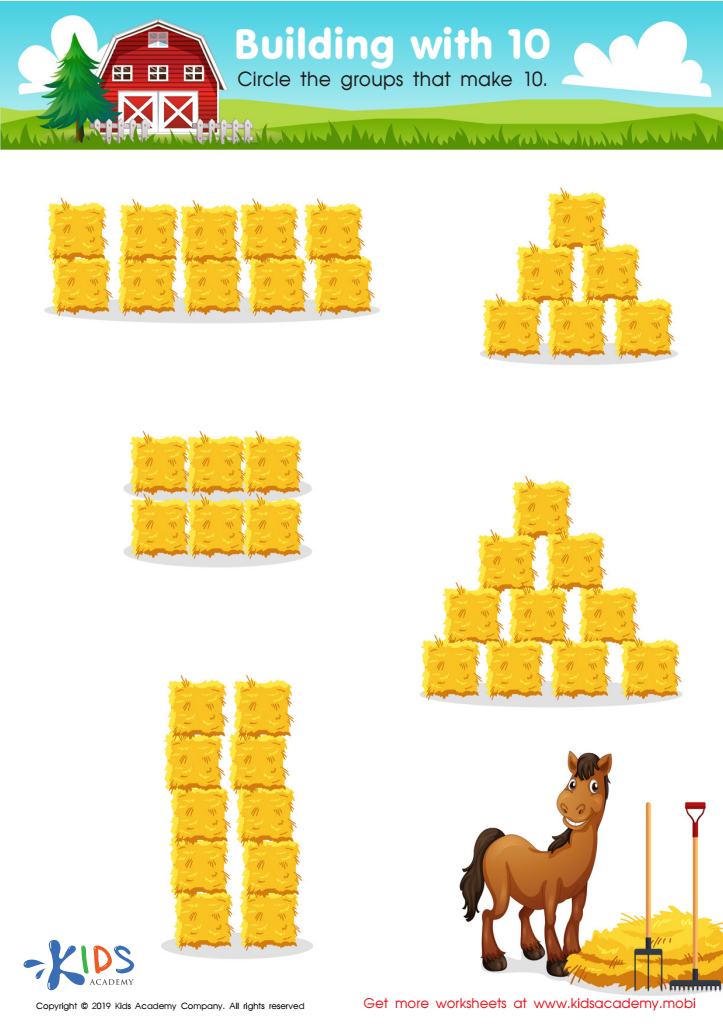
Building with 10 Worksheet
Counting numbers can be simple with this worksheet: Ask your kids to count the stacks of objects, ensure accuracy with your help, then circle the ones of ten. With practice and guidance, your children will soon become counting pros!
 Assign to My Students
Building with 10 Worksheet
Worksheet
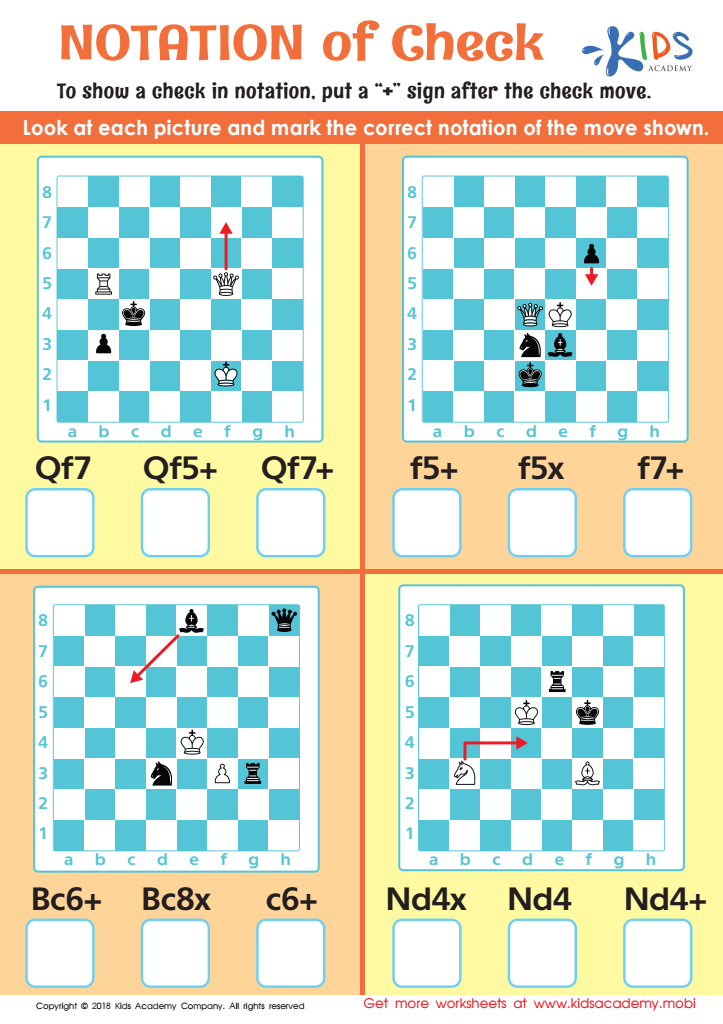
Notation of Check Worksheet
Chess is an addictive game! Once you know the basics of check and checkmate, you'll be hooked! Teach your little one to make check notation with this free PDF worksheet. They can use downloadable practice to look at each picture and mark the correct notation, strengthening their problem-solving skills while they learn to play - and win - this fun game!
Notation of Check Worksheet
Worksheet
Join Kids Academy for Free
Who is primarily going to use this learning content?








Understanding equivalence is fundamental for young learners aged 4-7 because it lays the groundwork for their mathematical thinking and problem-solving skills. At this age, children are developing crucial cognitive abilities, and grasping the concept of equivalence helps them make sense of numbers, quantities, and mathematical relationships.
Equivalence involves recognizing that different expressions can represent the same value, such as understanding that 2+3 is equivalent to 5 or knowing that two halves of a sandwich are equal to one whole sandwich. This understanding not only enhances children's numeracy skills but also fosters their critical thinking, as they learn to compare, contrast, and reason about different mathematical constructs.
Moreover, early exposure to equivalence can boost confidence in mathematics, which is essential for lifelong learning. When children confidently understand that there are various ways to represent the same idea, they are more likely to engage with complex mathematical concepts in the future.
For parents and teachers, promoting an early understanding of equivalence means they are equipping children with essential tools for academic success, nurturing intrinsic motivation, and helping to cultivate a positive attitude toward math that can last a lifetime. Creating a strong foundation in mathematical equivalence thus has long-term benefits for students' educational journeys.








