
Understanding length Worksheets for Ages 4-7
3 filtered results
Difficulty Level
Grade
Age
-
From - To
Subject
Activity
Standards
Understanding length is a crucial skill for young learners aged 4-7, and our engaging worksheets make it fun and easy! Designed to draw kids into the world of measurement, these worksheets introduce foundational concepts through vibrant visuals and interactive activities. Children will practice comparing, estimating, and measuring lengths using everyday objects, helping them develop critical thinking and problem-solving skills. Perfect for in-class or at-home learning, these worksheets are an excellent resource for parents and teachers alike, aiming to foster a strong grasp of length comparison while making learning enjoyable and effective. Discover the fun in learning lengths today!
Favorites
With answer key
Interactive
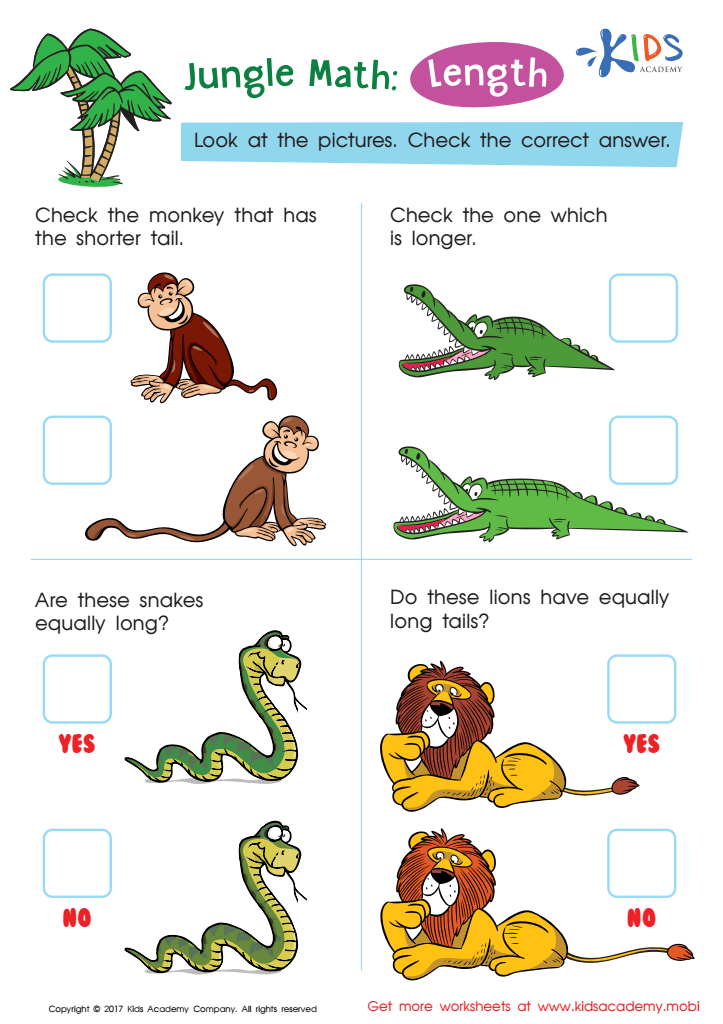
Which One Is Longer - Length Worksheet
Let's go to the jungle - kids get excited to practice math with animal-filled worksheets! This one is sure to have your pupil mastering length in no time.
 Assign to My Students
Which One Is Longer - Length Worksheet
Worksheet
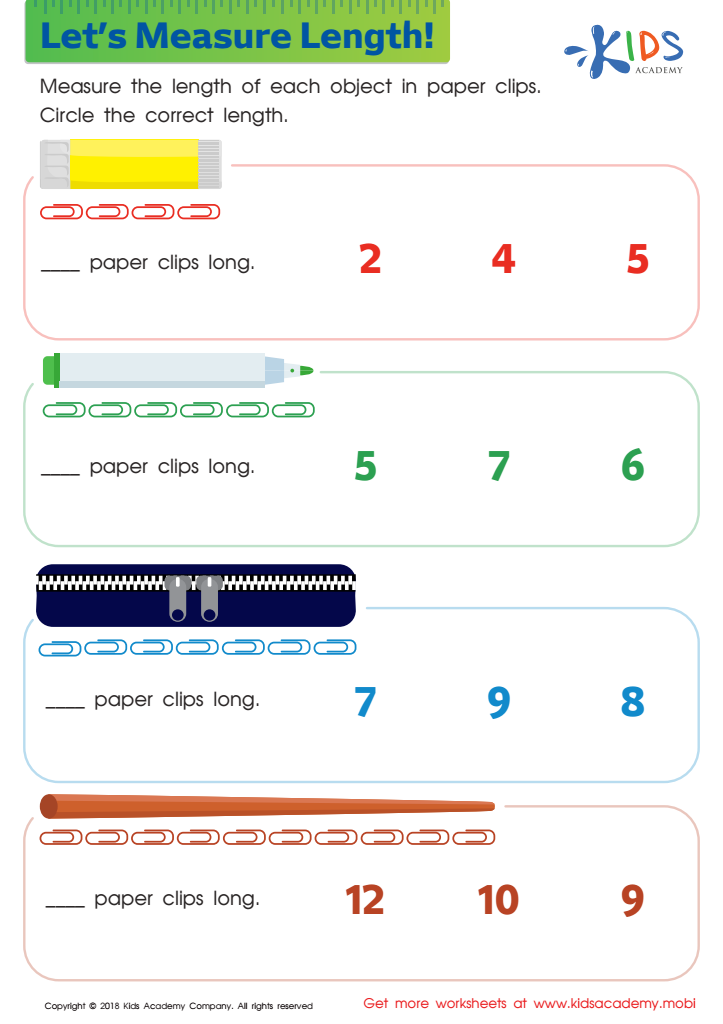
Lets Measure Length Worksheet
It's time to help your child take their measuring skills up a notch! This colorful PDF sheet from Kids Academy introduces kids to measuring with paperclips. Guide them through the page, showing them how to count the clips to measure each image. Then, circle the correct length for each to complete the sheet!
Lets Measure Length Worksheet
Worksheet
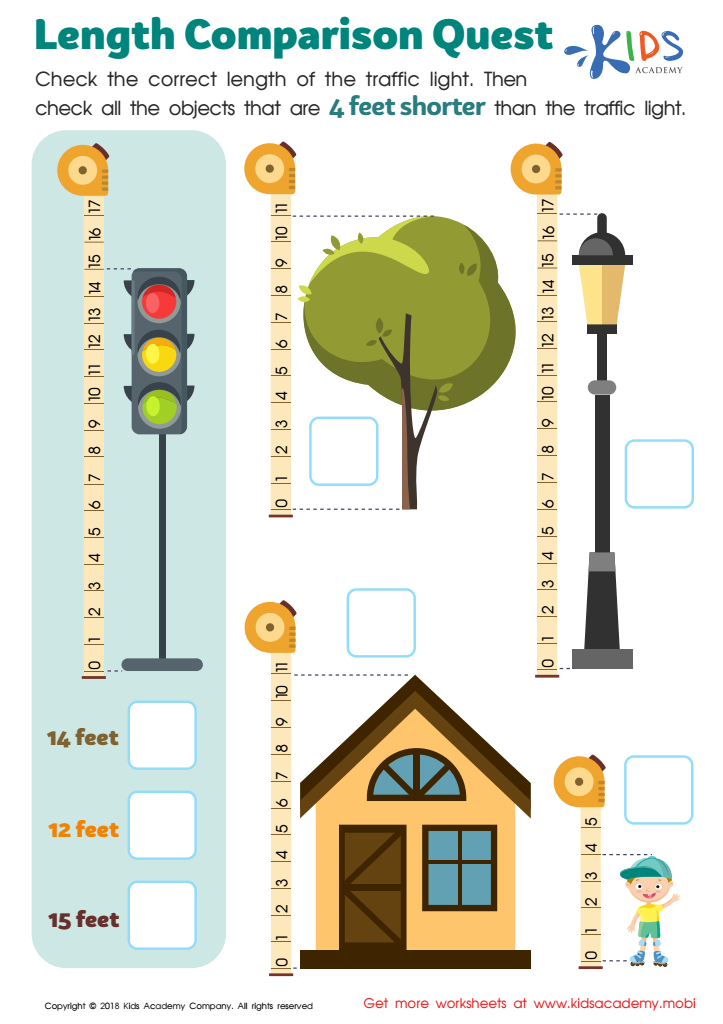
Length Comparison Quest Worksheet
Knowing measurement tools and how to use them is just the start. To be proficient, your kid must be able to accurately compare objects and their lengths. With the 'Length Comparison Quest' worksheet, they will check the correct length of the traffic light in the picture and then compare other objects to it, marking those that measure 4 feet shorter.
Length Comparison Quest Worksheet
Worksheet
Join Kids Academy for Free
Who is primarily going to use this learning content?



.jpg)




Understanding length is a foundational skill for children aged 4-7 that plays a crucial role in their overall cognitive development. At this age, kids enter a period where they're not just absorbing information but starting to make sense of the world around them through practical interaction. Grasping the concept of length helps in varied essential areas:
-
Daily Activities: It aids in performing everyday tasks, like setting the table by understanding the size of objects and distances between them, and helps in organizing their play materials.
-
Math Readiness: Comprehension of length is a precursor to more complex math skills. It introduces kids to measurement, comparison, and spatial awareness, which are fundamental for geometry and arithmetic learning.
-
Language and Communication: Understanding length also enriches kids' descriptive language, enabling them to describe objects and their environment more accurately. Terms like 'long', 'short', 'tall', and 'wide' become part of their vocabulary, building better communication skills.
-
Problem Solving and Logical Thinking: Measuring and comparing lengths instill problem-solving skills. For instance, figuring out if a toy will fit in a box requires them to think logically and apply their understanding practically.
-
Science and Overall Curiosity: Basic scientific understanding emerges when kids explore their environment.








