
Visual fraction representation Worksheets for Ages 4-7
3 filtered results
Difficulty Level
Grade
Age
-
From - To
Subject
Activity
Standards
Explore our captivating Visual Fraction Representation Worksheets designed specifically for children ages 4-7! These engaging worksheets help young learners grasp the concept of fractions through colorful visuals and interactive activities. By utilizing images and fun exercises, children will enhance their understanding of equal parts, enabling them to recognize and represent fractions effectively. Perfect for teachers, homeschoolers, and parents alike, our worksheets encourage hands-on learning, fostering a love for math from an early age. Download our printable resources today to make learning fractions enjoyable and memorable for your little ones! Empower their educational journey with our thoughtfully crafted materials.
Favorites
With answer key
Interactive
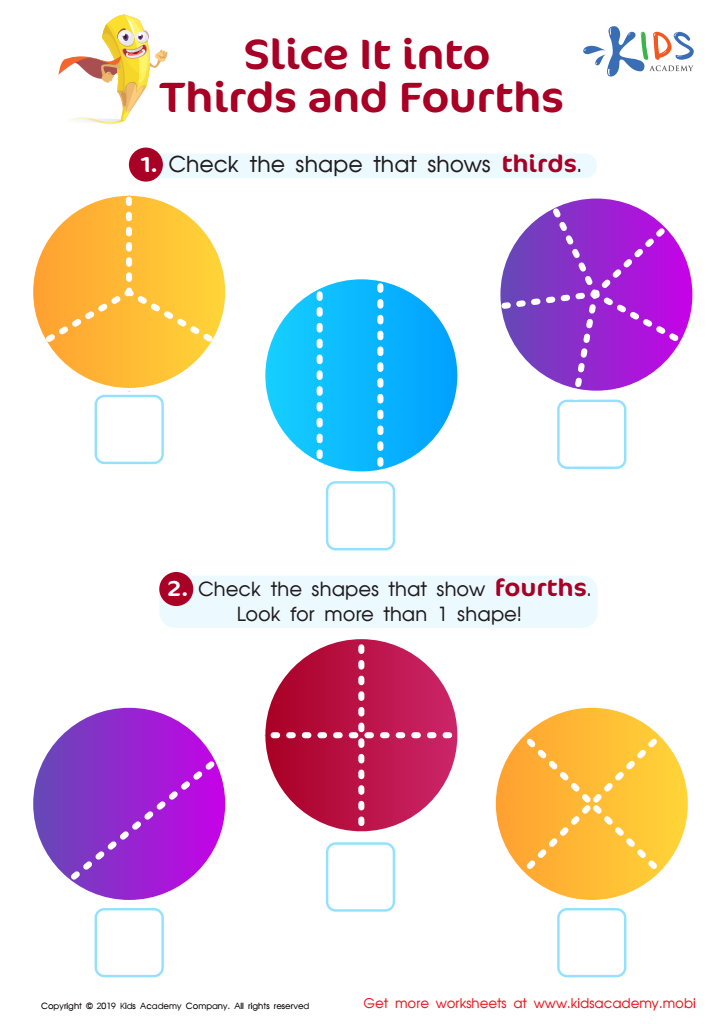
Slice in Thirds Fourths Worksheet
This worksheet helps kids learn fractions visually by dividing circles into thirds and fourths. They will learn that fractions must be equal parts, not just sets, by choosing the right colorful circles. It's an easy way to master fractions and have fun doing it!
 Assign to My Students
Slice in Thirds Fourths Worksheet
Worksheet
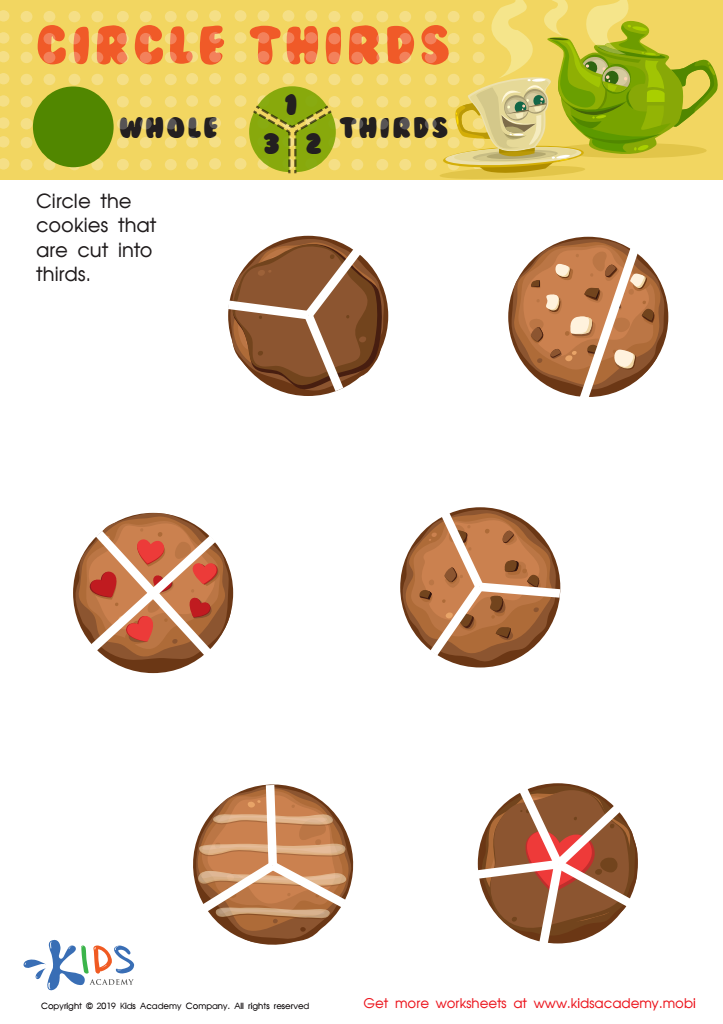
Circle Thirds Worksheet
Remind your kids of the different ways shapes can be divided: wholes, halves, thirds, and fourths. Now, look at the shapes in the worksheet and have them circle the cookies cut into thirds.
Circle Thirds Worksheet
Worksheet
Join Kids Academy for Free
Who is primarily going to use this learning content?






Visual fraction representation is crucial for children aged 4-7 as it lays a strong foundation for understanding fractions, a concept that often poses difficulties in later grades. At this stage, children are highly visual learners. Incorporating visual tools like fraction circles, bars, or number lines can help them grasp the concept of parts of a whole, equality, and relational understanding—key elements in mastering fractions.
Parents and teachers should recognize that developing a solid visual understanding of fractions can enhance children's mathematical confidence and performance. When children can see and manipulate fraction representations, they are more likely to engage with and comprehend more abstract mathematical ideas later on. This early engagement fosters critical thinking skills and problem-solving abilities.
Moreover, visual fraction representation promotes discussion and collaboration among peers, enhancing social learning. As children share and compare their understandings, they build language skills while deepening their conceptual knowledge.
Ultimately, caring about visual fraction representation means investing in children’s mathematical future. By making these early experiences enjoyable and meaningful, parents and teachers can inspire a lifelong interest in mathematics, paving the way for mastery in more complex topics as they progress in their education.








