Fine Motor Skills Adding up to 100 with Regrouping Worksheets for Ages 4-7
3 filtered results
-
From - To
Enhance your child’s fine motor skills while mastering addition with our “Adding Up to 100 with Regrouping” worksheets, designed for ages 4-7. These engaging, printable worksheets combine math practice with activities that promote hand-eye coordination and dexterity, essential for young learners. As children work through fun problems, they not only practice regrouping techniques critical for higher-level math but also strengthen their pencil grip and control. Each worksheet is crafted to provide a balance of challenges that foster independence and build confidence in both math and fine motor capabilities. Perfect for home or classroom use, these resources make learning truly enjoyable!
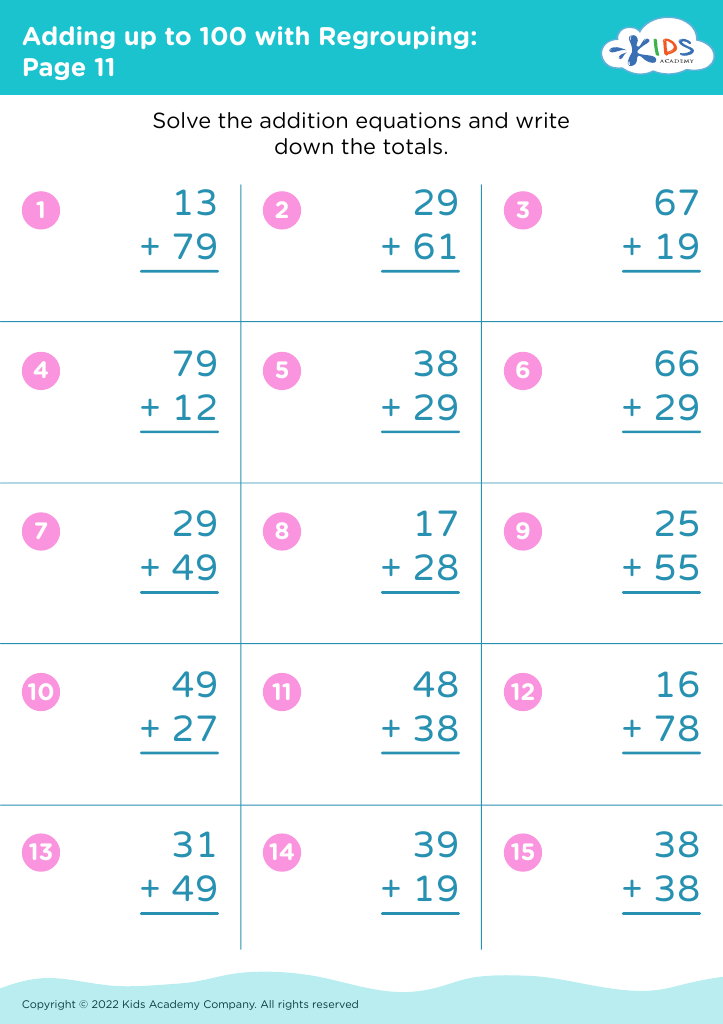
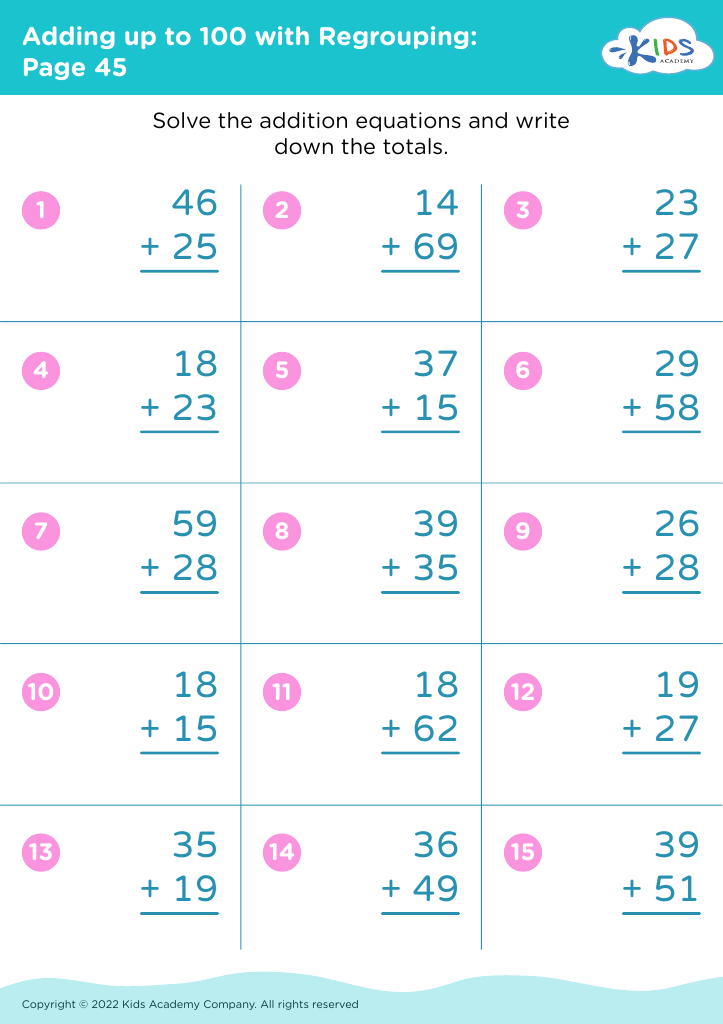
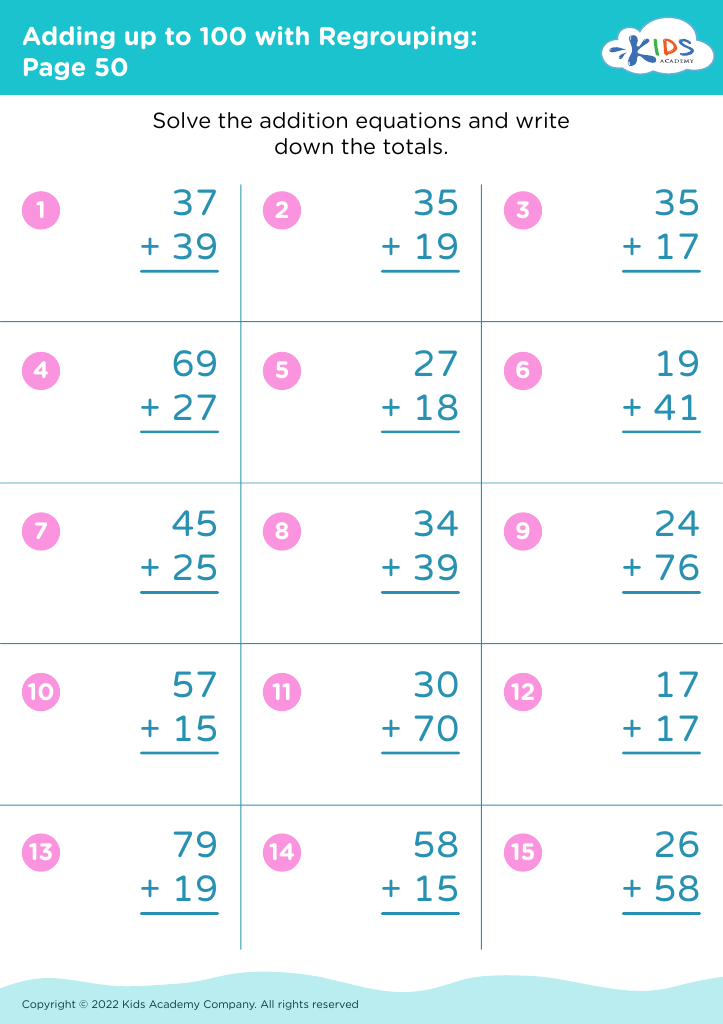




Fine motor skills and mathematical reasoning, especially concepts like adding up to 100 with regrouping, are crucial for children ages 4-7, as they are foundational for both academic and everyday success. Fine motor skills involve the coordination of small muscle movements, which children use for writing, drawing, and manipulating objects. Developing these skills enhances their ability to grasp pencils, use scissors, and perform tasks with precision—vital abilities in early education.
At the same time, understanding addition with regrouping helps children grasp essential mathematical concepts. This process not only involves number sense but also encourages cognitive skills such as problem-solving and logical reasoning. As children learn to add beyond single digits, they develop the ability to 'trade' and adjust values, building a deeper understanding of place value and numerical relationships.
Parents and teachers should care about nurturing both skill areas simultaneously. Strengthened fine motor skills can lead to greater confidence in math tasks, while proficiency in regrouping can make calculations more fluid and intuitive. By fostering these interconnected skills, parents and educators empower children to become competent learners, setting a strong foundation for future academic success and critical thinking.