Practicing multiplication Adding up to 100 Without Regrouping Worksheets for Ages 4-7
3 filtered results
-
From - To
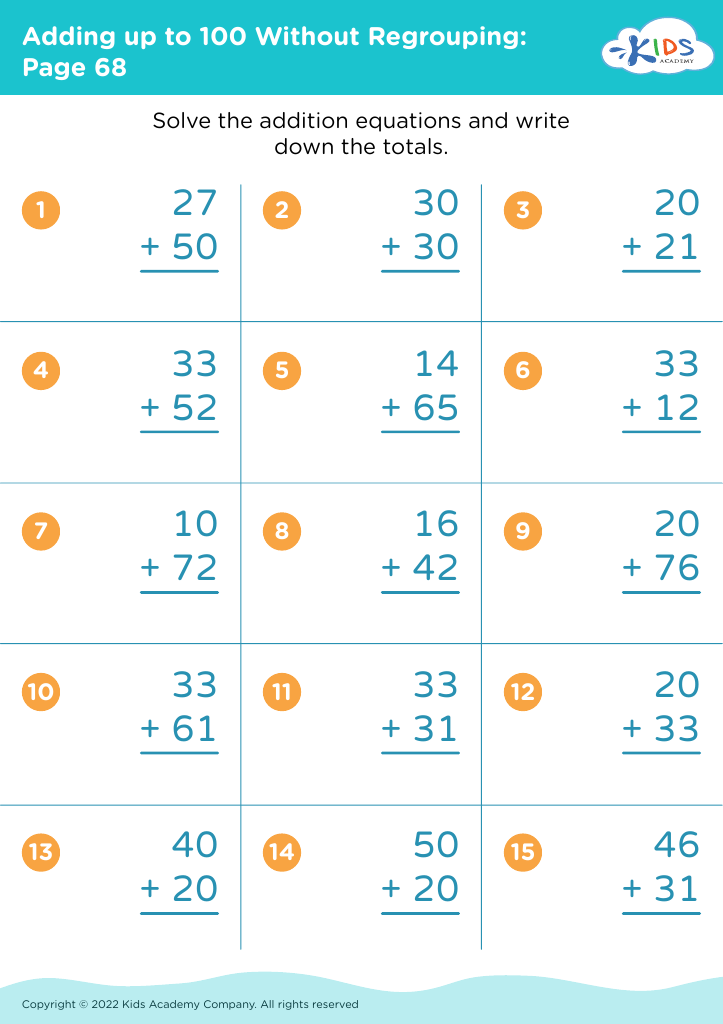
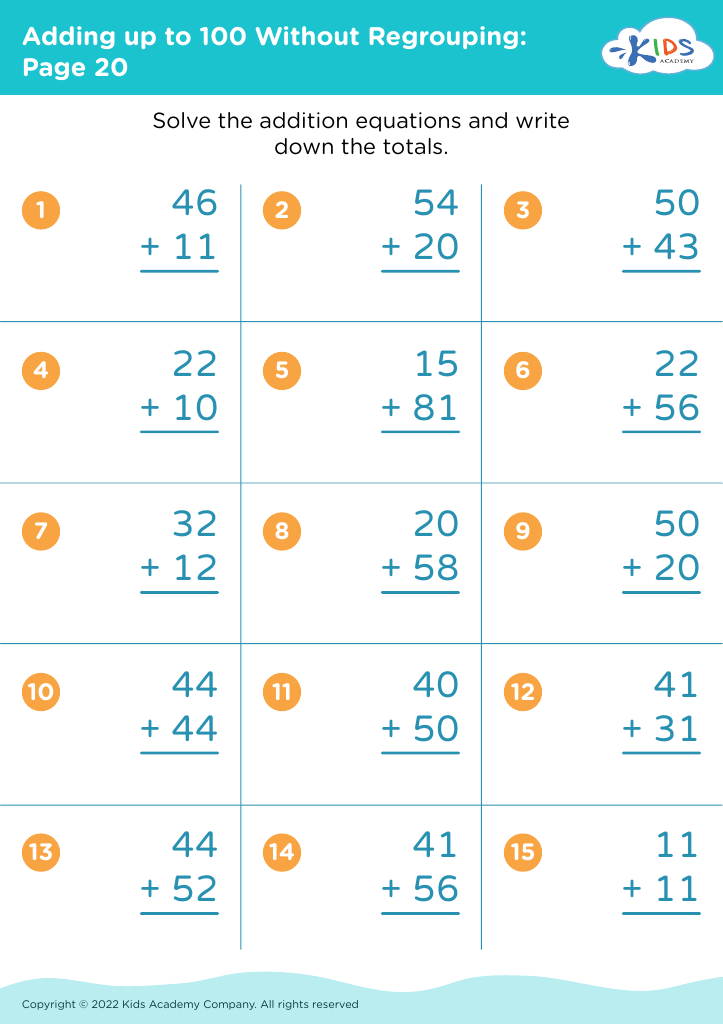
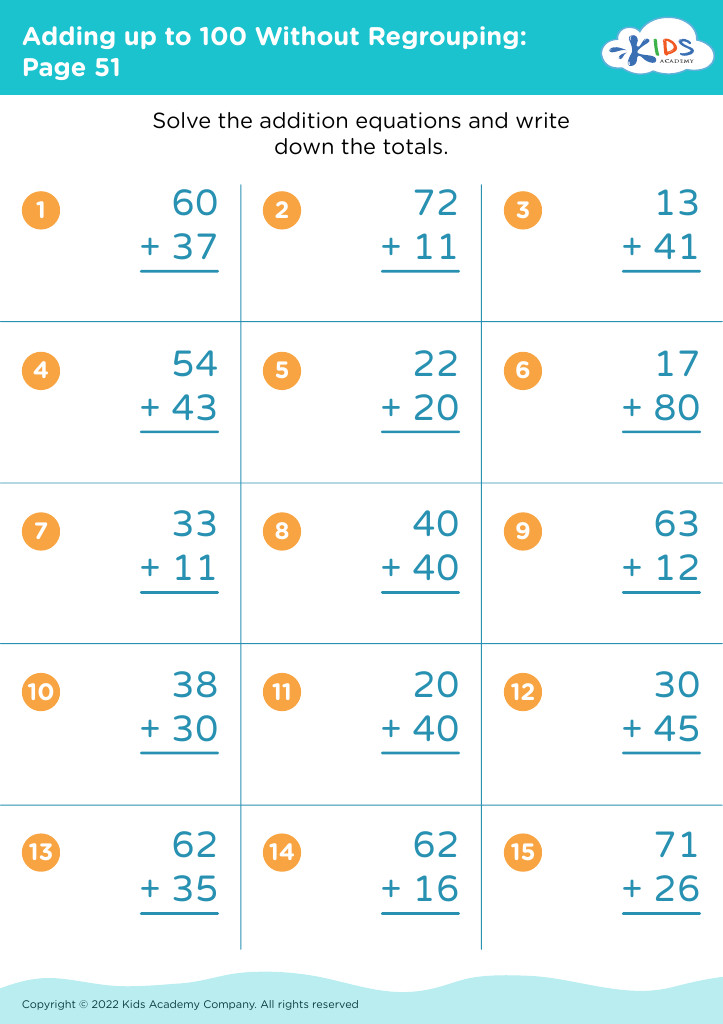
Introduce your young learner to the basics of multiplication with our "Practicing Multiplication Adding up to 100 Without Regrouping" worksheets, perfect for ages 4-7. These engaging and educational worksheets are designed to build a strong mathematical foundation, helping children to explore multiplication in a fun and stress-free way. By mastering addition up to 100 without regrouping, kids can confidently progress to more advanced math skills. Each worksheet is thoughtfully crafted to maintain children's interest while reinforcing important concepts essential for their academic growth. Enhance your child's learning experience with these enjoyable and effective multiplication practice sheets.




Parents and teachers play a crucial role in children's early education, and they should recognize the significance of activities that develop foundational math skills. Practicing multiplication and addition up to 100 without regrouping for ages 4-7 lays a critical groundwork for more advanced mathematical concepts.
For children in this age group, mastering basic arithmetic operations fortifies their understanding of number sense. This refers to an intuitive grasp of numbers, their relationships, and how they interact through fundamental operations like addition and multiplication. Engaging in these activities at an early age enhances cognitive functions such as memory, pattern recognition, and logical thinking, which are essential for all subjects, not just math.
Furthermore, achieving proficiency in simple arithmetic helps boost a child's confidence and self-esteem. When children know they can solve these problems, they're more likely to embrace further challenges, developing a positive attitude toward learning in general.
Practical life skills also emerge; math applicable in daily scenarios—be it shopping, cooking, or organizing keepsakes—is easier to grasp for those who practice these foundational skills early on. Thus, dedicating attention to these essential elements is not merely about academic achievement but also about preparing competent, confident individuals ready for life's myriad quantitative demands.