Identifying shapes Adding up to 1000 Worksheets for Ages 4-7
3 filtered results
-
From - To
Unlock your child's mathematical potential with our "Identifying Shapes Adding up to 1000 Worksheets for Ages 4-7." These engaging printable activities are designed to enhance early learners' math skills by combining shape recognition with addition problems. Ideal for preschool and early elementary students, our worksheets promote critical thinking and number sense in a fun, stimulating manner. With colorful illustrations and clear instructions, children will effortlessly learn to identify various shapes while mastering addition up to 1000. Cultivate your little one's love for math by downloading our worksheets and transforming learning into an exciting adventure today!
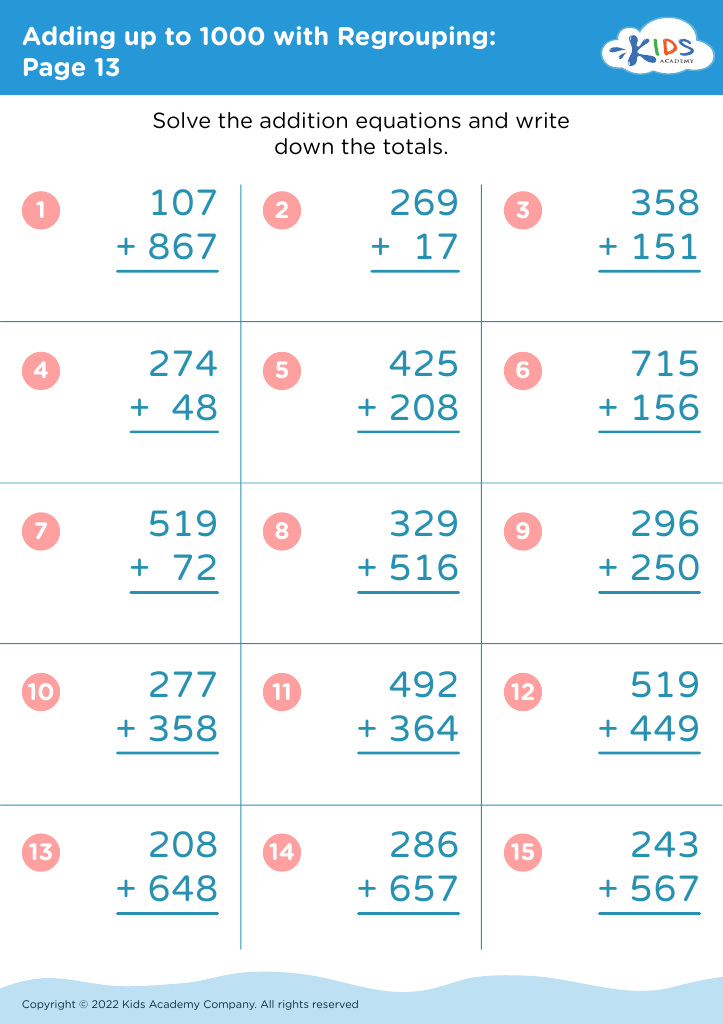
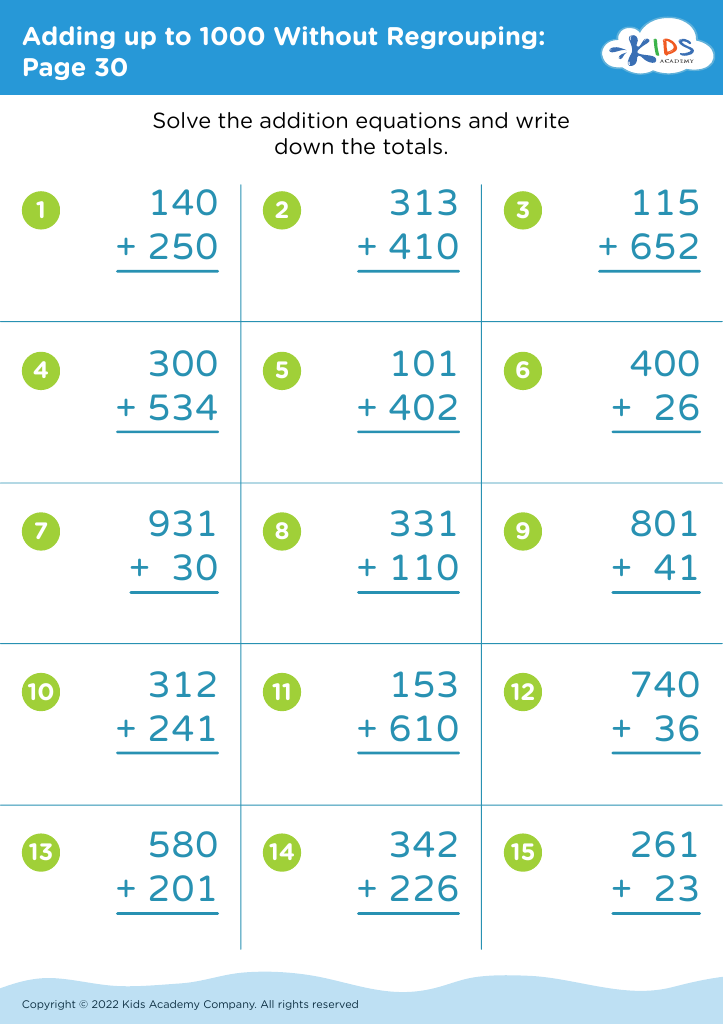
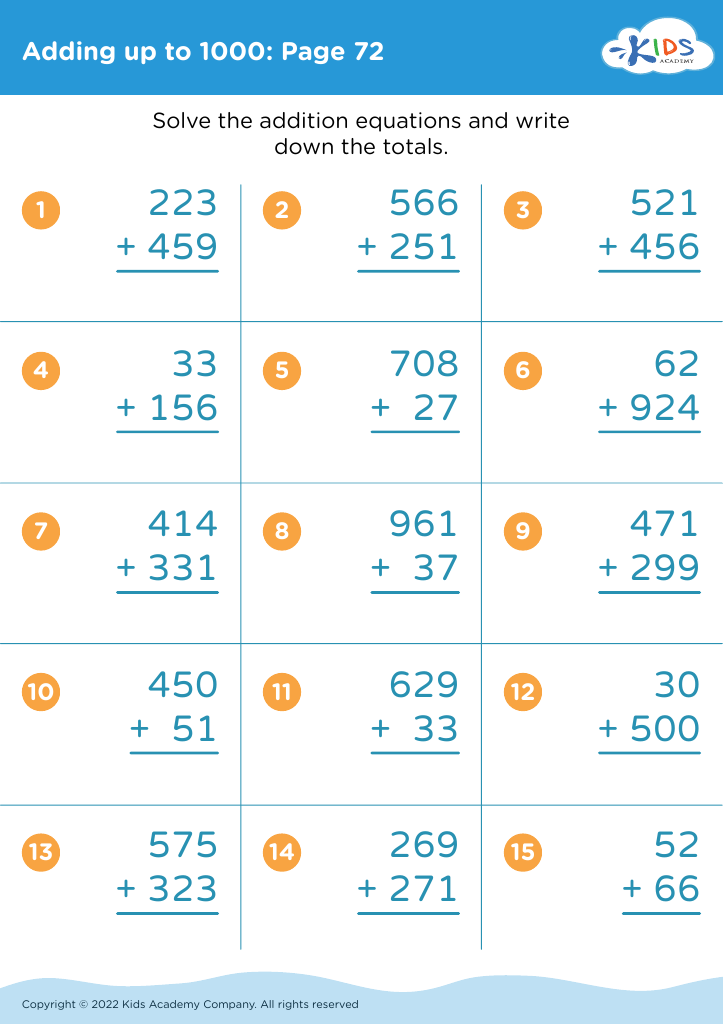



Understanding shapes and engaging in early math skills such as adding numbers up to 1000 play a crucial role in the cognitive development of children aged 4-7. Identifying shapes helps young minds grasp geometric concepts, which are foundational for more advanced math skills. Recognizing and categorizing shapes enhance visual-spatial awareness, aiding children in other areas like reading and critical thinking. When children identify a square, triangle, or circle, they not only learn the shape's name but also its properties, fostering an analytical mindset.
Adding up to 1000, although it may seem advanced for this age group, introduces fundamental arithmetic skills. For young learners, it's not solely about achieving quick calculations but developing a strong number sense. This age group often deals with smaller numbers practically, but introducing them gradually to larger numbers through games, counting, and visual aids can promote familiarity and comfort. This incremental exposure lays the groundwork for more advanced mathematics, making higher-level concepts less intimidating in future educational stages.
Both skills promote problem-solving and critical thinking, improving a child's overall intellectual growth. Hence, parents and teachers should incorporate playful and engaging activities related to shapes and basic arithmetic in daily routines to support comprehensive early childhood development.








