Problem-Solving Skills Adding up to 50 Worksheets for Ages 4-7 - Page 2
26 filtered results
-
From - To
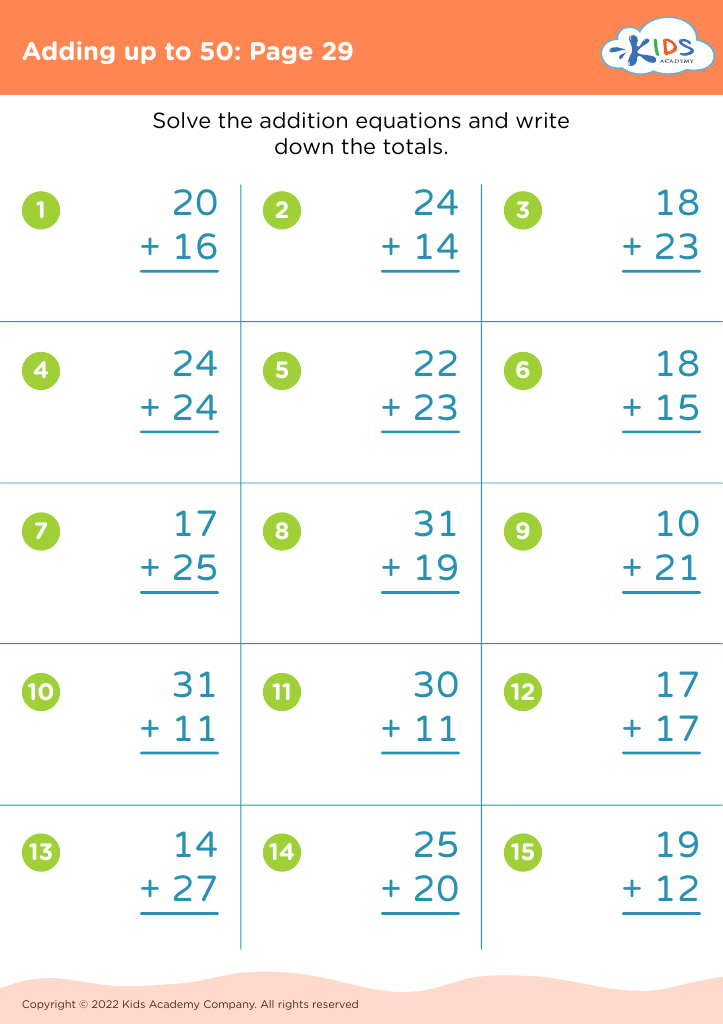
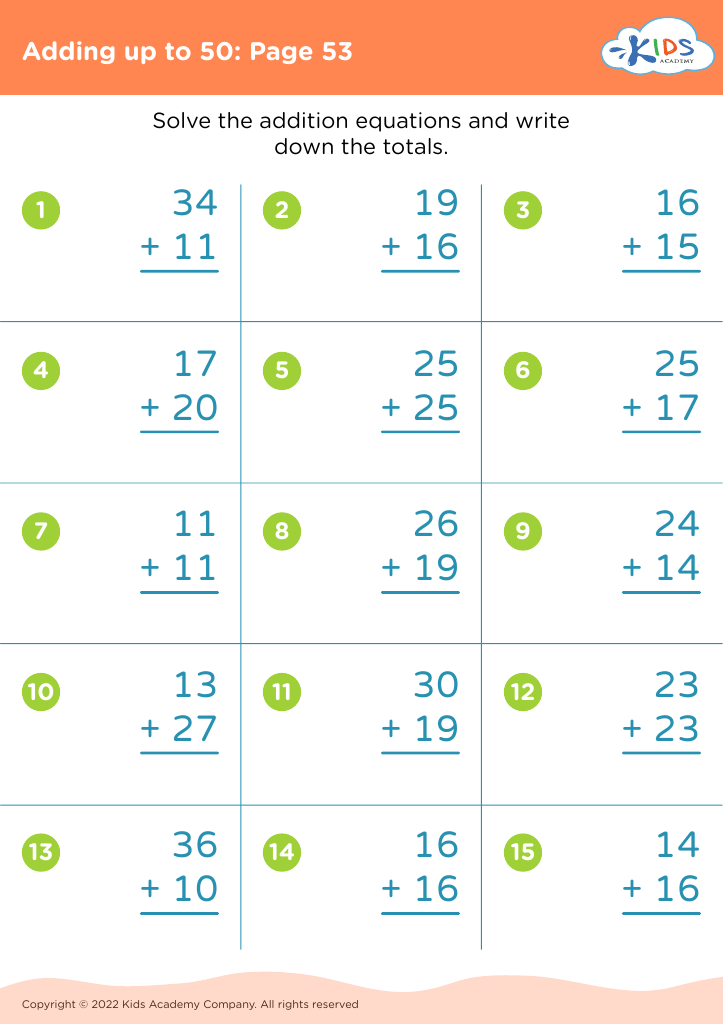




Problem-solving skills, especially those involving arithmetic like adding up to 50, are essential for children aged 4-7 because they form the foundation for more advanced mathematical reasoning and everyday decision-making. At this critical developmental stage, young minds are highly receptive to learning and can grasp fundamental concepts that will underpin their future education.
Firstly, mastering basic addition promotes numerical literacy and enhances mental calculation abilities, which are pivotal for academic success. By learning how to add numbers up to 50, children develop an intuitive sense for numbers, patterns, and relationships, paving the way for easy transition to more complex mathematical concepts like multiplication and division.
Furthermore, cultivating problem-solving skills at an early age nurtures critical thinking and analytical abilities. These skills are not only applicable in math but are also invaluable in daily life situations, such as figuring out how much time is needed to complete a task or making decisions based on different scenarios.
Engaging in these exercises also boosts confidence and resilience. When children overcome mathematical challenges, they gain a sense of accomplishment, fostering a positive attitude towards learning and problem-solving. This, in turn, builds their perseverance and willingness to tackle difficulties in various aspects of life.
In essence, focusing on early problem-solving skills sets children up for long-term educational success and better equips them to navigate the complexities of everyday life.








