Color Identification Addition & Subtraction Worksheets for Ages 4-7 - Page 2
27 filtered results
-
From - To
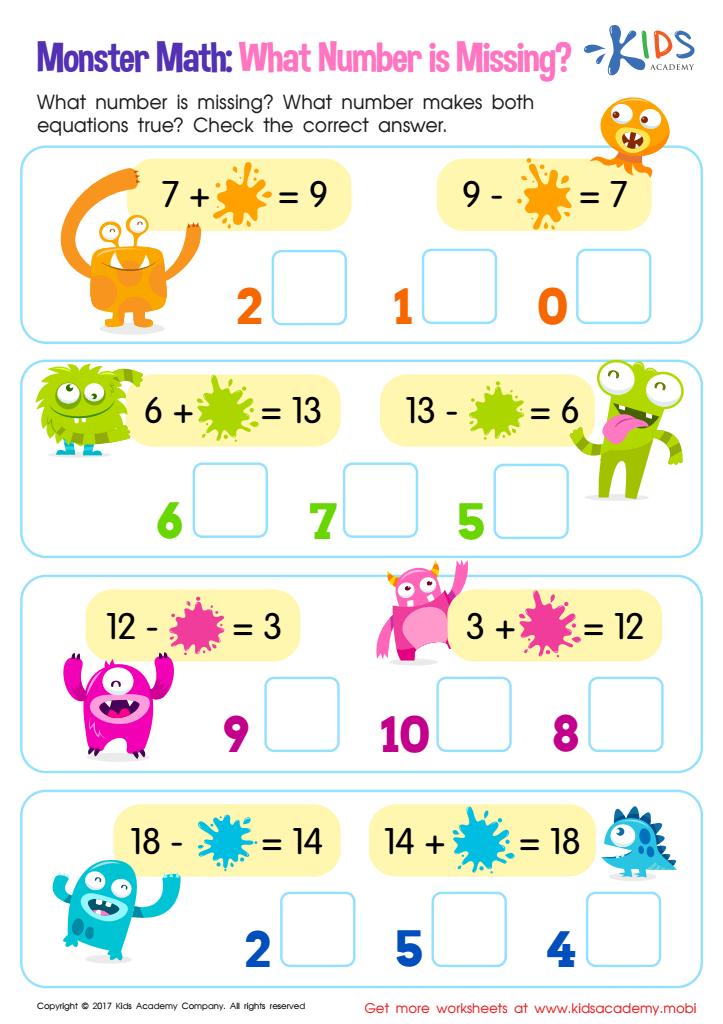
Missing Number: Monster Math Worksheet
 Assign to My Students








Color Identification and foundational addition and subtraction skills are crucial building blocks for early childhood development, especially for children aged 4-7. Integrating these skills offers multiple educational benefits and prepares children for more complex learning experiences.
Firstly, color identification is often one of the first ways children make sense of the world. Recognizing and naming colors enhance cognitive development, visual perception, and language skills. This foundational knowledge is frequently intertwined with other learning activities, making it a practical and engaging starting point for more complex concepts.
Combining color identification with addition and subtraction helps consolidate multiple skills simultaneously. For young learners, manipulating colored objects can make abstract math concepts more tangible and comprehensible. For instance, using colored counters or illustration-based worksheets where colors differentiate mathematical entities can simplify the process of learning and make it enjoyable.
Additionally, these activities promote fine motor skills and hand-eye coordination as children handle and sort objects. Social skills are also developed through cooperative tasks and sharing resources during group activities or games.
Overall, embedding color identification with basic math concepts builds a solid foundation that unfolds into a child’s future academic journey, ensuring a holistic developmental approach. Teachers and parents should care because these activities imbue learning with fun, foster critical early cognitive skills, and prepare children for success in more advanced areas.








