
Observation skills Addition & Subtraction Worksheets for Ages 4-7
3 filtered results
Difficulty Level
Grade
Age
-
From - To
Subject
Activity
Standards
Enhance your child's math journey with our observation skills addition and subtraction worksheets, designed specifically for ages 4-7. These engaging resources promote critical thinking as young learners observe, compare, and analyze patterns in math problems. Each worksheet uses colorful visuals and fun exercises that keep children motivated while mastering essential addition and subtraction concepts. By developing observation skills, your child will improve their ability to understand and solve math problems more effectively. Ideal for both classroom and home learning, our worksheets make math enjoyable and help set a solid foundation for future academic success. Start your child's learning adventure today!
Favorites
With answer key
Interactive
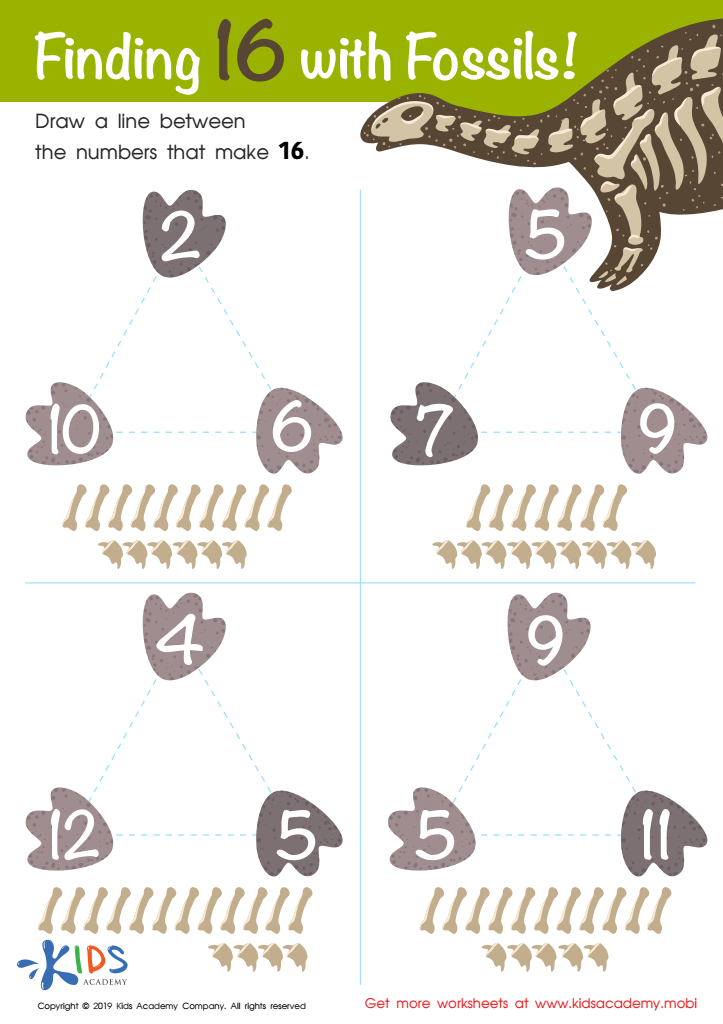
Finding 16 With Fossils Worksheet
Experts hunt for fossils, dig them up, and study them to learn more about past life forms - how they lived, what they looked like, and when they lived. Show kids the picture in this worksheet and point out the fossils. Help them count the bones and draw a line between the numbers that add up to 16 in each triangle.
 Assign to My Students
Finding 16 With Fossils Worksheet
Worksheet
Join Kids Academy for Free
Who is primarily going to use this learning content?








Observation skills in addition and subtraction are crucial for children aged 4-7, as they form the foundation for their mathematical understanding and overall cognitive development. For parents and teachers, fostering these skills promotes more than just arithmetic proficiency; it equips children with the ability to analyze, think critically, and draw connections between numbers and real-world situations.
At this age, children engage with numbers in playful and concrete ways. Observation allows them to identify patterns, understand relationships (e.g., knowing that subtracting means taking away), and make sense of quantities. Encouraging them to observe their surroundings—counting objects, comparing groups, and recognizing numbers in everyday contexts—cultivates an intuitive grasp of mathematical principles.
Moreover, enhancing these skills contributes to greater confidence and interest in mathematics. Children who can observe and manipulate numbers become more adept problem solvers, setting the stage for future learning. As parents and educators notice improvements in children's observation skills, they can celebrate progress and inspire a growth mindset.
Ultimately, effectively nurturing observation skills in addition and subtraction will lead to better academic outcomes, fostering a love for learning and a positive attitude toward math that can last a lifetime.








