Recognizing equivalent fractions Addition & Subtraction Worksheets for Ages 4-7
5 filtered results
-
From - To
Discover our engaging and educational "Recognizing Equivalent Fractions Addition & Subtraction Worksheets" designed specifically for children aged 4-7. These worksheets help young learners grasp the concept of equivalent fractions through fun activities that promote critical thinking and math fluency. Our user-friendly materials encourage hands-on learning, allowing kids to practice addition and subtraction of fractions in a playful way. Perfect for home or classroom use, these worksheets include colorful illustrations and clear instructions to keep little ones motivated. Enhance your child’s mathematical skills while making learning enjoyable with our high-quality, printable resources!
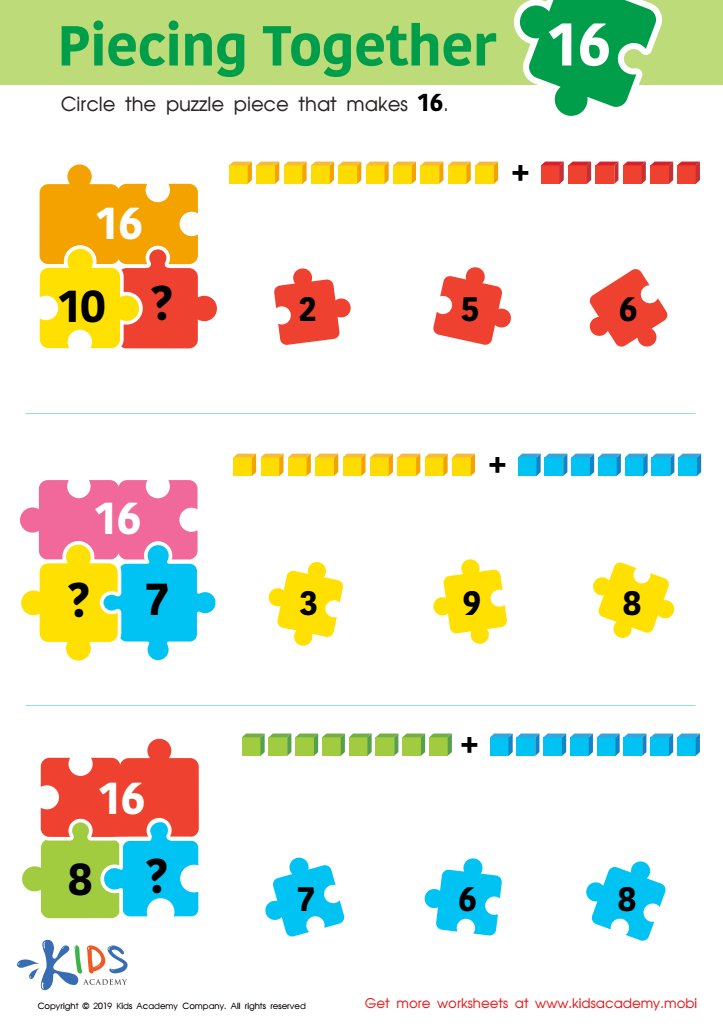
Piecing Together 16 Worksheet
 Assign to My Students
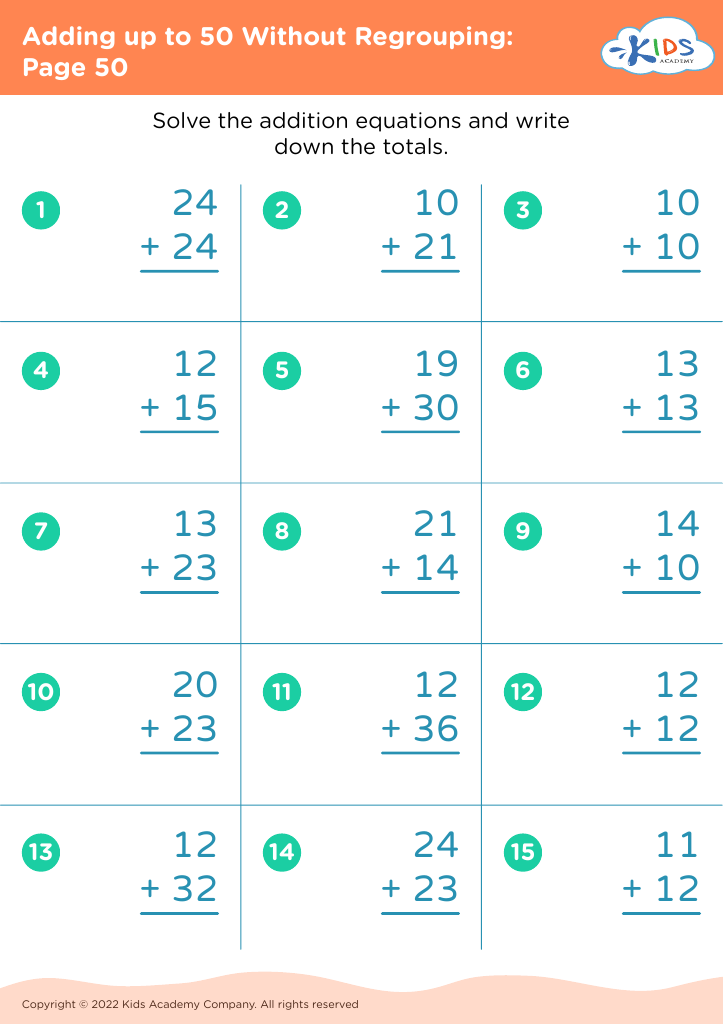








Recognizing equivalent fractions is a fundamental concept for young learners, especially those aged 4-7, as it serves as the foundation for more advanced mathematical skills. At this stage, children are developing their number sense and understanding of relationships between numbers. Recognizing that different fractions can represent the same value (e.g., 1/2 is equivalent to 2/4) enriches their understanding of proportionality and helps them grasp concepts related to sharing, partitioning, and grouping.
For parents and teachers, fostering this understanding promotes cognitive development and enhances problem-solving skills. Engaging children in activities that explore equivalent fractions through visual aids and manipulative tools encourages active learning and makes abstract concepts concrete. This lays the groundwork for addition and subtraction of fractions, paving the way for higher-level mathematics, such as algebra.
Moreover, recognizing equivalent fractions empowers children to simplify problems, which increases their confidence in mathematics. It also promotes a positive attitude towards math as they see connections between different concepts, enabling them to integrate knowledge across subjects. Thus, prioritizing the teaching of equivalent fractions is essential for nurturing a solid mathematical foundation, preparing children for future academic success while making learning enjoyable and interactive.








