
Observation skills Addition Worksheets for Ages 4-7
3 filtered results
Difficulty Level
Grade
Age
-
From - To
Subject
Activity
Standards
Enhance your child's math proficiency with our engaging Observation Skills Addition Worksheets designed for ages 4-7. These worksheets focus on developing essential observation skills while introducing basic addition concepts. Kids will enjoy a mix of fun activities that strengthen their ability to notice details, compare quantities, and recognize patterns. Perfect for early learners, these worksheets encourage critical thinking and problem-solving in a playful way. With colorful illustrations and age-appropriate challenges, your child will build confidence in their math skills. Explore the world of math through observation, and set the foundation for future success with our interactive resources!
Favorites
With answer key
Interactive
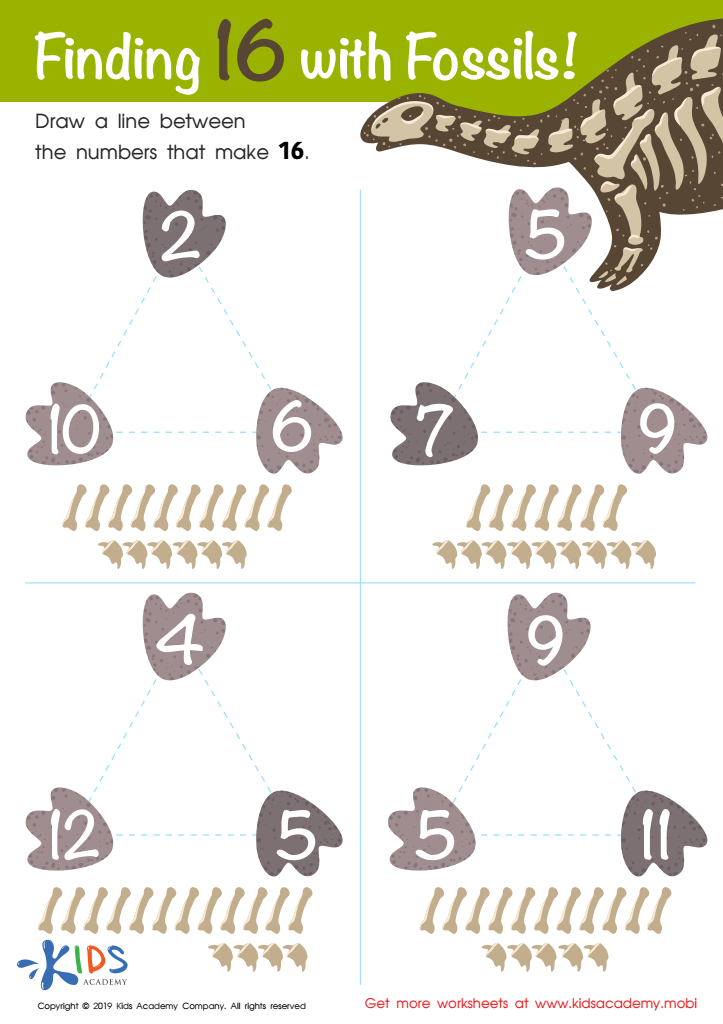
Finding 16 With Fossils Worksheet
Experts hunt for fossils, dig them up, and study them to learn more about past life forms - how they lived, what they looked like, and when they lived. Show kids the picture in this worksheet and point out the fossils. Help them count the bones and draw a line between the numbers that add up to 16 in each triangle.
 Assign to My Students
Finding 16 With Fossils Worksheet
Worksheet
Join Kids Academy for Free
Who is primarily going to use this learning content?







Observation skills are vital for children aged 4-7 as they form the foundation for learning and social development. For parents and teachers, fostering these skills is crucial due to their impact on literacy, numeracy, and critical thinking. Children who develop strong observation skills can recognize patterns, differences, and similarities, all of which enhance their ability to engage with their environment.
At this age, much of a child's learning occurs through play and exploration. When parents and teachers encourage observation, they create opportunities for children to ask questions, make connections, and express their thoughts. This active engagement helps enhance vocabulary and communication skills while promoting curiosity and a love for learning.
Moreover, observation skills aid in emotional and social development. Children learn to read body language and facial expressions, which enables them to understand social cues, foster empathy, and build respectful relationships with peers and adults.
Ultimately, prioritizing observation skills not only supports academic readiness but also nurtures well-rounded individuals equipped to navigate their world. By being involved in this aspect of learning, parents and educators can lay the groundwork for lifelong skills in inquiry, analysis, and interpersonal relationships.








