Learning number patterns Math Worksheets for Ages 4-7
4 filtered results
-
From - To
Discover our engaging Learning Number Patterns Math Worksheets tailored for children ages 4-7! These thoughtfully designed worksheets aim to enhance early math skills through fun and interactive activities. Young learners will explore sequences, identify patterns, and strengthen their numerical reasoning in a playful way. Our resources cater to diverse learning styles, making math enjoyable and accessible. Each worksheet features colorful visuals and creative challenges to keep kids motivated while they build foundational skills. Perfect for both classroom use and home learning, our worksheets provide a comprehensive approach to mastering number patterns, setting the stage for future math success!
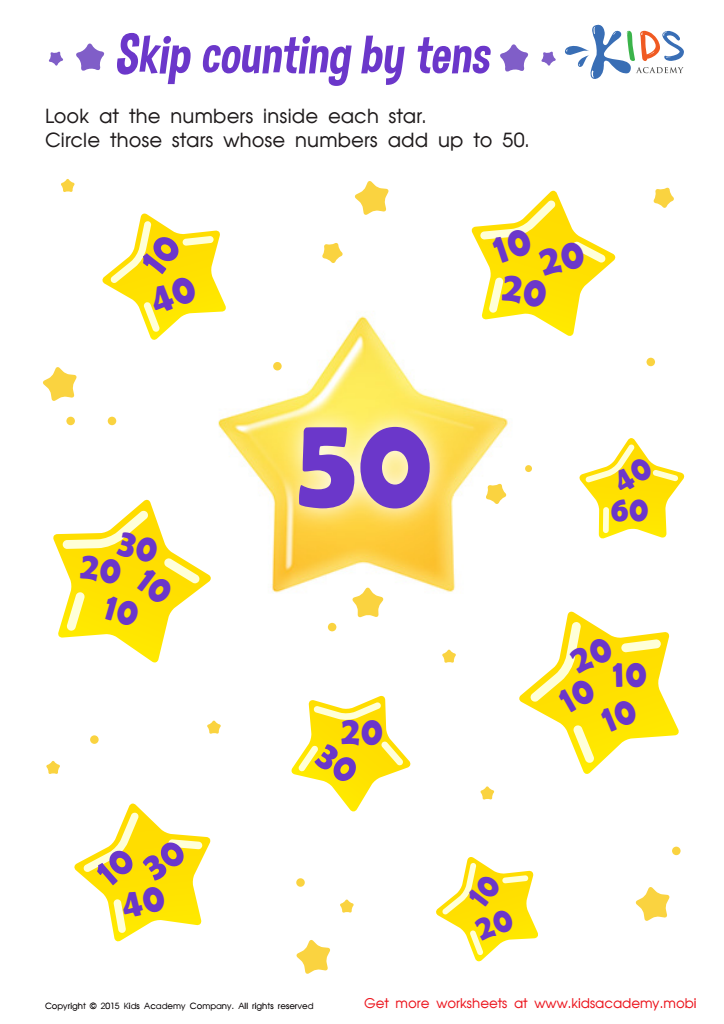
Learn Dozens: Skip Counting by Tens Printable
 Assign to My Students








Understanding number patterns is a vital foundation for young learners aged 4 to 7. At this stage, children are developing critical thinking and problem-solving skills, which are essential for mathematical reasoning. Recognizing and working with number patterns enhances their ability to identify relationships between numbers, an important concept that extends beyond simple calculation.
Parents and teachers should care about this area of math because it not only reinforces number sense but also boosts children's confidence in mathematics. When children learn to detect patterns, they engage in logical thinking and prediction, skills that are beneficial in various subjects and real-life scenarios. Additionally, grasping patterns helps students recognize sequences, develop their understanding of addition and subtraction, and prepare them for more complex arithmetic and algebra in the future.
Fostering an environment where pattern recognition is encouraged fuels curiosity and enjoyment in learning. Whether through games, hands-on activities, or everyday experiences, integrating patterns into learning experiences will create a positive association with math. Investing in this foundational skill today sets the stage for a lifetime of mathematical understanding and success, making it a priority for parents and educators alike.








