Understanding measurements Math Worksheets for Ages 4-7 - Page 2
25 filtered results
-
From - To
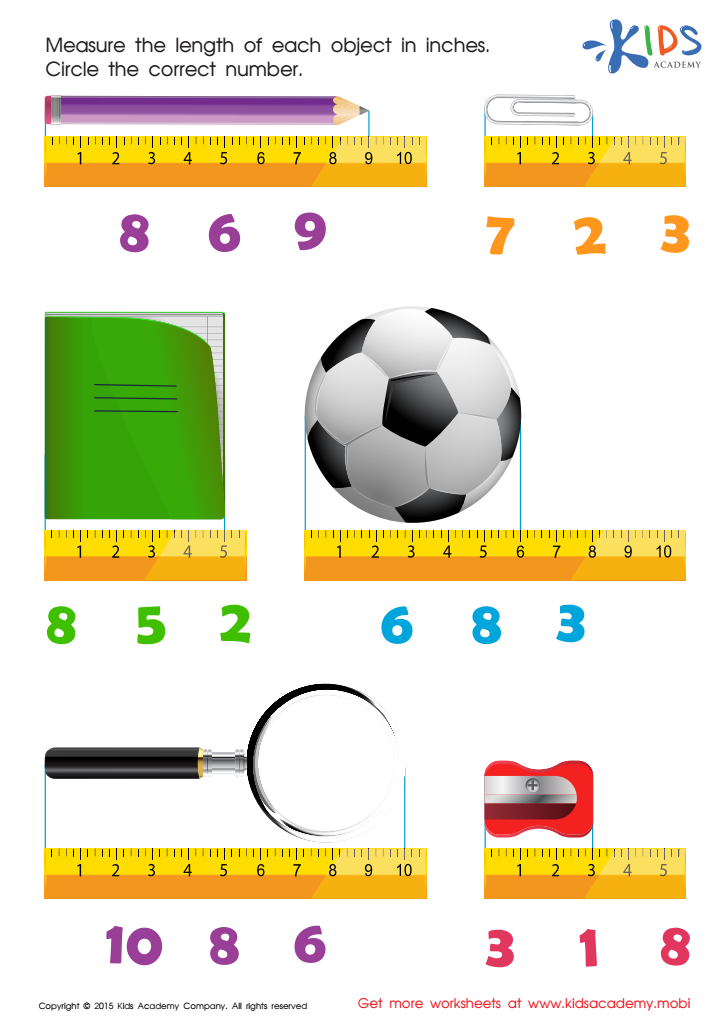
Learning measuring objects in inches Worksheet
 Assign to My Students






Understanding measurements in math is crucial for children ages 4-7 as it lays the foundation for critical thinking and problem-solving skills. At this stage, children are naturally curious and engage with their surroundings in concrete ways. Introducing measurement concepts helps them quantify and make sense of the world around them, fostering both cognitive and social development.
Parents and teachers should care because measurement is inherently linked to everyday experiences. Children measuring ingredients while cooking, comparing heights of plants, or estimating the length of a favorite toy helps them grasp abstract mathematical concepts through hands-on experiences. This engagement promotes numeracy skills, such as number recognition and operations, while encouraging language development through vocabulary associated with measurement.
Furthermore, understanding measurements prepares children for future mathematical learning. It introduces concepts of but also helps develop reasoning skills as they learn to estimate, compare, and assess sizes and quantities. Moreover, it nurtures a sense of confidence and accomplishment as children learn to solve real-life problems. Ultimately, supporting children in their measurement journey fosters a positive attitude towards mathematics, benefiting their overall academic success and lifelong learning. By encouraging curiosity and exploration in measurements, adults are equipping children with essential life skills.








