Weather identification Math Worksheets for Ages 4-7
4 filtered results
-
From - To
Introduce your young scholars to fun and educational experiences with our Weather Identification Math Worksheets for Ages 4-7. These engaging worksheets from Kids Academy seamlessly combine early math skills development with weather learning. Children will delight in activities that include counting, sorting, and identifying various weather elements, all designed to boost critical thinking and observation skills. Perfect for ages 4-7, these worksheets support hands-on learning and are easily printable for use at home or in the classroom. Elevate your child's learning journey with our expertly crafted resources.
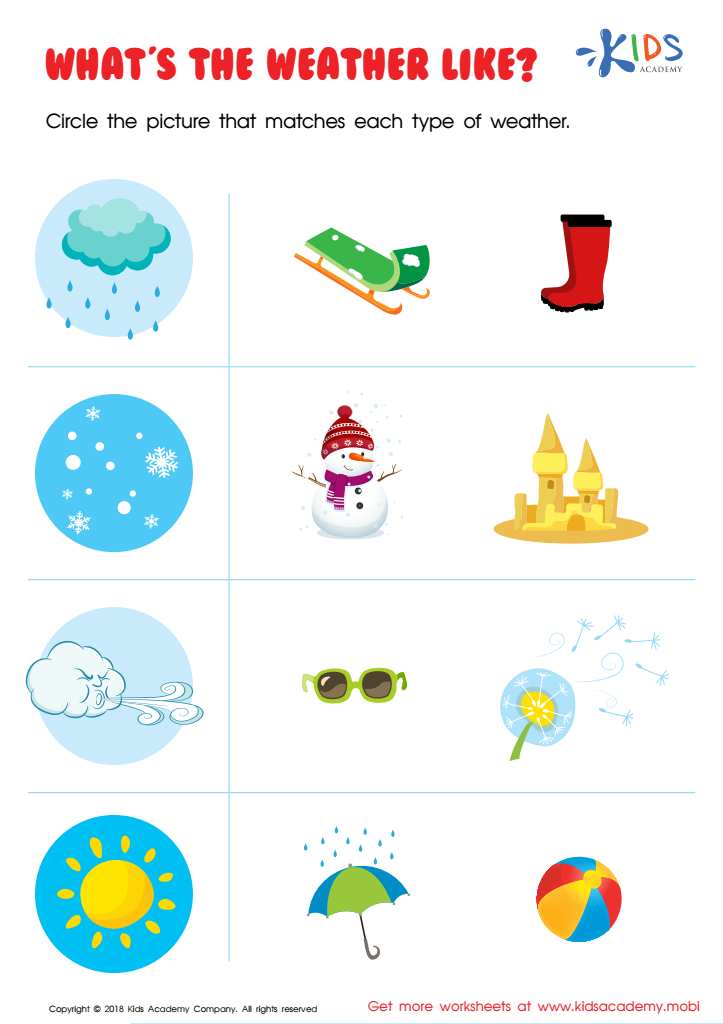
What's the Weather Like? Worksheet
 Assign to My Students
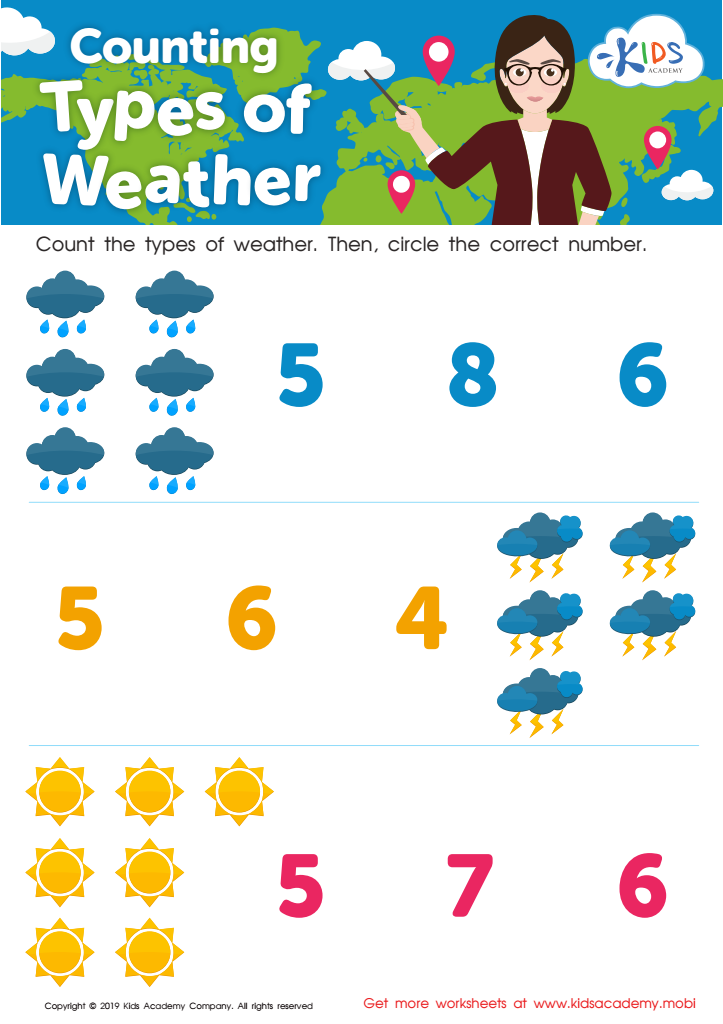
Counting Types of Weather Worksheet
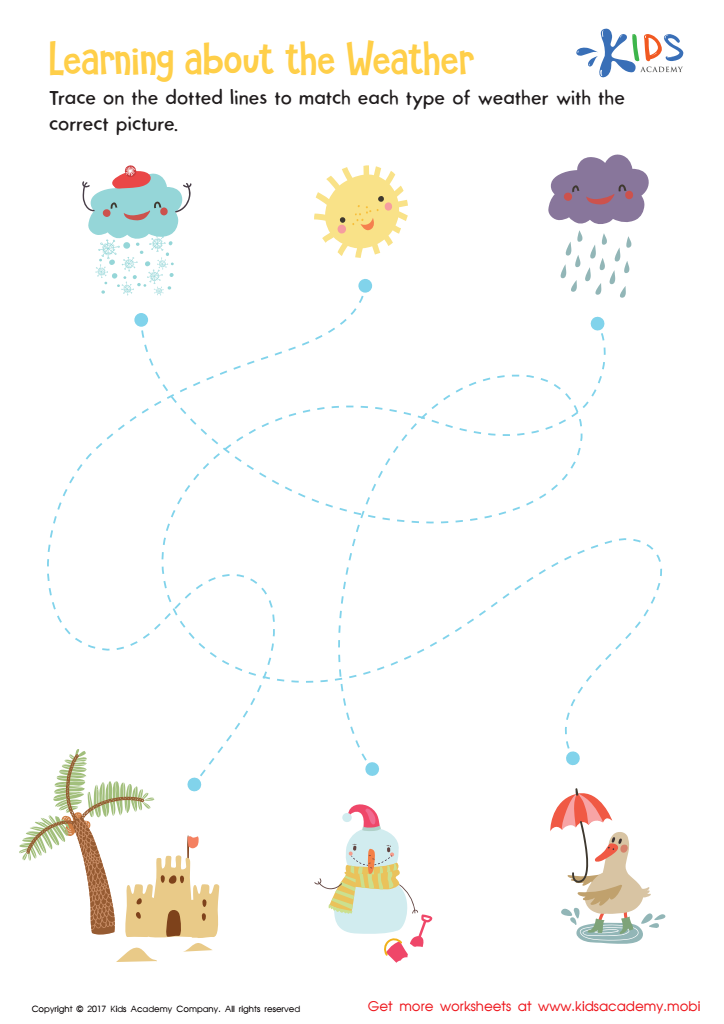






.jpg)

Parents and teachers should care about weather identification math for ages 4-7 because it builds foundational skills in both scientific observation and mathematical reasoning, crucial for young learners' development. First and foremost, weather identification enhances children's observational skills, encouraging them to notice and differentiate various weather conditions such as sunny, cloudy, rainy, or snowy days. This practice fosters curiosity and a closer connection with their environment.
Moreover, incorporating mathematical concepts into weather identification by tracking weather patterns, counting sunny days, or graphing temperatures transforms abstract ideas into tangible experiences. This blend of science and math helps children understand data collection and basic statistics, which are vital skills for future academic pursuits. Such activities also promote critical thinking, as children must compare, contrast, and categorize different weather elements systematically.
Importantly, understanding weather has practical implications. Children learn to associate weather with appropriate clothing and activities, fostering independence and practical decision-making in daily life.
Overall, weather identification math nurtures a well-rounded cognitive development. By integrating observing, recording, and analyzing weather data, educators and parents set a solid groundwork for scientific inquiry and numeracy, nurturing a generation that's both curious and skilled in STEM fields.








