
Lowercase letter writing Worksheets for Ages 4-8
3 filtered results
Difficulty Level
Grade
Age
-
From - To
Subject
Activity
Standards
Our Lowercase Letter Writing Worksheets are specially designed for children ages 4-8 to master the art of writing lowercase letters. These engaging and colorful sheets provide step-by-step instructions and ample practice opportunities, ensuring kids not only learn proper letter formation but also enhance their fine motor skills. Perfect for preschoolers and early elementary students, each worksheet combines fun activities with essential learning. Give your child a head start in literacy with our effective, enjoyable, and expertly crafted worksheets that make learning to write both easy and enjoyable. Practical, educational, and fun – an ideal resource for parents and teachers!
Favorites
With answer key
Interactive
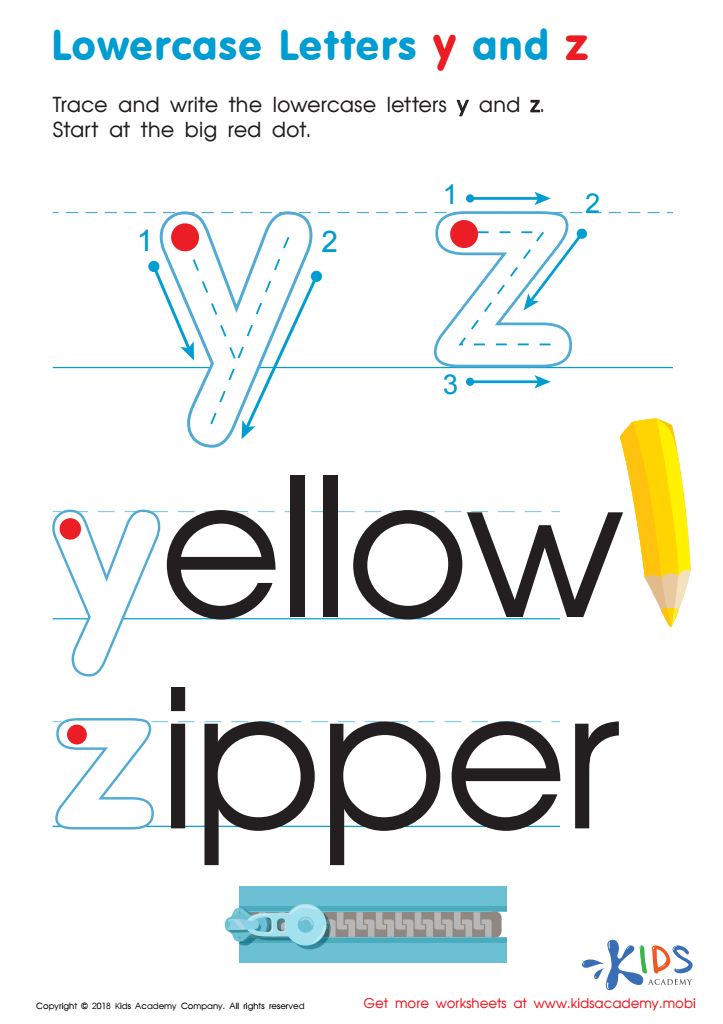
Lowercase Letters y z Worksheet
Help your child get a good start in writing and reading by tracing and writing the lowercase letters y and z. With this activity, they will learn the alphabet, which is essential for literacy success. Guide them through the worksheet and make sure they form the letters correctly. This will help them learn the basics needed to write and read fluently.
 Assign to My Students
Lowercase Letters y z Worksheet
Worksheet
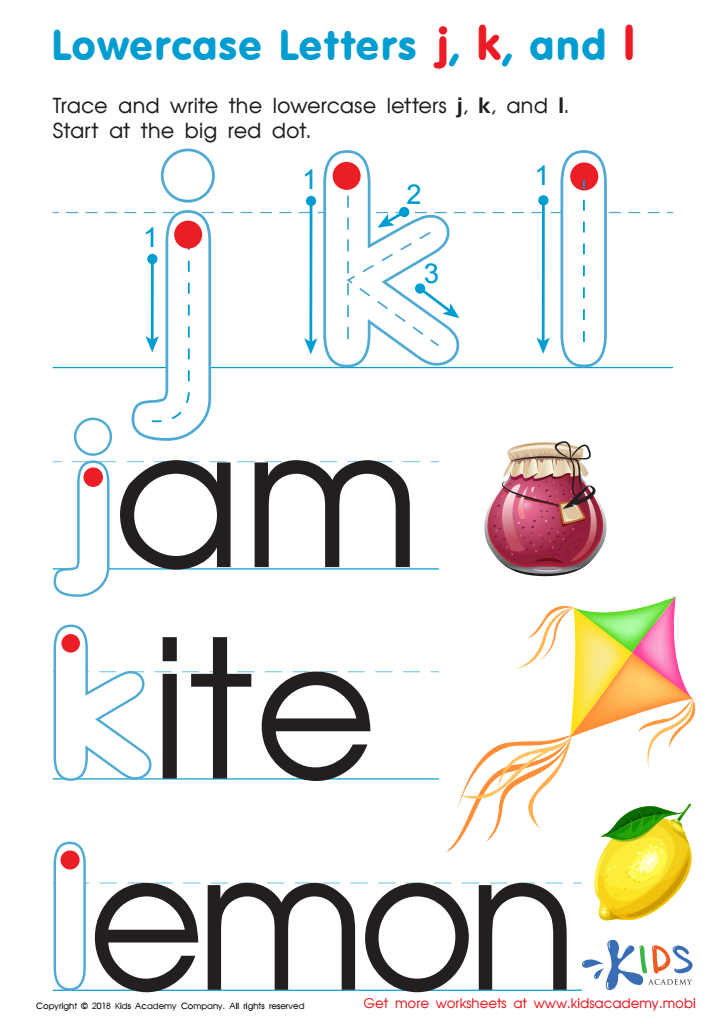
Lowercase Letters j k l Worksheet
Teach your child the difference between uppercase and lowercase letters. Have them trace and write the lowercase letters j, k, and l, starting at the red dot. Guide your child's hand to form the letters correctly.
Lowercase Letters j k l Worksheet
Worksheet
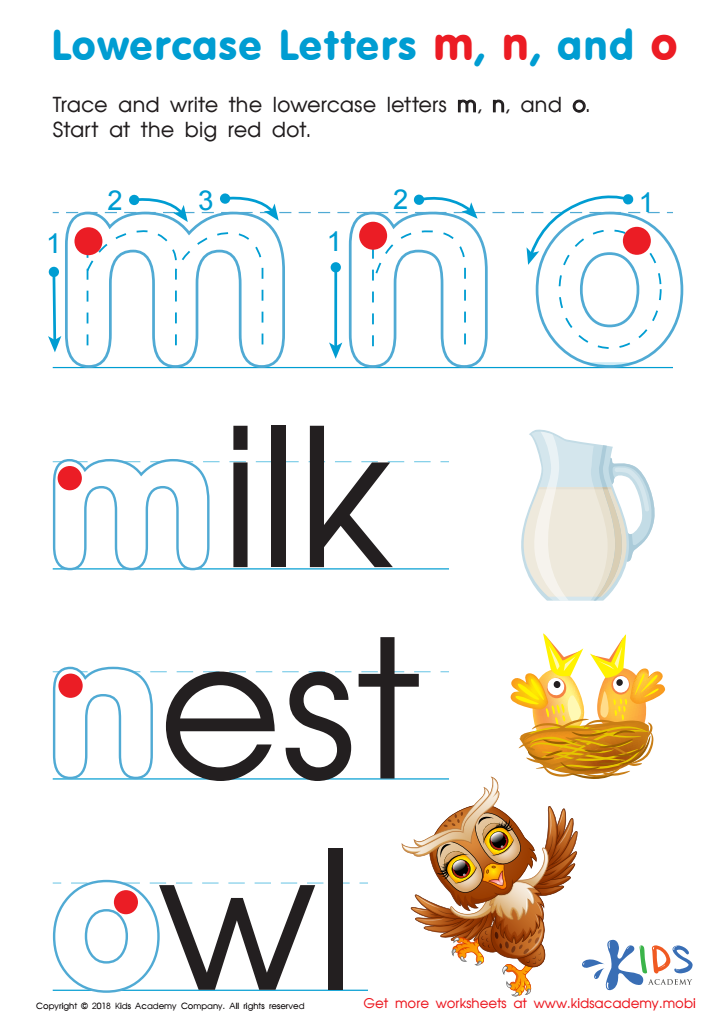
Lowercase Letters m n o Worksheet
Help your child learn the alphabet with letter tracing. Show them the difference between uppercase and lowercase letters by working through this free worksheet, tracing and writing lowercase m, n and o.
Lowercase Letters m n o Worksheet
Worksheet
Join Kids Academy for Free
Who is primarily going to use this learning content?







Ensuring that children aged 4-8 master lowercase letters is foundational for several reasons. During early childhood, these years are critical for developing literacy skills that lay the groundwork for all future learning. Lowercase letters form the bulk of written language; hence, proficiency in writing and recognizing them is essential for reading fluency.
When teachers and parents emphasize lowercase letter writing, they help children strengthen fine motor skills and hand-eye coordination. This ability to control a pencil or crayon successfully transfers to other daily activities, boosting overall coordination and dexterity. Furthermore, well-practiced handwriting can improve a child's confidence, making them more eager to participate in both writing and reading activities.
Lowercase letters also play a crucial role in phonemic awareness, enabling kids to discern letters' shapes, sounds, and roles within words. This recognition enhances spelling abilities and vocabulary acquisition. Advocating for lowercase readiness makes lesson integration seamless: the transition to full text reading becomes smoother, and children are more likely to enjoy learning.
Counter to the digital age’s trends, writing skills infuse cognitive flexibility and improvement in tactile learning. Therefore, fostering lowercase letter proficiency not only nurtures immediate academic skills but also bolsters holistic early childhood development. The attention that parents and teachers dedicate to this cannot be overstated—it is an investment in the child's lifelong journey of learning.








