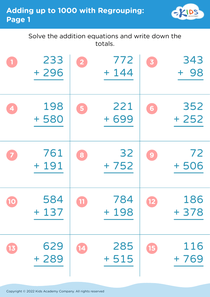
Improving counting skills Adding up to 1000 Without Regrouping Worksheets for Ages 4-8
4 filtered results
-
From - To
Enhance your child's counting skills with our engaging worksheets designed specifically for ages 4-8. "Improving Counting Skills: Adding Up to 1000 Without Regrouping" incorporates fun exercises that foster essential mathematical understanding. These worksheets are tailored to help young learners practice addition within 1000, reinforcing number recognition and improving their ability to add without regrouping. With vibrant illustrations and age-appropriate challenges, children will enjoy mastering these foundational skills. Ideal for both classroom and at-home use, our worksheets ensure children gain confidence in their math abilities while having fun. Explore our resources today and watch your child's counting skills flourish!
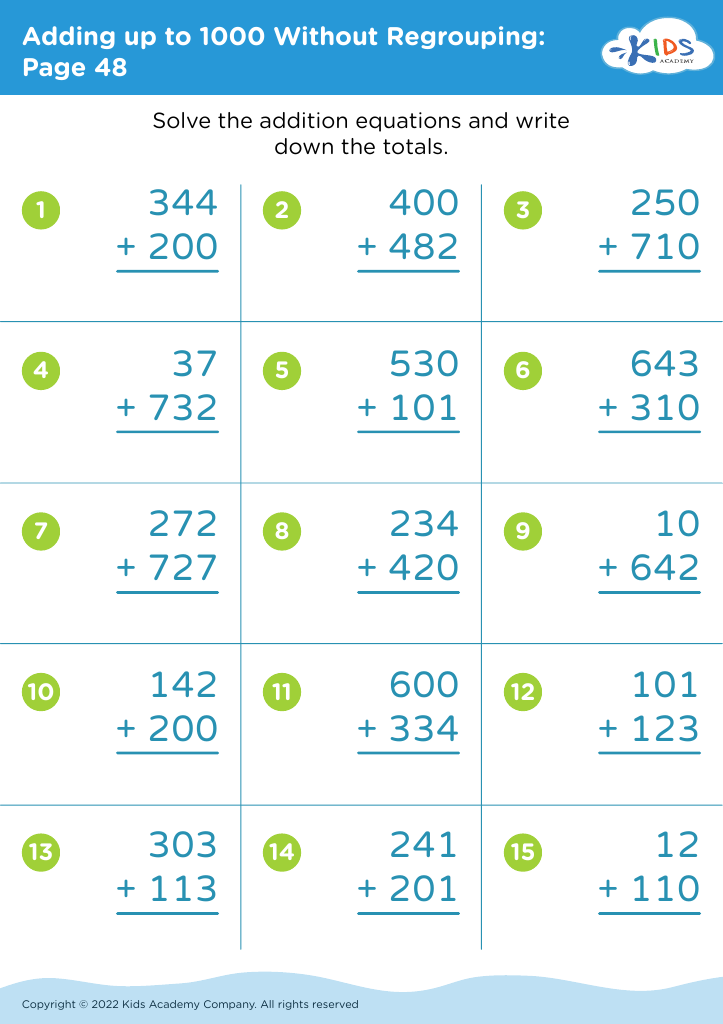
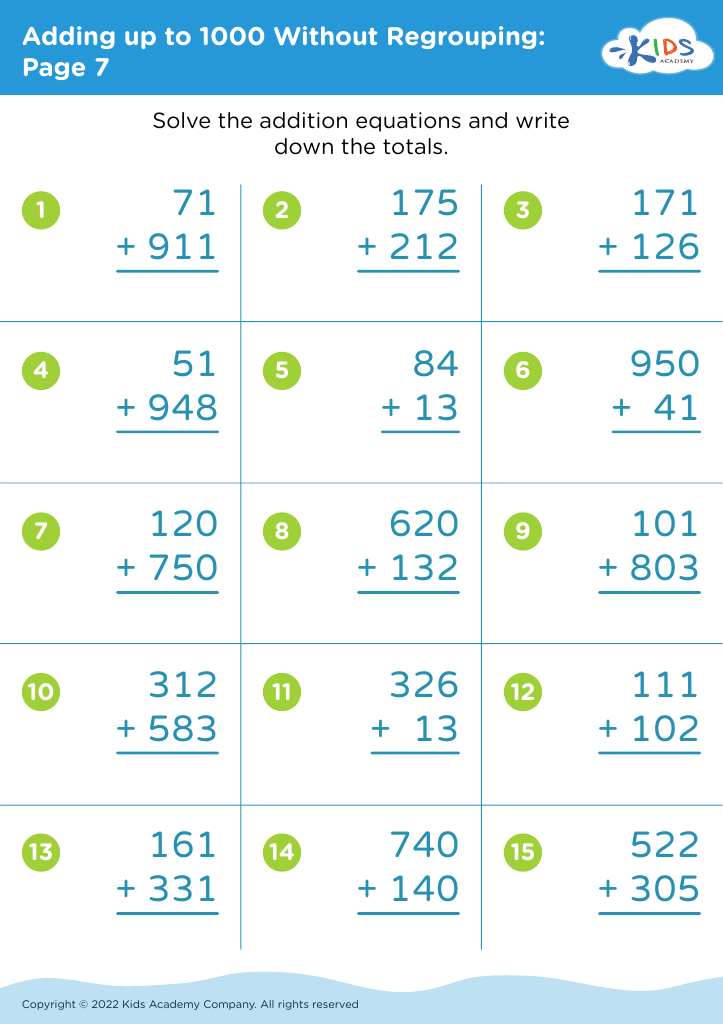
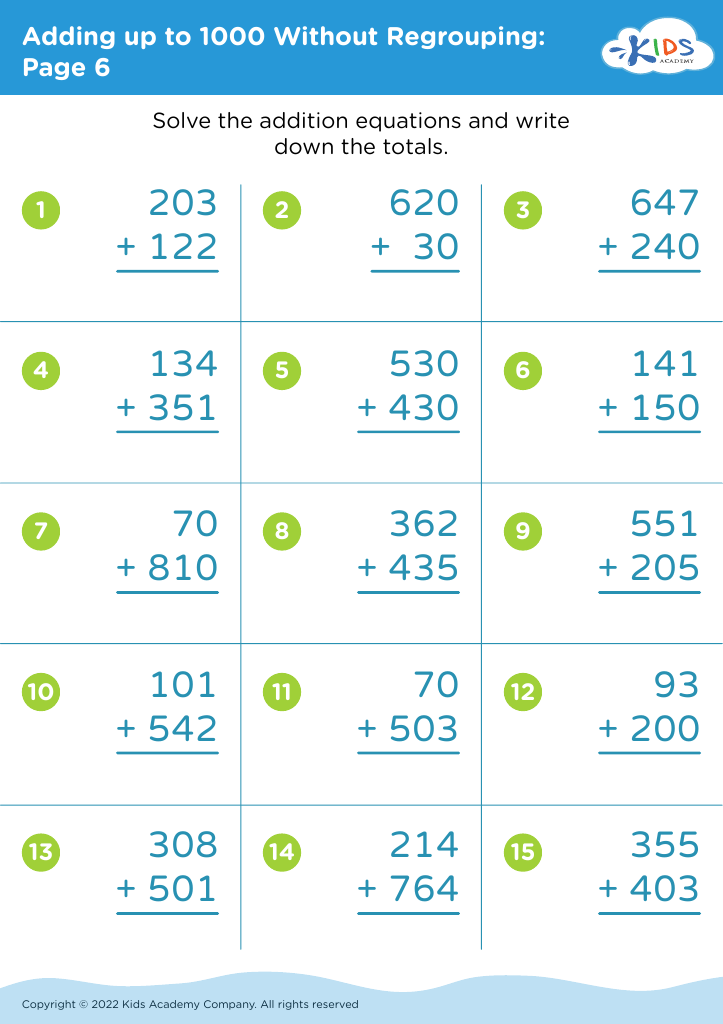
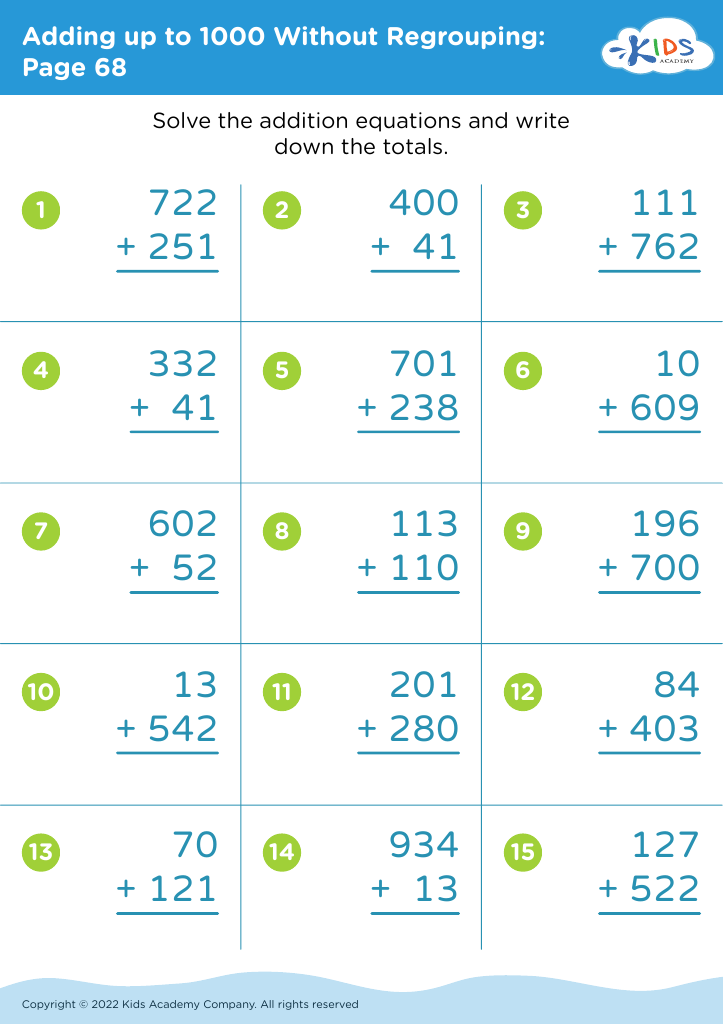


Improving counting skills, particularly adding up to 1000 without regrouping, is crucial for children aged 4-8 as it lays a strong mathematical foundation that influences future learning. At this early age, children's brains are highly adaptable, making it the ideal time to introduce and reinforce counting concepts. Mastering addition in a straightforward manner boosts their confidence and provides clarity in understanding numerical relationships.
Strong counting skills enhance children's ability to tackle more complex math concepts as they advance in their education. By grasping how to count and add numbers without regrouping, children develop a sense of number sense, enabling them to approach mathematical problems with ease. It promotes critical thinking and problem-solving skills, essential competencies in today's fast-paced world.
Additionally, these foundational skills enhance daily life and real-world problem-solving; whether managing money, measuring ingredients in cooking, or understanding time and schedules, practical applications abound. For teachers and parents, fostering these skills encourages positive attitudes towards math, reducing math anxiety. By prioritizing counting and addition practices, adults can equip children with essential tools that not only impact their academic success but also provide them with skills necessary for lifelong learning and problem-solving.