Improving math skills Adding up to 1000 Without Regrouping Worksheets for Ages 4-8
3 filtered results
-
From - To
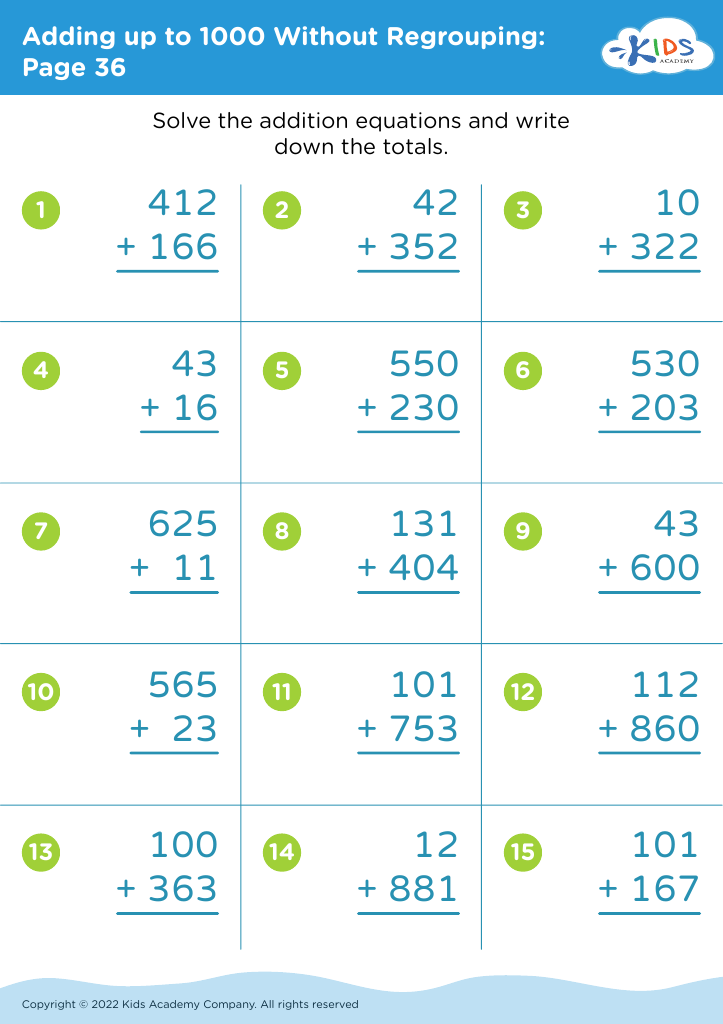
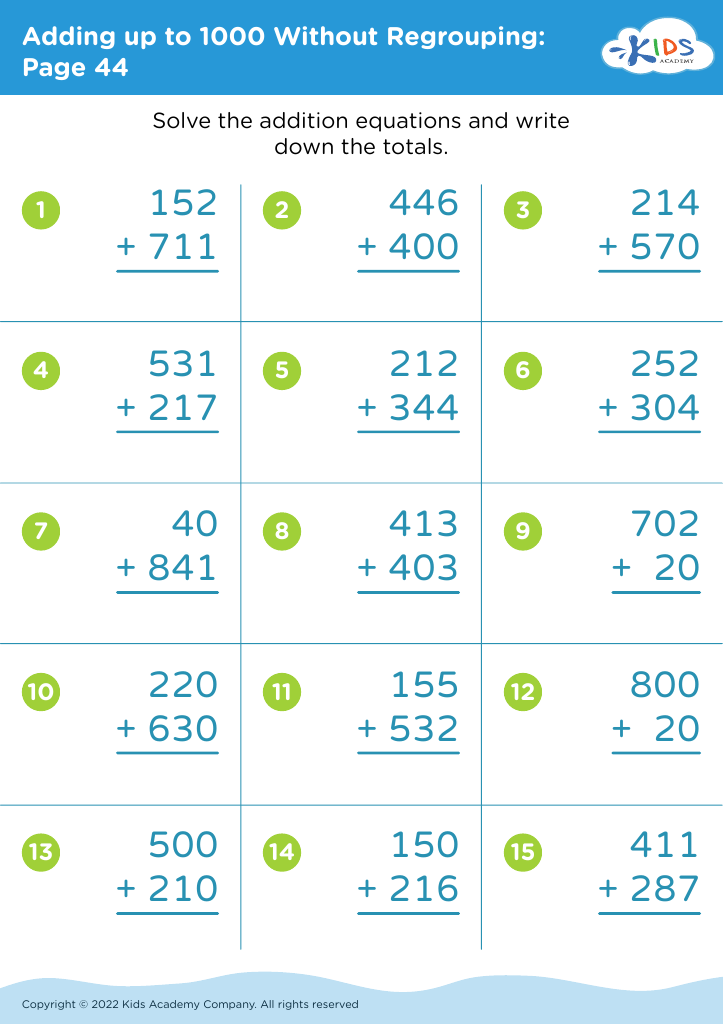
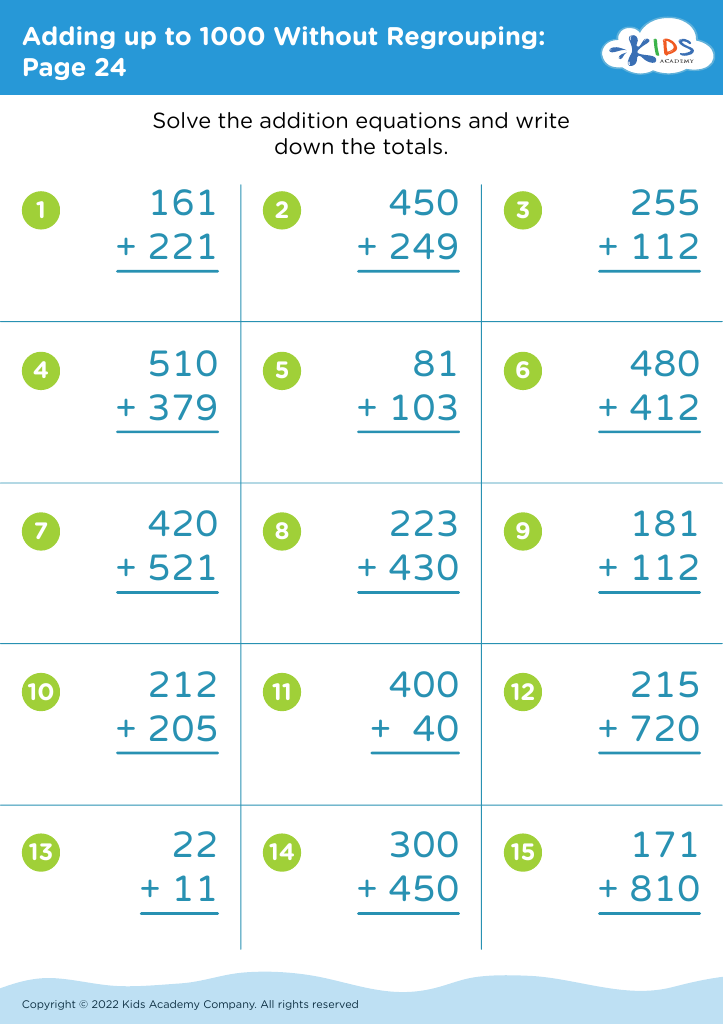
Boost your child's math proficiency with our "Improving Math Skills: Adding Up to 1000 Without Regrouping Worksheets for Ages 4-8." These specially designed worksheets help young learners master addition up to 1000 without the need for regrouping, promoting confidence and foundational numeracy. Suitable for children aged 4-8, these exercises facilitate understanding through simple and engaging calculations. Our resources are perfect for both classroom and home use, providing essential practice for developing essential math skills. Make learning math a fun and stress-free experience with Kids Academy's expertly crafted worksheets.


Improving math skills, particularly adding up to 1000 without regrouping, is crucial for children ages 4-8 as it forms the foundation for higher-level arithmetic and problem-solving. This skill strengthens their understanding of number relationships and the base-ten system, making future concepts like multiplication and division easier to grasp. Mastery at this stage boosts their confidence and promotes a positive attitude toward math, which can influence their engagement and achievement in later grades.
For parents, nurturing these skills at an early age ensures their children are not only prepared for academic challenges but also able to apply math in everyday situations, like estimating costs during shopping or managing allowances. Teachers, on the other hand, understand that early proficiency in basic math concepts reduces learning gaps, allowing for smooth transitions into more complex arithmetic tasks.
Moreover, early competency in math has been linked to better performance across other subjects due to the development of logical thinking, pattern recognition, and analytical skills. Counting fluently up to 1000 lays these neural pathways early, making advanced mathematical concepts less intimidating. Overall, investing in math proficiency at this age cultivates long-term academic success, critical thinking, and practical life skills, setting the stage for lifelong learning.