Basic Addition Skills Adding up to 1000 Worksheets for Ages 4-8
3 filtered results
-
From - To
Boost your child's math confidence with our "Basic Addition Skills Adding up to 1000 Worksheets for Ages 4-8"! Perfectly crafted for young learners, these engaging and colorful activities make mastering addition fun and easy. Tailor-made for children, these worksheets help develop essential skills in adding numbers up to 1000. Each worksheet nurtures critical thinking and problem-solving abilities, laying a strong foundation for future math success. Ideal for classroom use or extra practice at home, they ensure gradual learning with step-by-step progression. Empower your child today and transform math from a challenge to an adventure with our expertly designed addition resources.
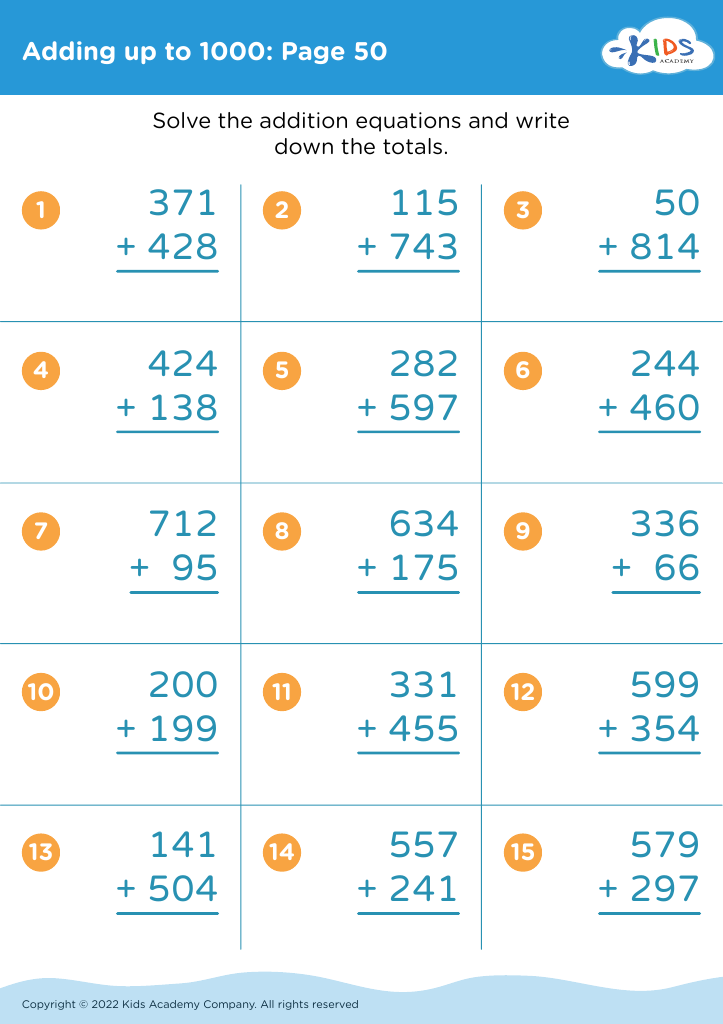
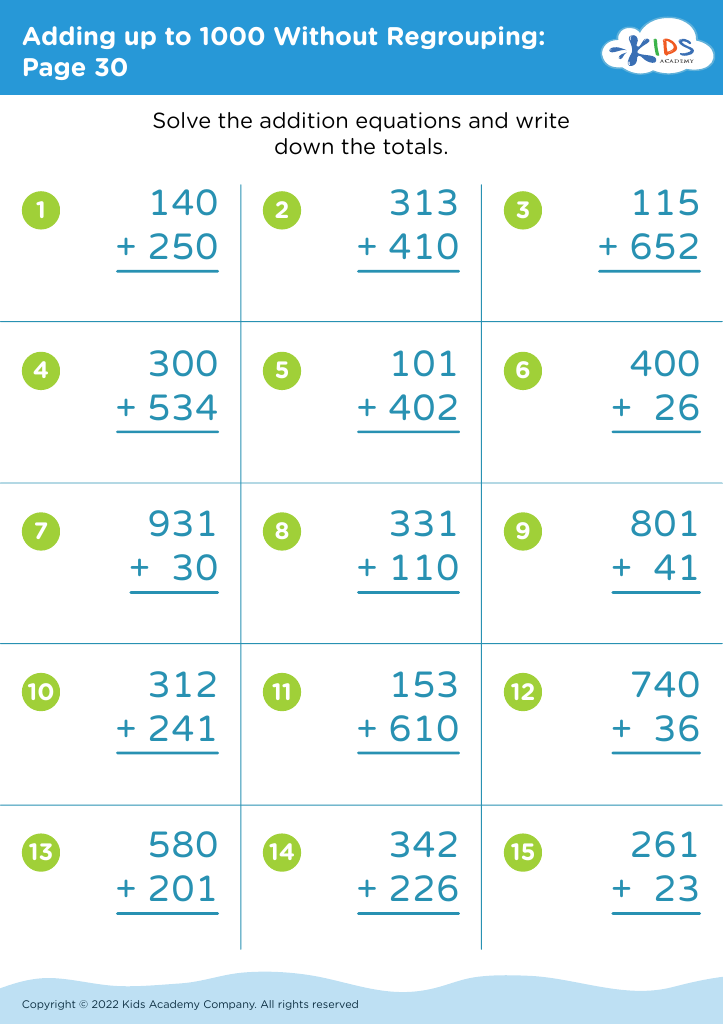
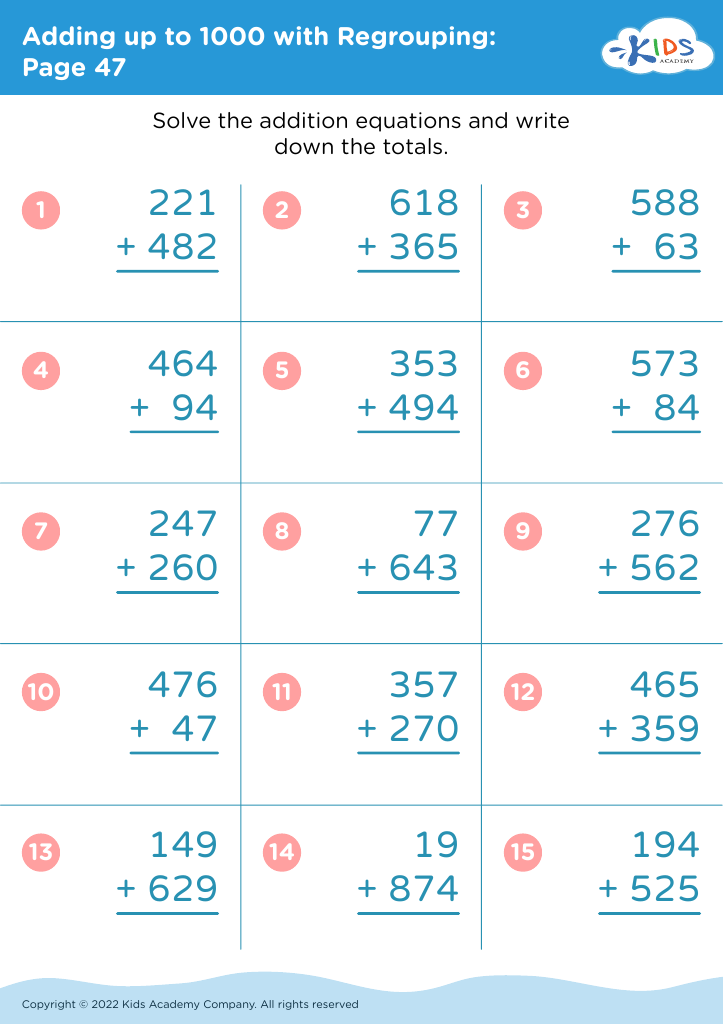



Basic addition skills adding up to 1000 are pivotal for children aged 4-8 because this foundation is essential for their overall mathematical growth. At a young age, children’s brains are highly receptive to new information. Establishing strong arithmetic skills during this period ensures that more complex concepts in higher grades, such as multiplication, division, and problem-solving, will be more digestible.
Firstly, proficiency in basic addition fosters confidence in young learners, providing them the courage to tackle more challenging tasks. Secondly, addition skills help develop logical thinking and problem-solving abilities. Counting and calculating promote an understanding of patterns, sequence, and numerical relationships, all fundamental for everyday decision-making.
Moreover, basic arithmetic is a gateway to real-world applications. Grocery shopping, cooking, and time management increasingly require proficiency in addition. Children able to handle numbers comfortably will naturally find everyday activities more manageable and less intimidating.
Furthermore, early engagement with addition allows educators and parents to identify potential learning difficulties sooner. Timely support can significantly improve a child’s academic trajectory.
In essence, honing basic addition skills adding up to 1000 during early childhood equips kids with essential tools for their future academic endeavors and practical life, ensuring they thrive both in and out of the classroom.








