Practice subtraction Adding up to 1000 Worksheets for Ages 4-8
3 filtered results
-
From - To
Discover engaging "Practice Subtraction Adding up to 1000" worksheets tailored specifically for ages 4-8. Our expertly designed worksheets from Kids Academy blend fun and education, helping young learners master subtraction skills confidently. Ideal for home or classroom use, these exercises promote critical thinking and problem-solving abilities through beautifully illustrated, interactive content. Watch as your child develops fluency in subtracting large numbers, paving the way for advanced math concepts. Download now and give your young mathematicians the tools they need to excel. Prepare them for a bright mathematical future with Kids Academy's trusted resources.
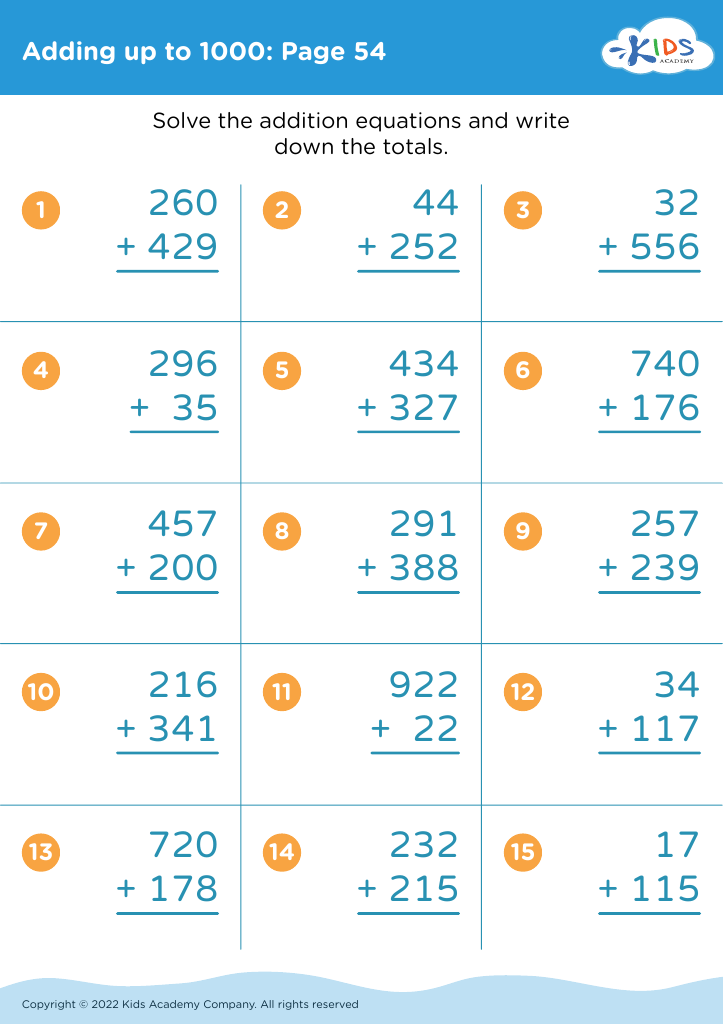
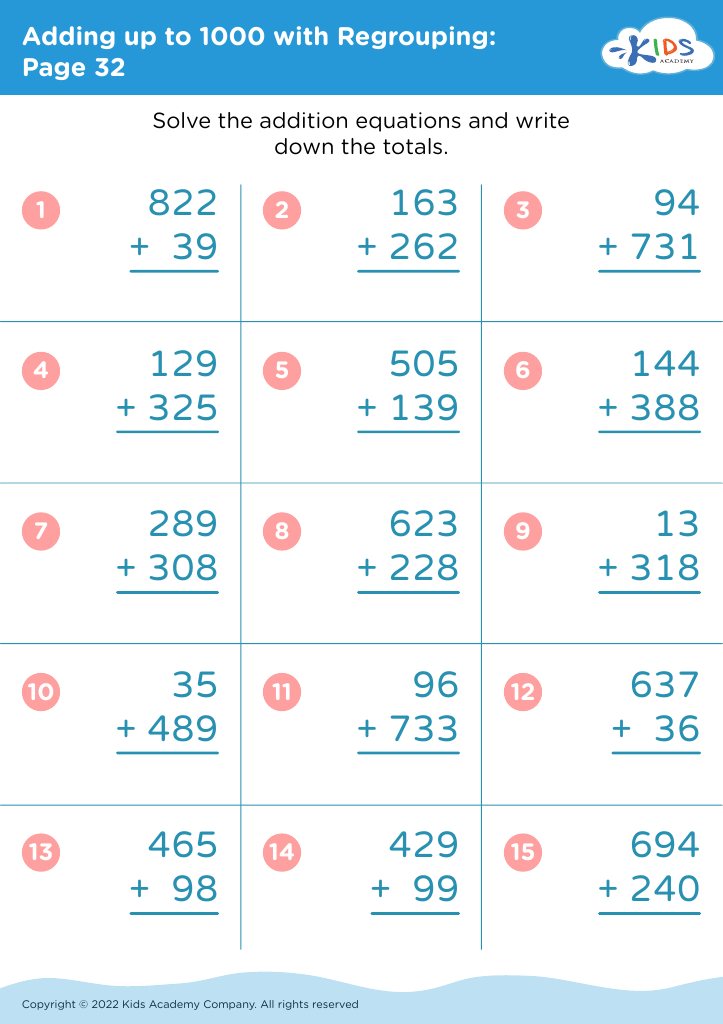
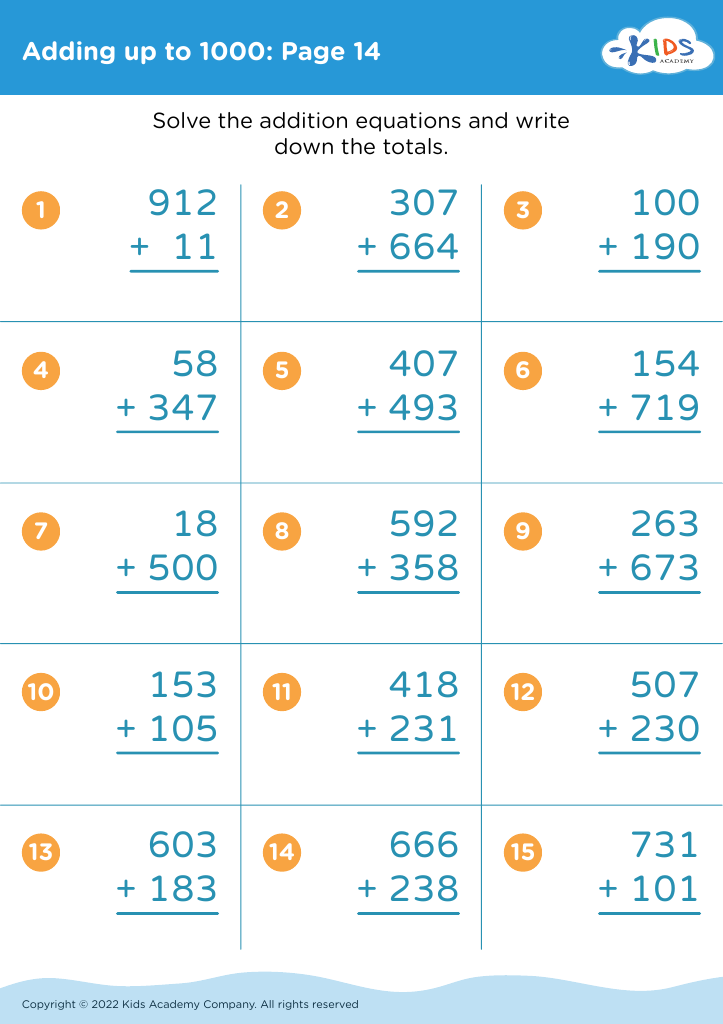



Parents and teachers should emphasize practicing subtraction up to 1000 for children ages 4-8 because it equips them with essential mathematical skills needed for future academic success and daily life problem-solving. Early development of subtraction fluency boosts a child’s confidence and promotes a deeper understanding of mathematical concepts. Mastering these foundational skills at a young age can lead to better performance in more advanced math topics, which are critical for academics and many career paths.
Subtraction practice enhances cognitive skills such as critical thinking, pattern recognition, and logical reasoning. It nurtures a child’s ability to analyze and approach problems systematically. Additionally, mastering subtraction and addition by age 8 sets the stage for understanding more complex arithmetic operations, such as multiplication, division, and fractions.
Engaging with numbers in a hands-on way also fosters a child’s intuitive grasp of quantities, helping them make sense of the world around them. Subtraction is a practical skill used in everyday activities like making purchases, cooking, and time management. Therefore, early practice encourages a child's confidence and independence in handling real-world situations that involve mathematical reasoning. Ultimately, fostering strong math skills from a young age significantly contributes to a child's overall cognitive development and lifelong learning abilities.








