Understanding quantity Adding up to 1000 Worksheets for Ages 4-8
3 filtered results
-
From - To
Unlock your child's numerical potential with our "Understanding Quantity: Adding up to 1000 Worksheets for Ages 4-8." These engaging and educational resources are designed to develop young learners' understanding of numbers and quantities in a fun and interactive way. With activities that guide children through addition up to 1000, these worksheets fit perfectly into home learning or classroom settings. Enhance your child's skills in foundational math while fostering a love for learning. Each worksheet is crafted to complement structured learning and help kids confidently progress on their mathematical journey. Discover the perfect blend of challenge and fun today!
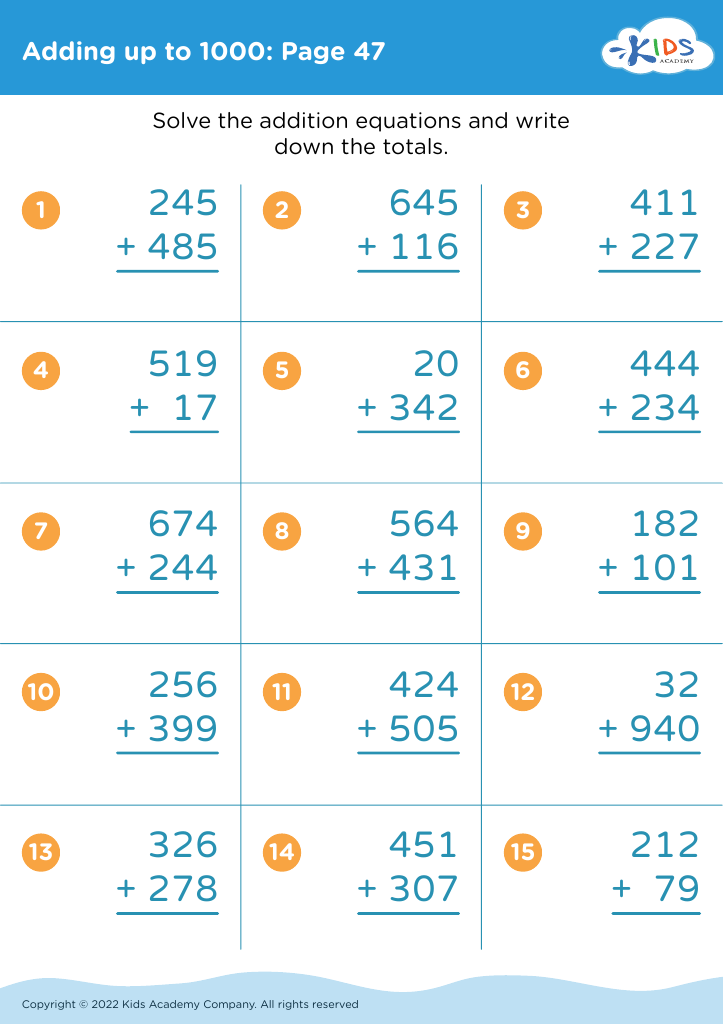
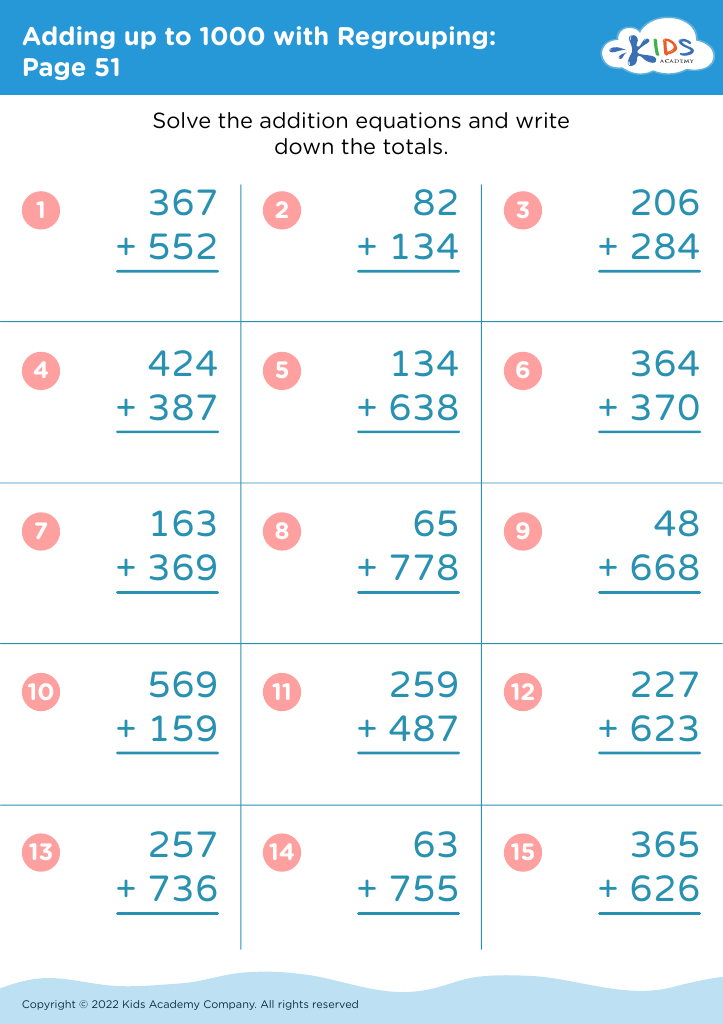
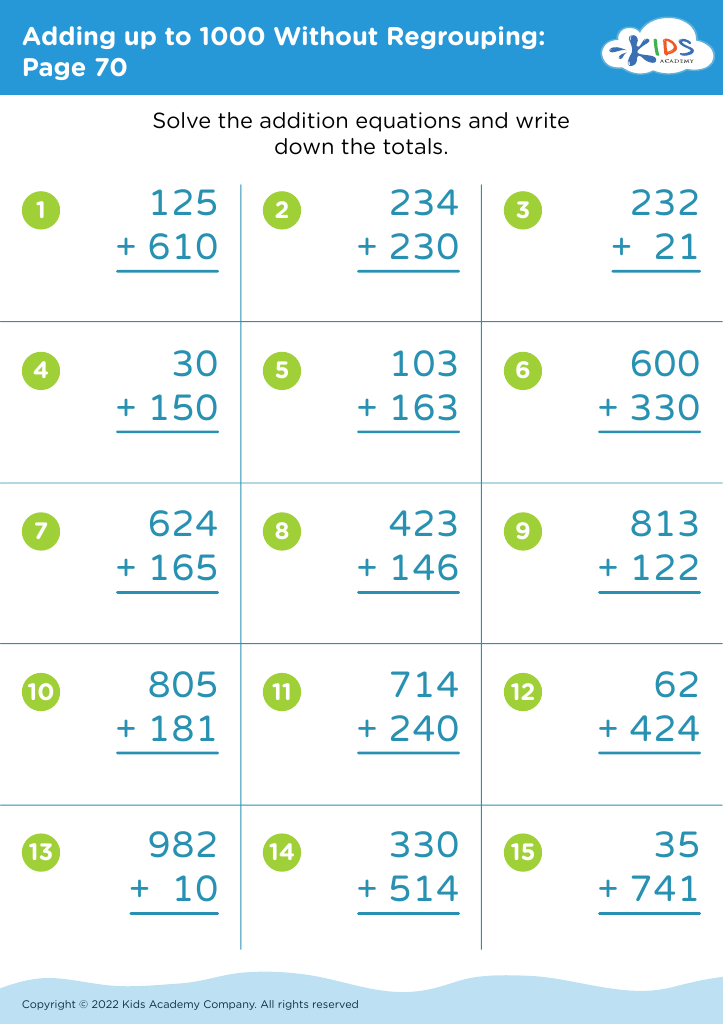



Understanding quantities adding up to 1000 is an essential building block for young children, particularly those aged 4-8, as it forms the basis for more advanced mathematical concepts crucial in their academic journey. At this age, children develop cognitive abilities rapidly; therefore, introducing them to the concept of adding various quantities up to 1000 enhances their number sense and offers practical life skills.
For parents and teachers, nurturing this understanding builds a child's confidence in dealing with larger numbers, fostering a positive attitude toward math. Early exposure to addition up to 1000 also aids in the development of problem-solving skills and logical thinking, both of which are important across all areas of learning and day-to-day activities.
Moreover, grasping these mathematical concepts from a young age lays a strong foundation for future studies, including topics in arithmetic, algebra, and beyond. Children who catch on early are more likely to excel and find joy in math, which is critical for their success since many aspects of education—and many careers—involve numerical understanding.
Supporting children's ability to manage and understand large quantities also democratizes learning; children are uniformly equipped to tackle challenges in the same way, ensuring no child is left behind due to foundational gaps in their early education. Thus, caring parents and teachers significantly impact a child's educational trajectory and broader opportunities in life by focusing on these skills.








