Simplifying Fractions Adding up to 50 with Regrouping Worksheets for Ages 4-8
4 filtered results
-
From - To
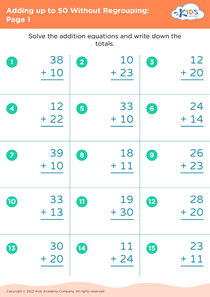
Welcome to our "Simplifying Fractions Adding up to 50 with Regrouping Worksheets" designed for children aged 4-8! Our engaging worksheets help young learners master the concept of simplifying fractions while exploring the colorful world of numbers. With a focus on regrouping, these resources make math accessible and enjoyable. Each worksheet encourages critical thinking and problem-solving, setting the foundation for future math skills. Interactive and visually appealing, our worksheets are suitable for both classroom and home learning. Join us on this mathematical adventure, where simplifying fractions becomes an exciting challenge for your child while boosting their confidence in math!
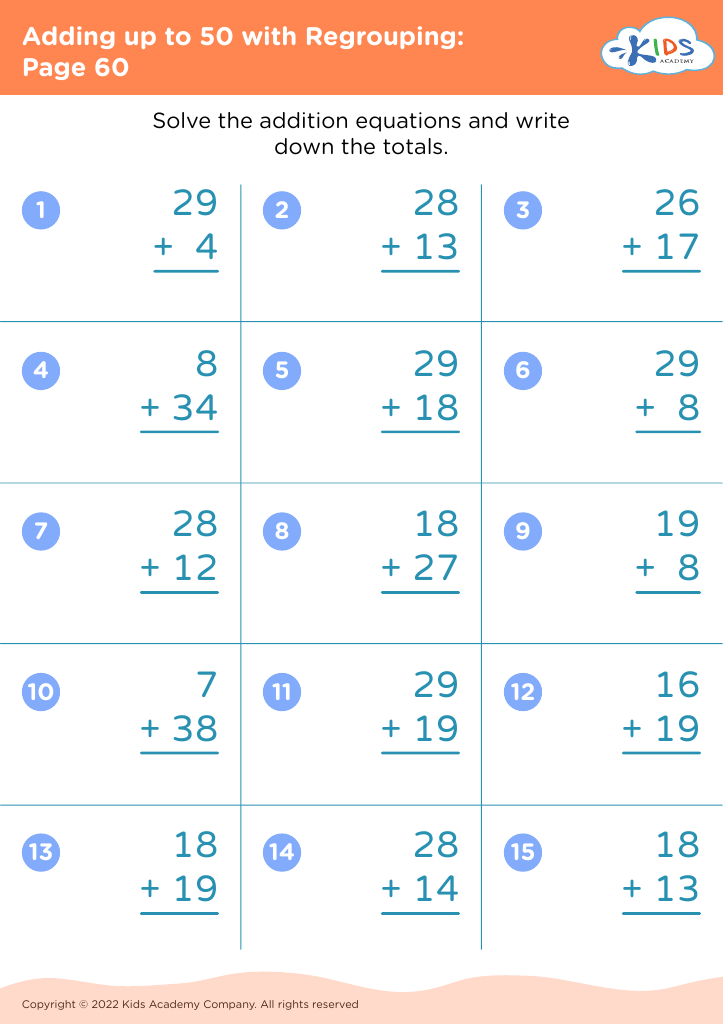
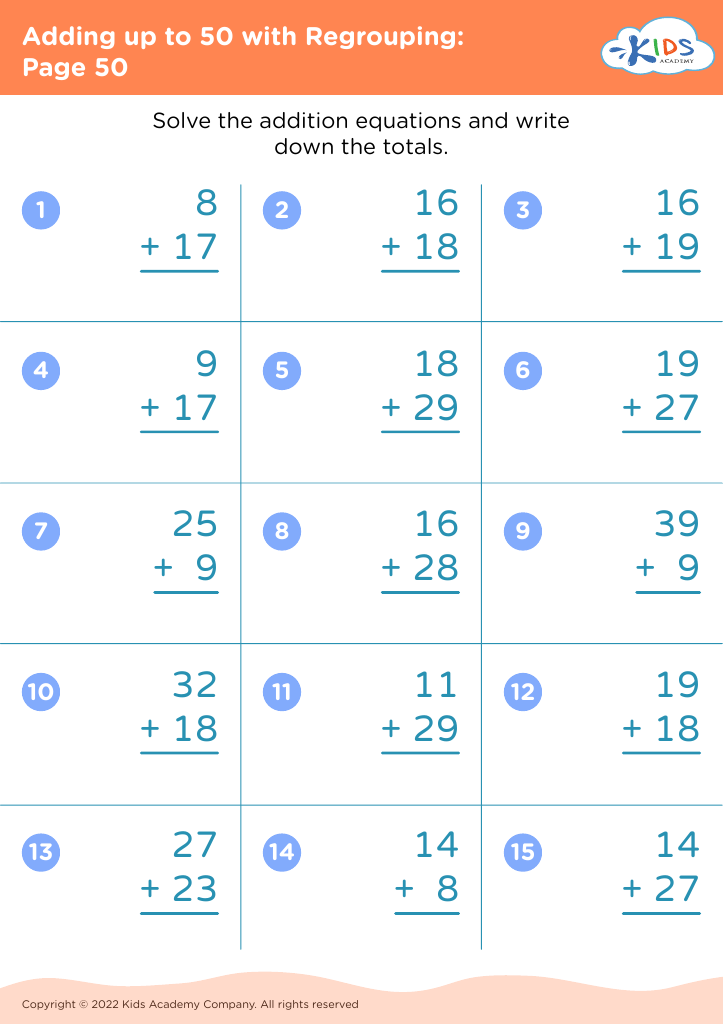
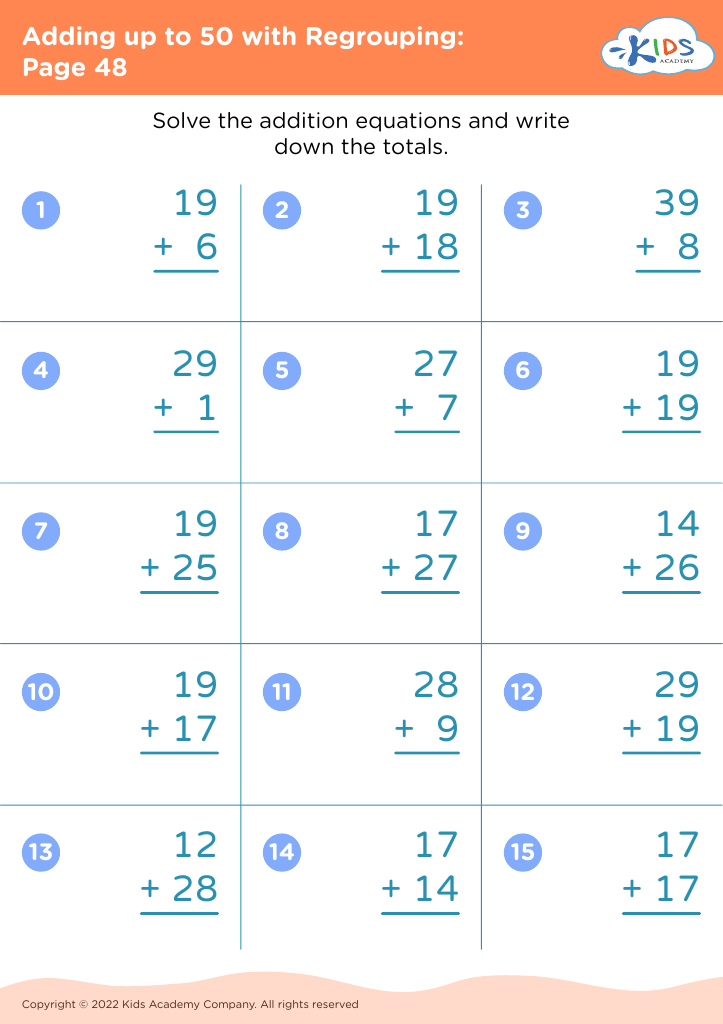
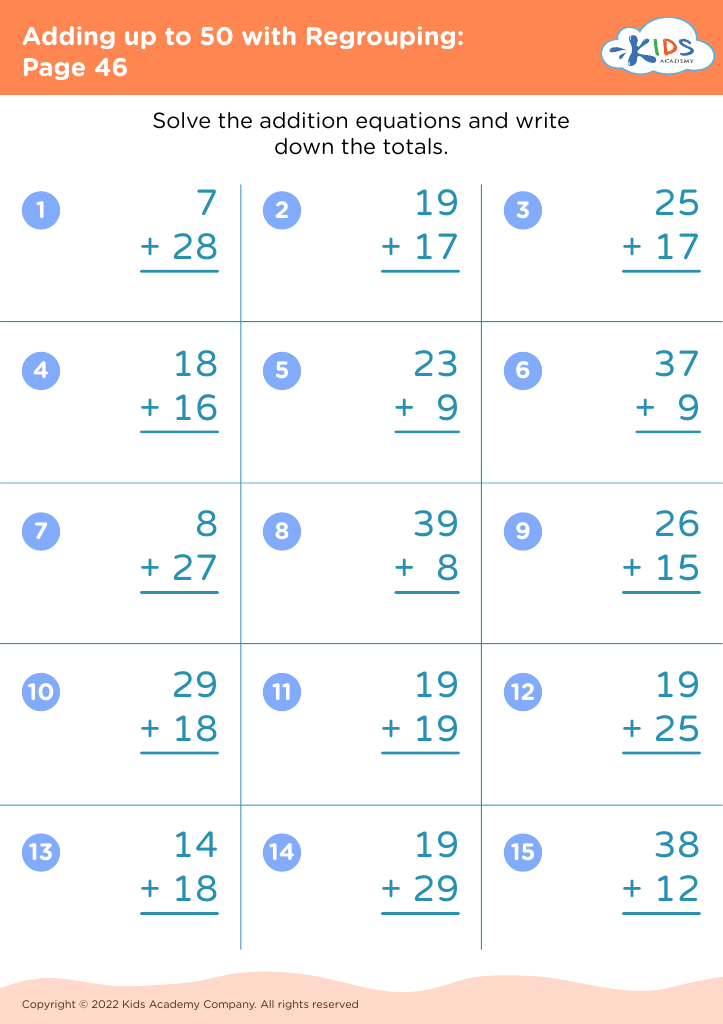


Simplifying fractions and mastering addition concepts, like those adding up to 50 with regrouping, are crucial mathematical skills for young learners aged 4-8. Parents and teachers should care about these foundational skills because they serve as building blocks for more complex mathematical understanding. At this age, children are developing their number sense and their ability to approach problems in a logical way.
Understanding how to simplify fractions helps children grasp that different expressions can represent the same quantity, fostering a sense of equivalence and enhancing problem-solving skills. It encourages critical thinking, as children learn to assess and manipulate numbers in various forms. This type of cognitive engagement boosts their overall mathematical confidence and lays the groundwork for future concepts.
Similarly, mastering addition with regrouping cultivates skills in carrying values, sequencing, and organizing numbers, which are essential for arithmetic fluency. When children learn these strategies early, it promotes persistence and adaptability in their approach to challenging problems. Additionally, engagement in this stage signals to parents and teachers the importance of nurturing a positive learning environment, where children feel empowered to explore and excel in mathematics. Overall, investing time in these skills not only builds competence but also inspires a lifelong love for learning.