Basic addition practice Adding up to 50 Without Regrouping Worksheets for Ages 4-8
3 filtered results
-
From - To
Boost your child’s math skills with our engaging "Basic Addition Practice: Adding Up to 50 Without Regrouping Worksheets" designed for ages 4-8. These worksheets provide a fun and effective way for young learners to master basic addition concepts while enhancing their problem-solving abilities. Each worksheet focuses on addition problems that stay within the limit of 50, ensuring students build confidence and accuracy without the complexity of regrouping. Perfect for home practice or classroom use, these resources are tailored to spark interest and reinforce foundational arithmetic skills. Explore our collection now and watch your child's mathematical confidence grow!
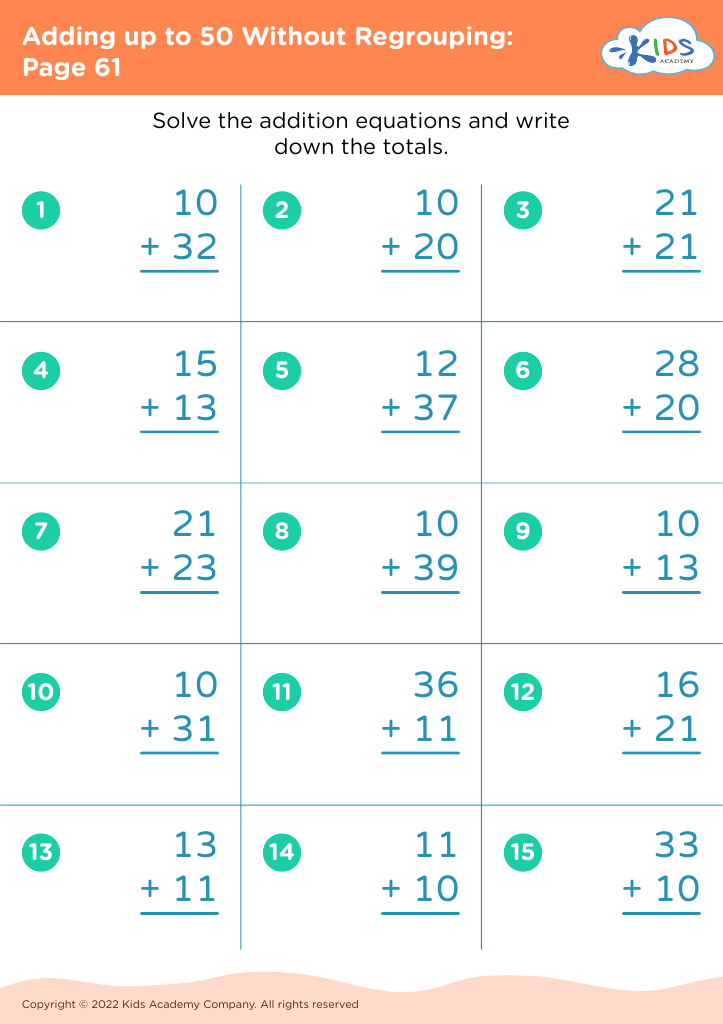
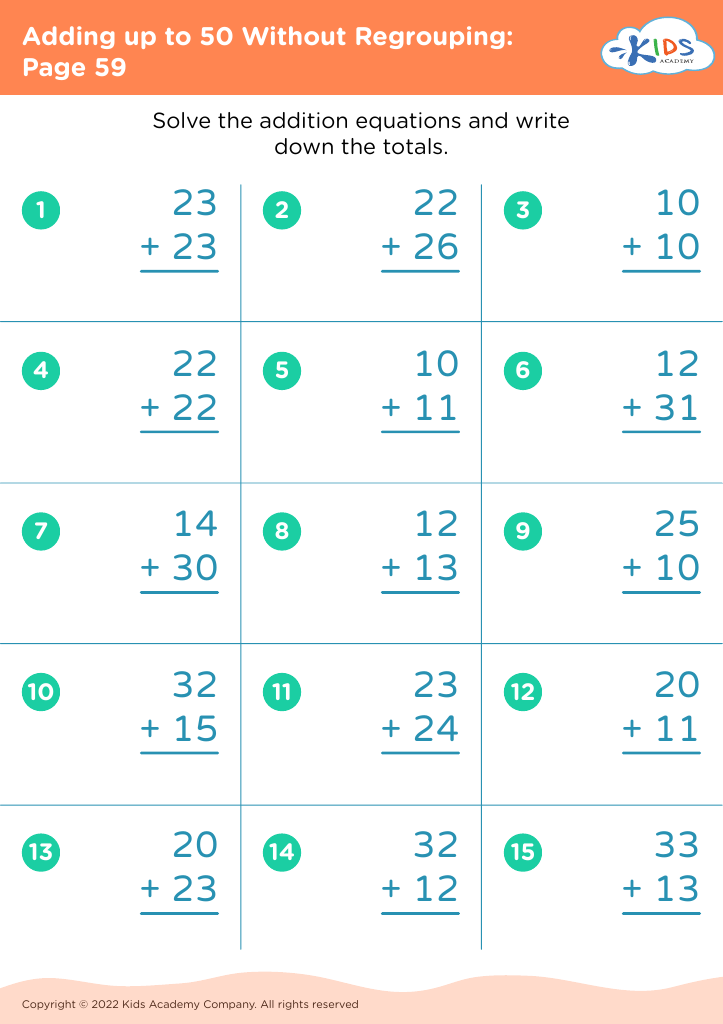
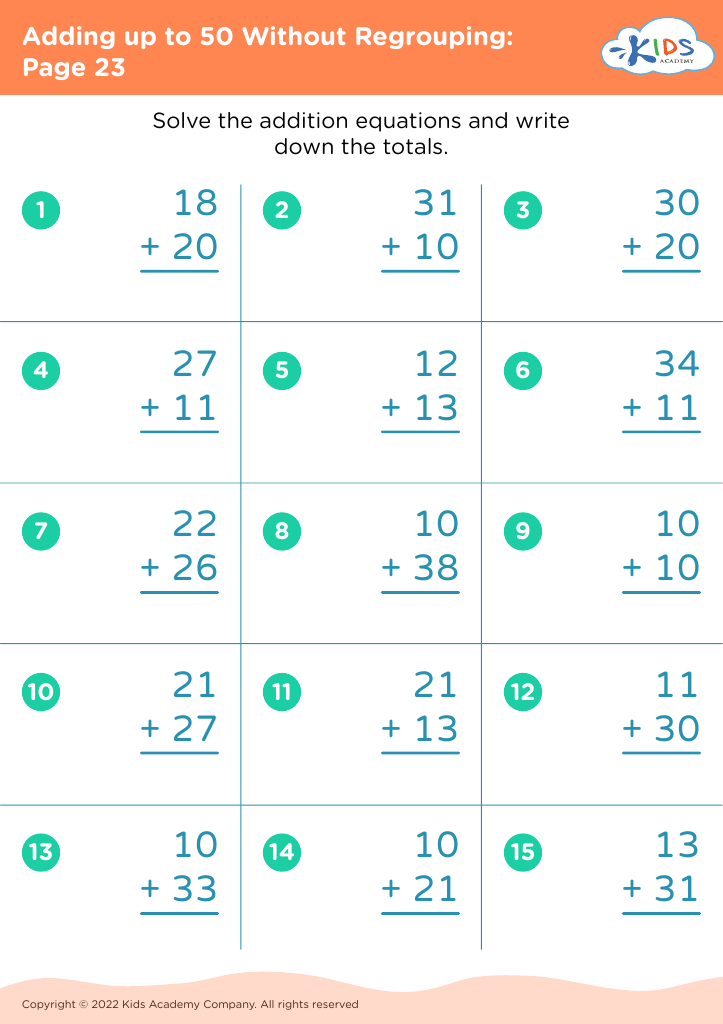


Basic addition practice, specifically adding up to 50 without regrouping, is vital for children aged 4-8 for several reasons. First and foremost, mastering these foundational math skills builds confidence. When children can confidently add small numbers, they develop a positive attitude toward math, which sets the tone for future learning.
Additionally, basic addition helps improve critical thinking and problem-solving skills. It lays the groundwork for more complex mathematical concepts they will encounter later on, such as subtraction, multiplication, and division. Early competence in addition can reduce math anxiety and improve overall academic performance across the board.
Furthermore, routine practice of basic addition enhances cognitive development. It encourages children to improve their focus, memory, and visual-spatial skills, all important components for learning. From a social-emotional perspective, working on math can foster achievements and teamwork when done in collaborative settings with peers or parents.
Finally, in a world influenced heavily by data and numbers, being numerically literate is essential for daily life tasks like budgeting and time management. Therefore, the emphasis on basic addition up to 50 without regrouping is not just about numbers; it’s about fostering a well-rounded education and preparing children for future success.