Pattern identification Addition Worksheets for Ages 4-8
3 filtered results
-
From - To
Discover our engaging Pattern Identification Addition Worksheets designed specifically for children aged 4-8. These worksheets provide a fun and interactive way for young learners to master addition while identifying and recognizing patterns. With vibrant images and age-appropriate activities, students will enhance their mathematical skills and critical thinking abilities. Our resource encourages creativity and promotes a deeper understanding of numbers, helping kids connect the dots between addition and patterns. Ideal for home or classroom use, these worksheets make learning enjoyable and effective. Start building a strong mathematical foundation for your child with our Pattern Identification Addition Worksheets today!
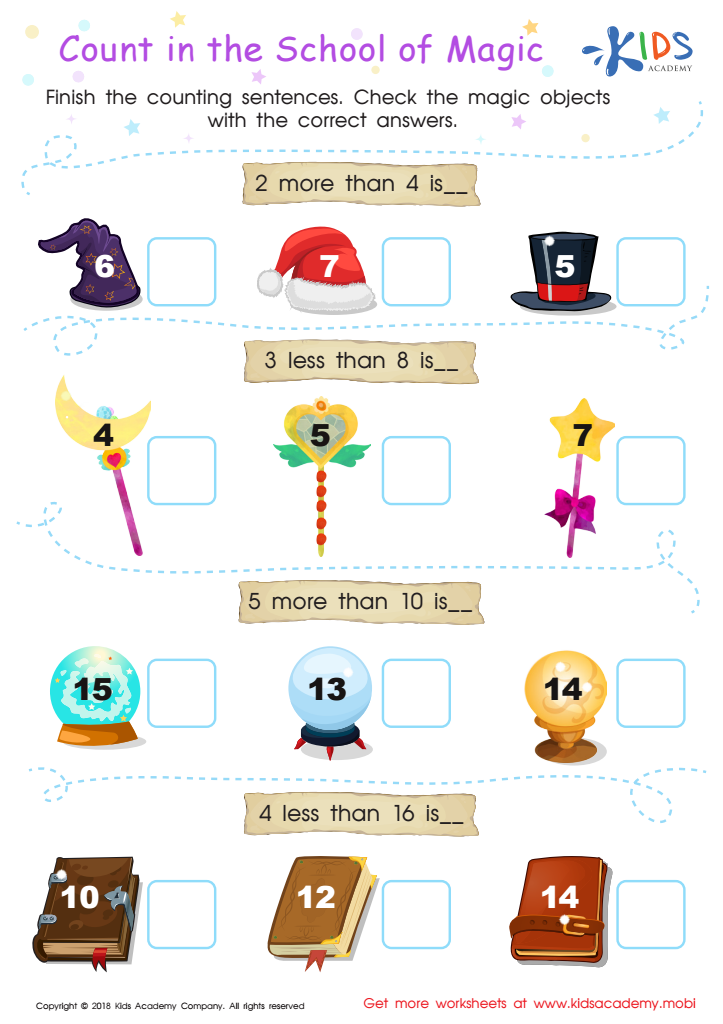
Count in the School of Magic Worksheet
 Assign to My Students








Parents and teachers should care about pattern identification in addition for children ages 4-8 because it lays the groundwork for essential mathematical skills. Recognizing patterns helps children understand relationships between numbers, enhancing their critical thinking and problem-solving abilities. By engaging with patterns, young learners begin to identify sequences, which is crucial for grasping the concept of addition.
Additionally, pattern identification fosters confidence in computational skills. When children can recognize patterns in numerical sequences (such as 2, 4, 6, 8), they can quickly perform addition without rote memorization. This understanding aids in bridging more advanced arithmetic operations in the future.
Moreover, incorporating pattern identification into early education aligns with developmental milestones for this age group. It creates an interactive learning environment that makes math fun and engaging, promoting a positive attitude toward learning. Educators can use games and hands-on activities that involve patterns to reinforce this concept, making lessons memorable.
Ultimately, by focusing on pattern identification in addition, parents and teachers empower children to build a robust mathematics foundation, leading to better academic performance and a more profound appreciation for the subject as they grow.








