
Spatial awareness development Math Worksheets for Ages 4-8
3 filtered results
Difficulty Level
Grade
Age
-
From - To
Subject
Activity
Standards
Enhance your child's spatial awareness with our engaging math worksheets designed for ages 4-8. Our expertly crafted activities help young learners develop crucial skills such as recognizing patterns, understanding shapes, and visualizing spatial relationships. Perfect for both classroom use and at-home practice, these worksheets are a fun and effective way to build strong foundational math skills. Boost your child's confidence and proficiency through stimulating exercises that make learning enjoyable. Dive into a world of captivating puzzles and exciting tasks that foster a love for math and spatial thinking. Start now and watch your child's spatial competence soar!
Favorites
With answer key
Interactive
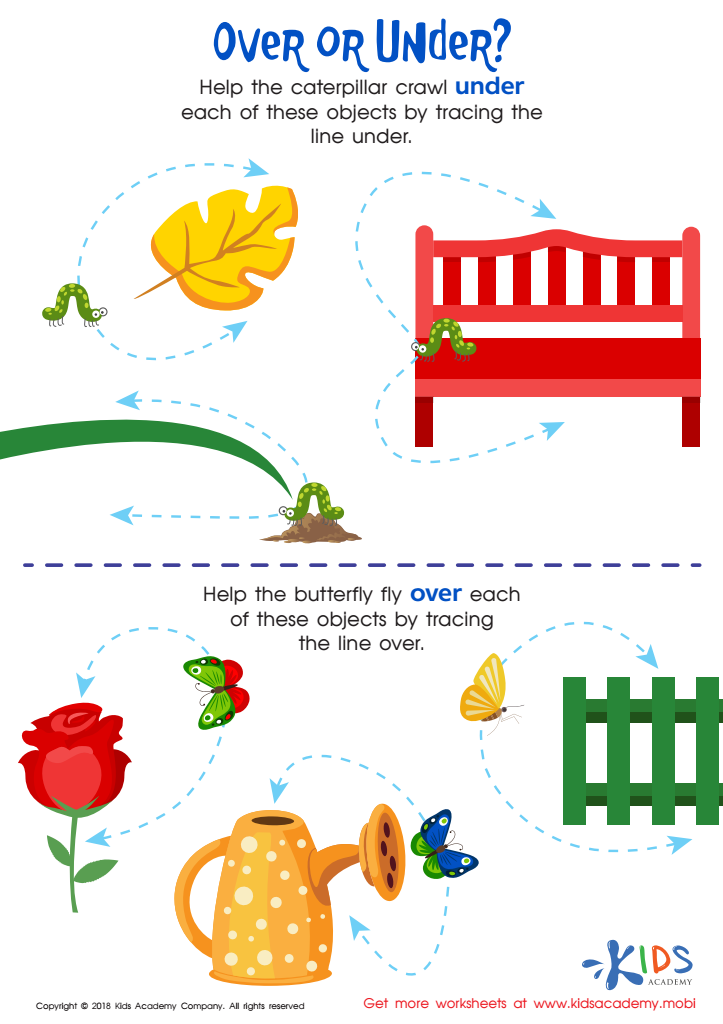
Over or Under? Worksheet
Math for young kids isn't just about numbers and counting, but also spatial concepts like geometry. This worksheet helps students learn "over" and "under" by tracing the movement of caterpillars and butterflies. Downloadable for free, it's an effective teaching tool for early learners.
 Assign to My Students
Over or Under? Worksheet
Worksheet
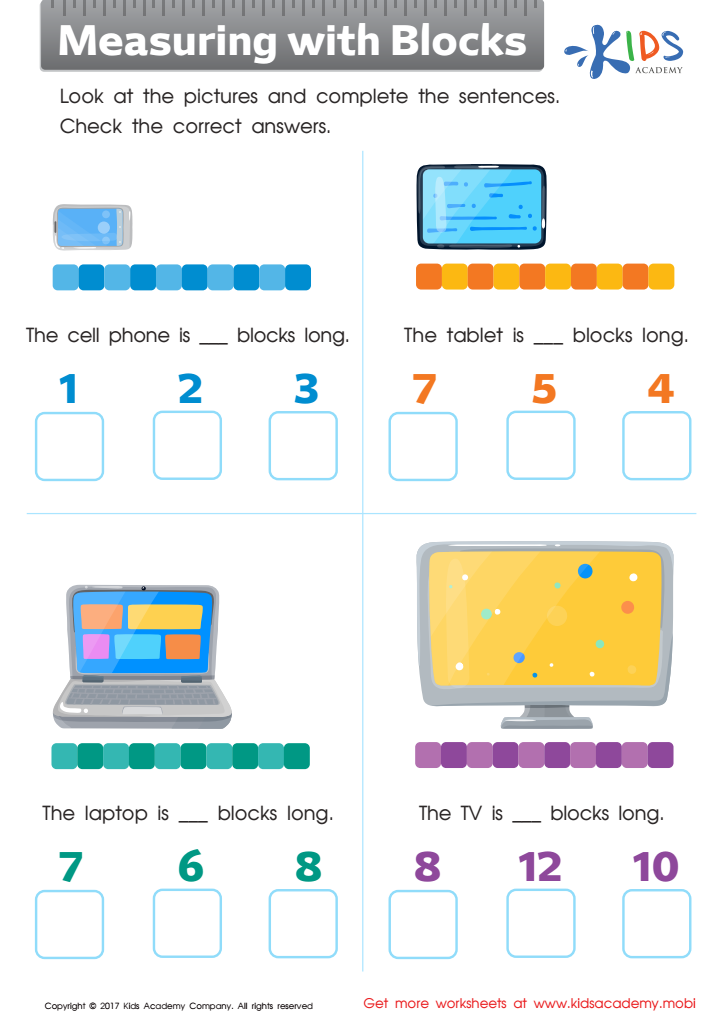
Measuring with Blocks Worksheet
Help your child get ready for math success with this Kids Academy worksheet. It provides colorful blocks to practice measuring objects. Coach them to count the boxes under each picture, then check the box with the right answer. It's a fun way to get acquainted with rulers!
Measuring with Blocks Worksheet
Worksheet
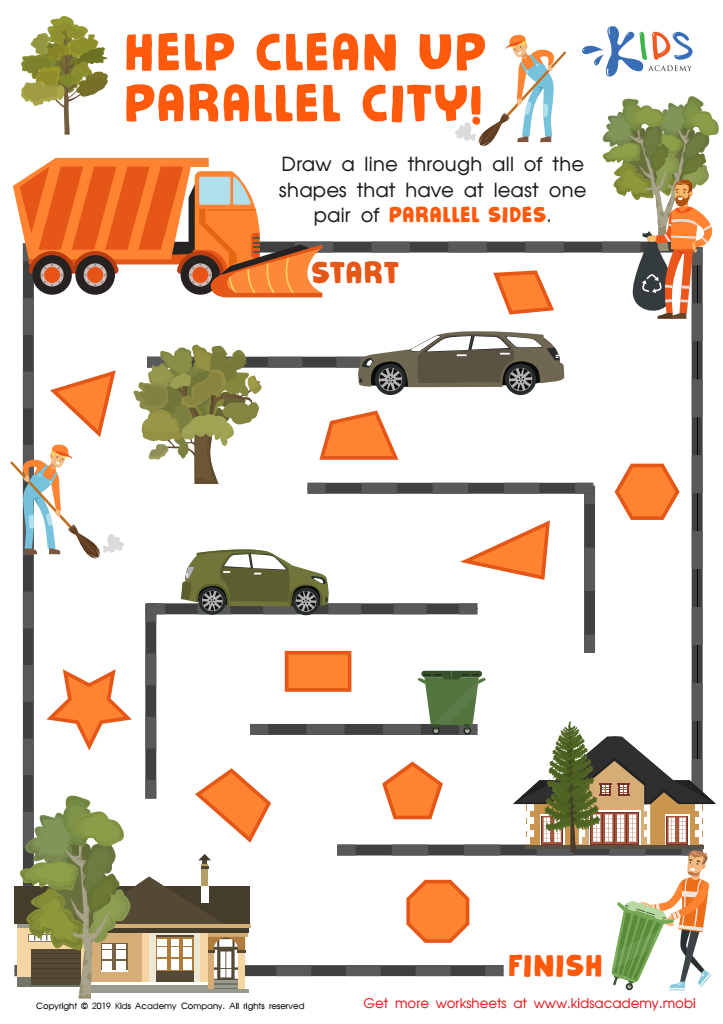
Help Clean Up Parallel City Worksheet
Explain to your kids what parallel sides are and have them identify the shapes with parallel sides in the picture. Then let them draw a line through all the shapes with at least one pair of parallel sides. This colorful worksheet will help them understand and practice this concept.
Help Clean Up Parallel City Worksheet
Worksheet
Join Kids Academy for Free
Who is primarily going to use this learning content?






Spatial awareness is a critical component of early childhood development and forms the foundation for later success in mathematics and various life skills. When children aged 4-8 develop spatial awareness, they engage in understanding how objects and shapes relate to each other in space. This skill is important for recognizing patterns, envisioning movement, and comprehending geometric concepts.
For parents and teachers, fostering spatial awareness at this stage translates to enhanced mathematical abilities. Children with strong spatial skills can better understand number sequences, relationships between figures, and even foundational algebraic ideas. Activities such as building blocks, puzzles, drawing, and exploring tangrams encourage spatial reasoning, preparing children for more advanced math topics including geometry and estimation.
Additionally, spatial awareness contributes to everyday cognitive abilities and problem-solving skills. For instance, children become adept at navigating their environment, recognizing patterns, and organizing information visually. This can lead to better performance in both academic and non-academic settings.
Moreover, spatial skills are strongly linked to STEM (Science, Technology, Engineering, and Mathematics) fields. Early proficiency in such abilities sets the groundwork for future success in these areas. Therefore, prioritizing spatial awareness development helps in fostering a well-rounded, confident, and capable young learner.








