
Chess piece identification Worksheets for Ages 4-9
3 filtered results
Difficulty Level
Grade
Age
-
From - To
Subject
Activity
Standards
Discover our engaging Chess Piece Identification Worksheets designed for children ages 4-9! These worksheets blend fun and education by introducing young minds to the fascinating world of chess. Kids will learn to identify various chess pieces, including kings, queens, knights, and more, all while enhancing their cognitive and problem-solving skills. Our colorful and interactive printables help transform this classic game into a playful learning experience. Perfect for home or classroom use, each sheet captures the essence of chess in an accessible manner for young learners. Inspire a love for strategy and critical thinking with these delightful resources!
Favorites
With answer key
Interactive
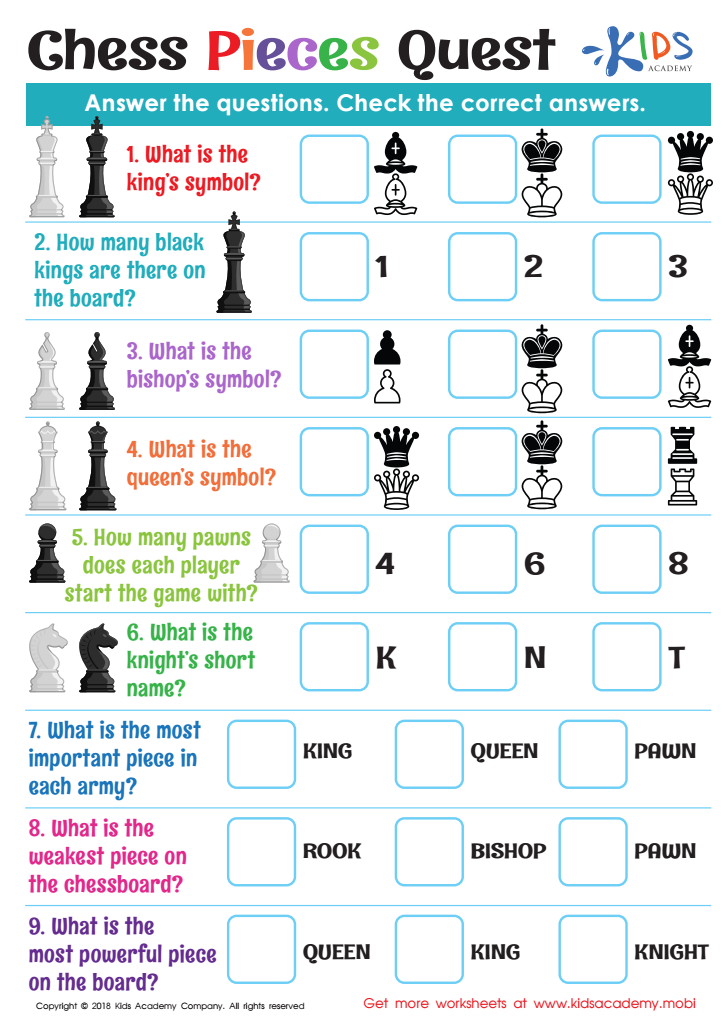
Chess Pieces Quest Worksheet
Help your child prepare for the chess quest by refreshing their knowledge of the symbols and characteristics of each chess piece. Then, have them try the 9 questions on this worksheet. These questions will assess their understanding of the symbols and how many pieces each player starts with.
 Assign to My Students
Chess Pieces Quest Worksheet
Worksheet
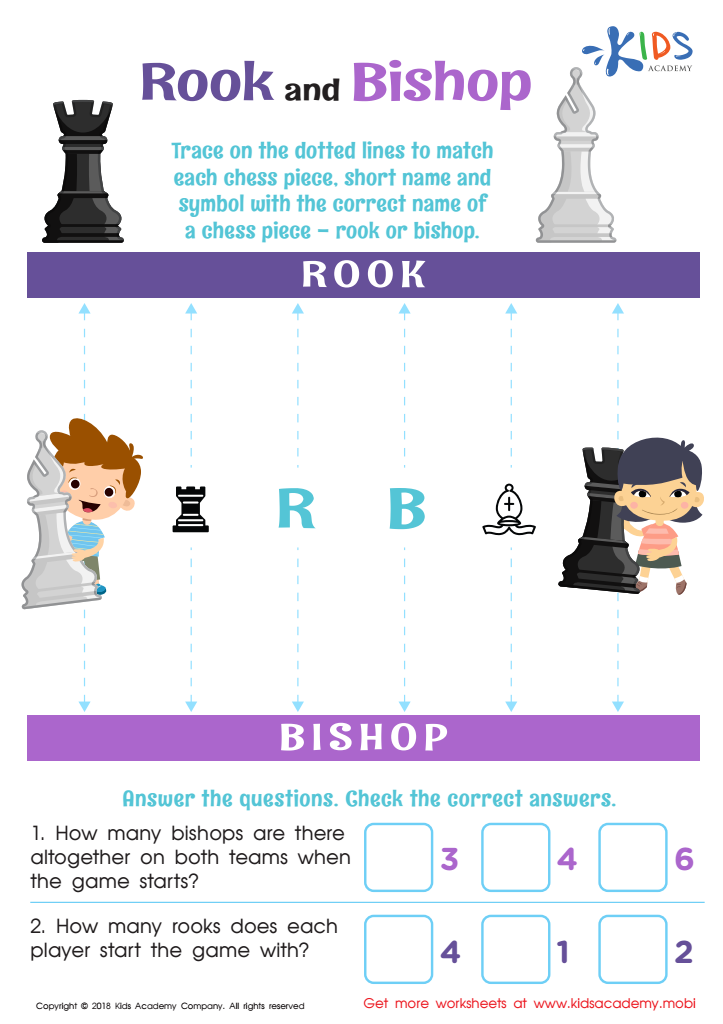
Rook and Bishop Worksheet
This tracing sheet helps your child learn chess pieces by matching each piece, short name and symbol to the correct name. After tracing, have them answer the questions and check their answers. It's a great way for them to become familiarized with chess.
Rook and Bishop Worksheet
Worksheet
Join Kids Academy for Free
Who is primarily going to use this learning content?






Chess piece identification is an essential skill for young children as it offers numerous educational benefits and fosters cognitive development. Parents and teachers should care about it for several reasons. First, identifying chess pieces can significantly enhance a child's visual memory and attention to detail. Recognizing different shapes and symbols helps improve their memory retention and concentration skills.
Second, learning the roles and movements of each piece develops critical thinking and strategic planning abilities. Children as young as four can begin to grasp problem-solving skills and forward-thinking as they learn how each piece interacts on the board.
Furthermore, understanding chess pieces can boost a child's mathematical skills by teaching them about spatial relationships, patterns, and even basic counting and elementary math principles. Cognitive exercises such as these lay the groundwork for more complex mathematical concepts.
Additionally, the social benefits cannot be understated. Chess often involves interaction, patience, and communication with an opponent, skills that are valuable for emotional intelligence and social development.
Finally, recognizing chess pieces provides a fun and educational pastime that can help divert children from excessive screen time. Encouraging early chess interest fosters a love for intellectually stimulating activities, which can have long-term positive effects on their overall academic performance and mental growth.








