
Understanding punctuation Worksheets for Ages 4-9
5 filtered results
Difficulty Level
Grade
Age
-
From - To
Subject
Activity
Standards
Unlock the world of punctuation with our engaging worksheets designed for ages 4-9! These resources provide a fun and interactive way for young learners to master essential punctuation marks such as periods, commas, and question marks. Our carefully crafted activities help children recognize punctuation in sentences, understand its importance, and apply it correctly in their writing. With colorful illustrations and age-appropriate tasks, students will build confidence and improve their language skills. Perfect for home or classroom use, these worksheets ensure a comprehensive understanding of punctuation while making learning enjoyable! Start your child’s punctuation journey today and watch their skills flourish!
Favorites
With answer key
Interactive
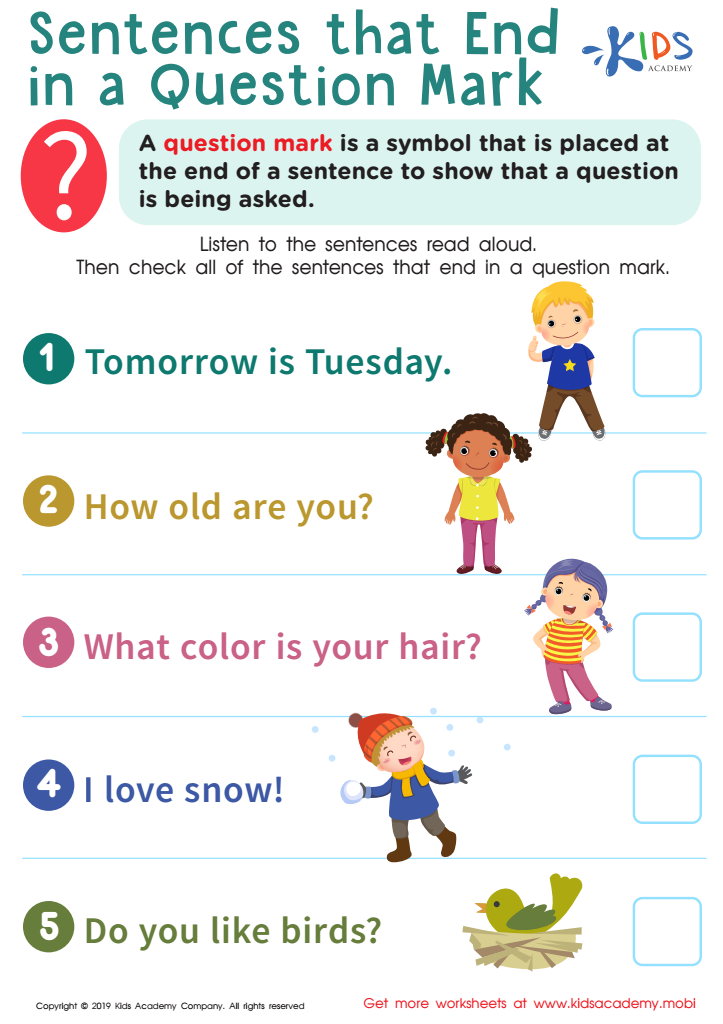
Sentences That End in an Question Mark Worksheet
Teach your students about the four most common punctuation marks - period, comma, question mark, and exclamation mark - with this worksheet. Show them how to use the question mark to indicate a sentence is a question. Then, have them check all sentences that end in a question mark.
 Assign to My Students
Sentences That End in an Question Mark Worksheet
Worksheet
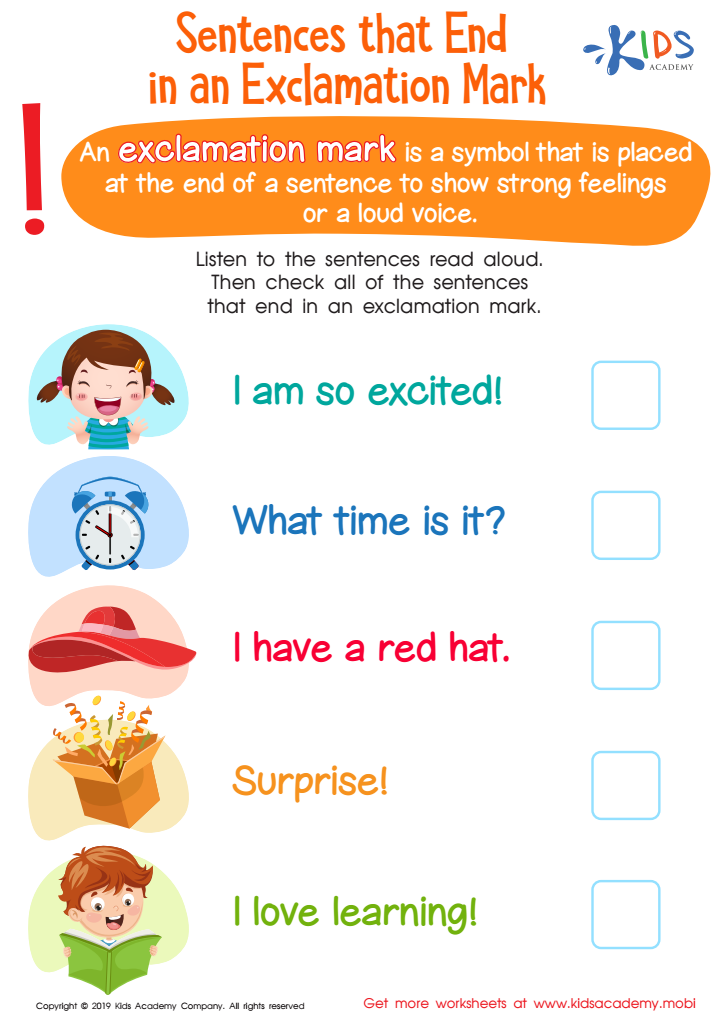
Sentences That End in an Exclamation Mark Worksheet
This worksheet is a great way to brush up kids' punctuation skills. Period, comma, question mark and exclamation mark are the first four punctuation marks they should learn. Exclamation marks show strong emotion or a noise. Use this printout to teach and test kids' understanding of exclamation marks.
Sentences That End in an Exclamation Mark Worksheet
Worksheet
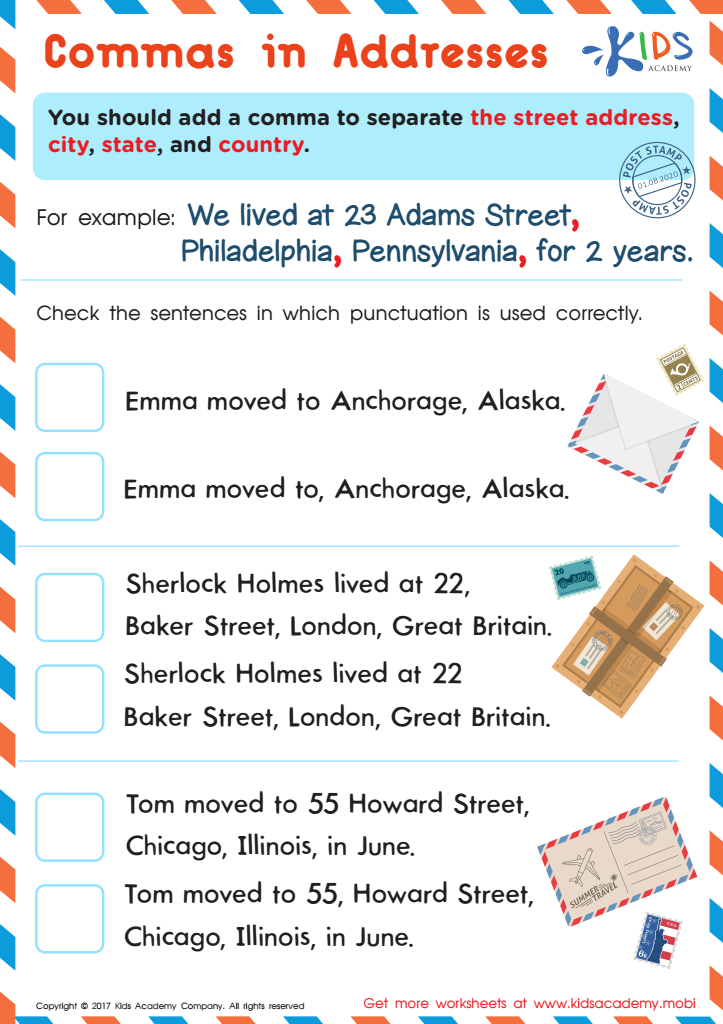
Commas in Addresses Worksheet
Learning comma rules can be tough for kids. Help make it easier with free worksheets, like this fun letter-themed exercise. It'll teach them the rules in isolation and keep them engaged.
Commas in Addresses Worksheet
Worksheet
Join Kids Academy for Free
Who is primarily going to use this learning content?







Understanding punctuation is crucial for children aged 4-9 as it forms the backbone of effective communication and literacy development. At this stage, children are beginning to read and write independently. Familiarity with punctuation marks—like periods, commas, question marks, and exclamation points—helps them discern the meaning of sentences and navigate the structure of written language.
When children grasp how punctuation conveys emotion and pauses in speech, it enhances their reading fluency and comprehension. For instance, an exclamation point can transform a statement into one laden with excitement or urgency, while a question mark differentiates between a statement and an inquiry, influencing how they respond to texts.
From a writing perspective, punctuation aids children in organizing their thoughts. It teaches them how to create clear and structured sentences, making their written communication more effective. This foundational skill fosters their confidence as storytellers and writers.
Moreover, as future digital communicators, awareness of punctuation continues to be essential in emails, social media, and other online formats. Therefore, both parents and teachers should emphasize punctuation, as it equips children with critical literacy skills necessary for their educational journey and beyond.








