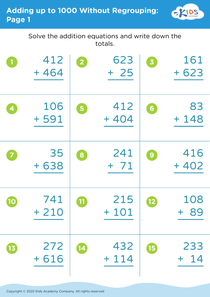
Mathematical reasoning Adding up to 1000 Misc Worksheets for Ages 4-9
5 filtered results
-
From - To
Enhance your child’s mathematical reasoning with our "Adding up to 1000" worksheets, uniquely designed for ages 4-9. These intuitive resources from Kids Academy encourage young learners to master addition fundamentals and develop essential problem-solving skills. Tailored exercises engage children in fun, educational experiences, ensuring they grasp concepts with ease. Our worksheets span diverse scenarios, promoting logical thinking and accuracy as kids work towards adding up to 1000. These printable activities are perfect for reinforcing classroom teaching, providing parents and educators with effective tools for nurturing bright mathematical minds. Unlock your child's potential with our comprehensive, age-appropriate math worksheets.
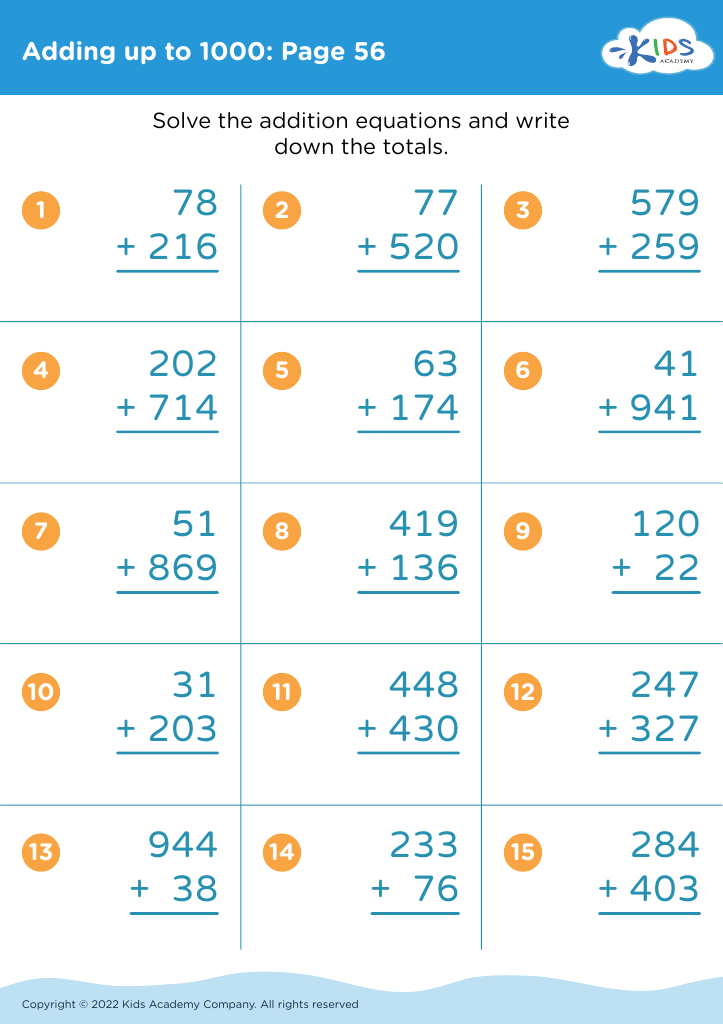
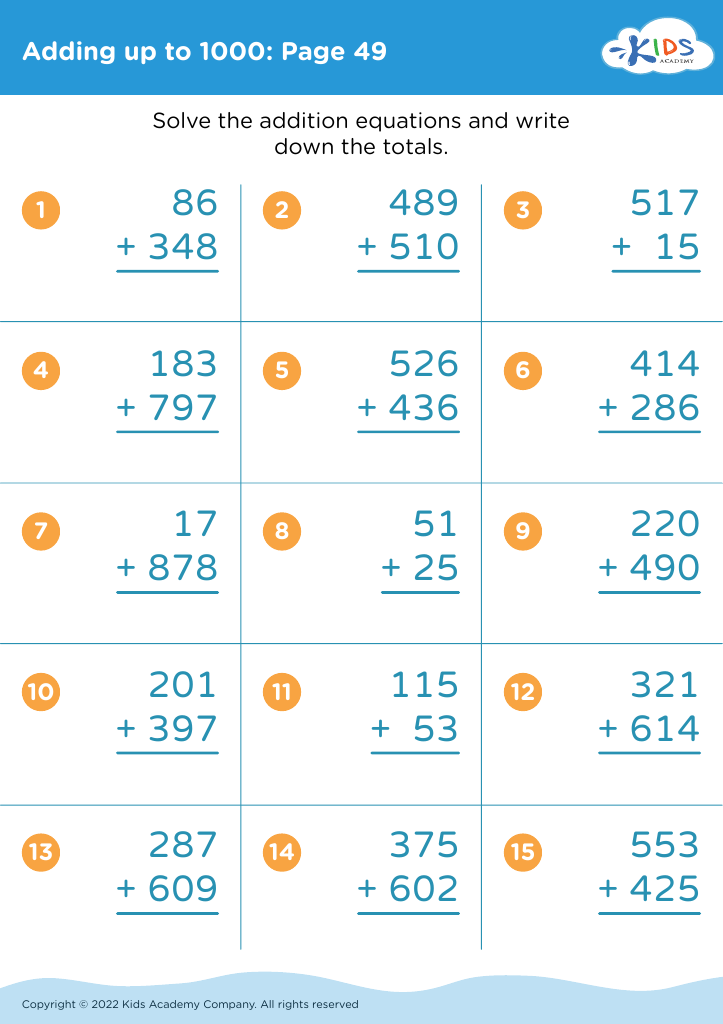
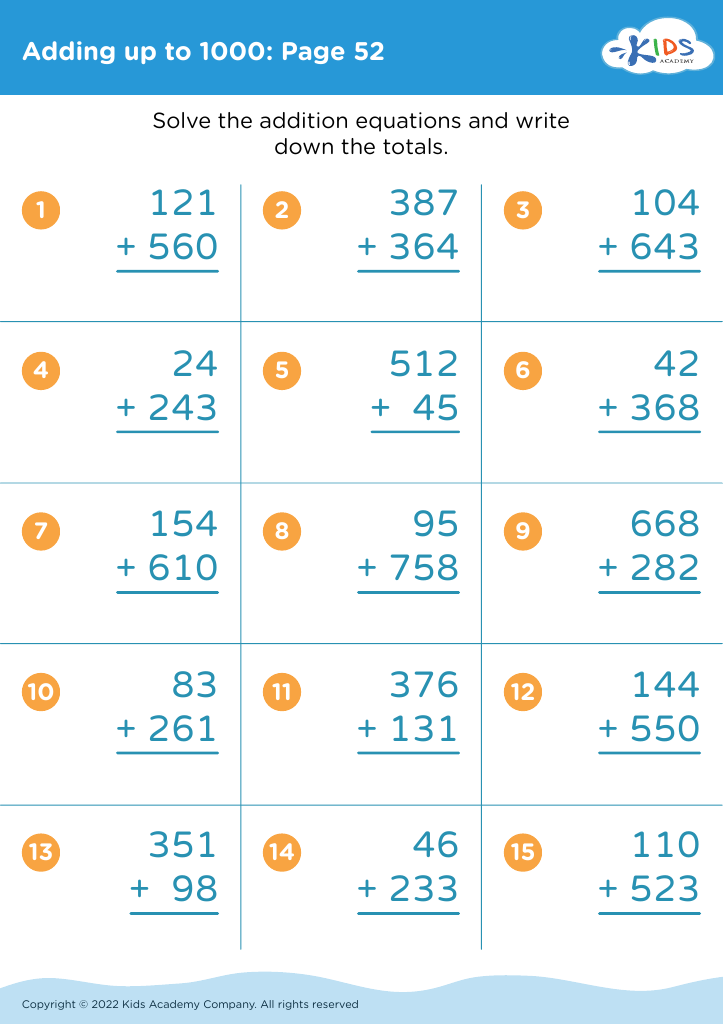
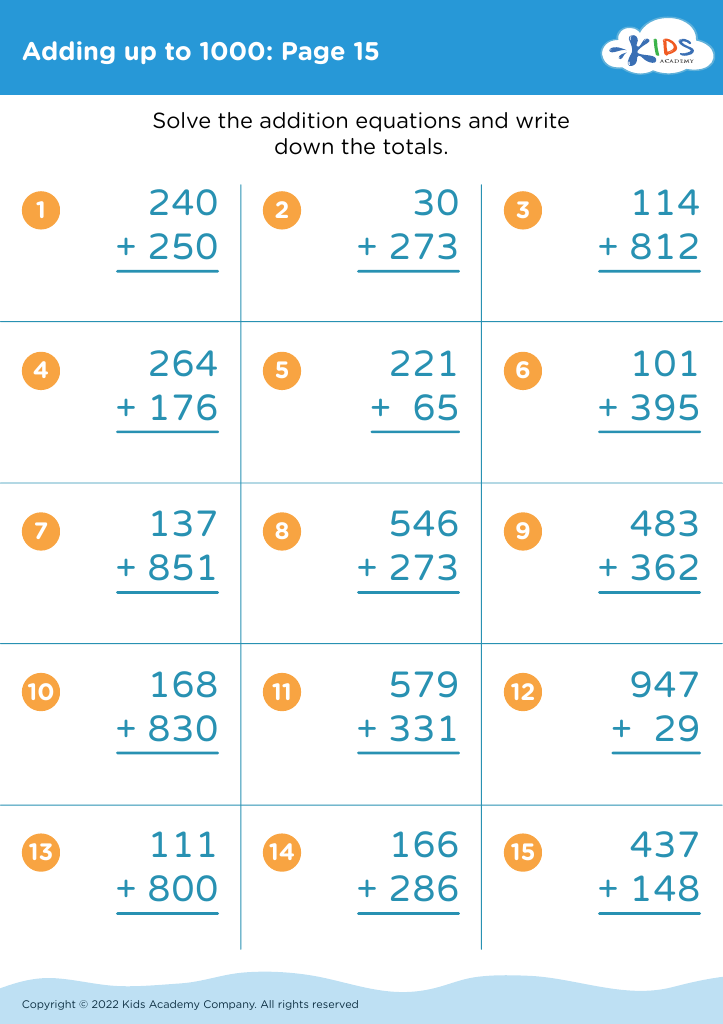
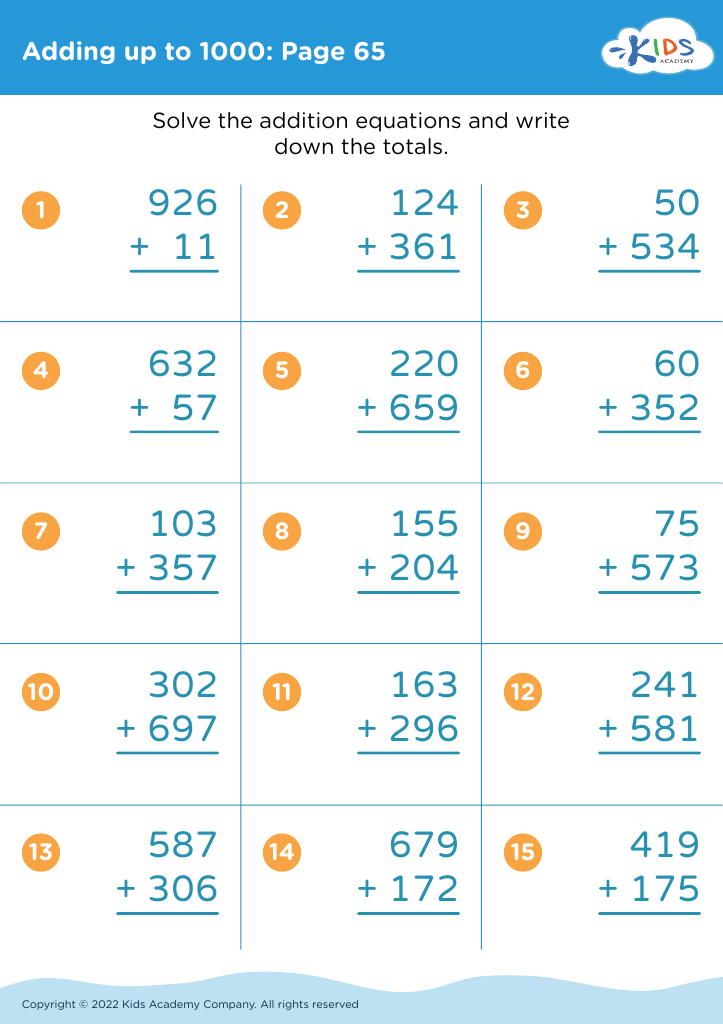


Mathematical reasoning, particularly the ability to add up to 1000, is foundational for young children aged 4-9. Parents and teachers should prioritize this skill because it fosters critical thinking and problem-solving abilities that extend beyond the classroom. Learning to add up to 1000 challenges children to understand place value, carry over numbers, and conceptualize the magnitude of numbers, all of which are essential for more complex math problems they'll encounter later.
Early mastery of mathematical reasoning boosts a child's confidence and encourages a positive attitude toward learning. It lays a foundation for academic success across subjects since math skills are often integrated into science, technology, engineering, and even arts. Furthermore, number sense and basic arithmetic are critical life skills, helping children manage everyday tasks like handling money, understanding time, and measuring ingredients in recipes.
In young learners, these activities can be taught through fun, interactive methods like games and stories that make math relatable and enjoyable. This early engagement helps to demystify math, turning it from a source of anxiety into a natural, integral part of everyday life. By nurturing mathematical reasoning from a young age, parents and teachers are investing in a child's long-term educational journey, setting them up for future success in a variety of fields.