Mathematical reasoning Adding up to 1000 with Regrouping Worksheets for Ages 4-9
3 filtered results
-
From - To
Discover our engaging "Mathematical Reasoning: Adding Up to 1000 with Regrouping Worksheets" tailored for children aged 4-9. These worksheets provide a fun and interactive way for young learners to master addition, especially with regrouping concepts. By using colorful visuals and age-appropriate challenges, students will build confidence as they learn to add numbers up to 1000 while enhancing their problem-solving skills. Perfect for classroom or home use, these worksheets promote a strong mathematical foundation, ensuring children grasp essential concepts critical for their future learning. Help your child excel in math while enjoying the process with these captivating educational resources!
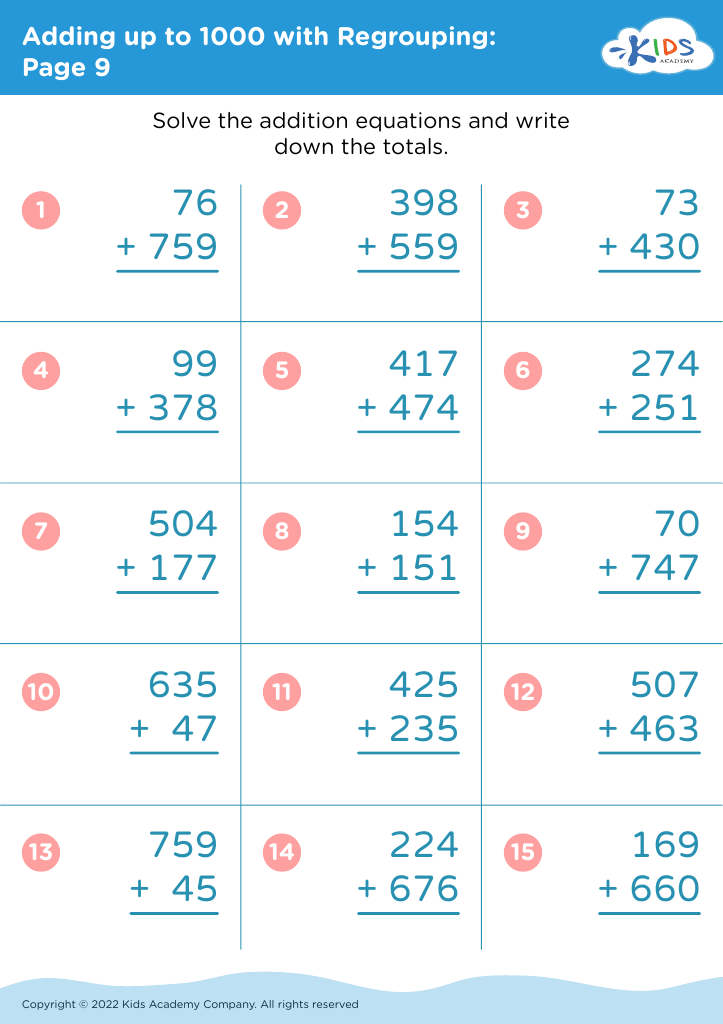
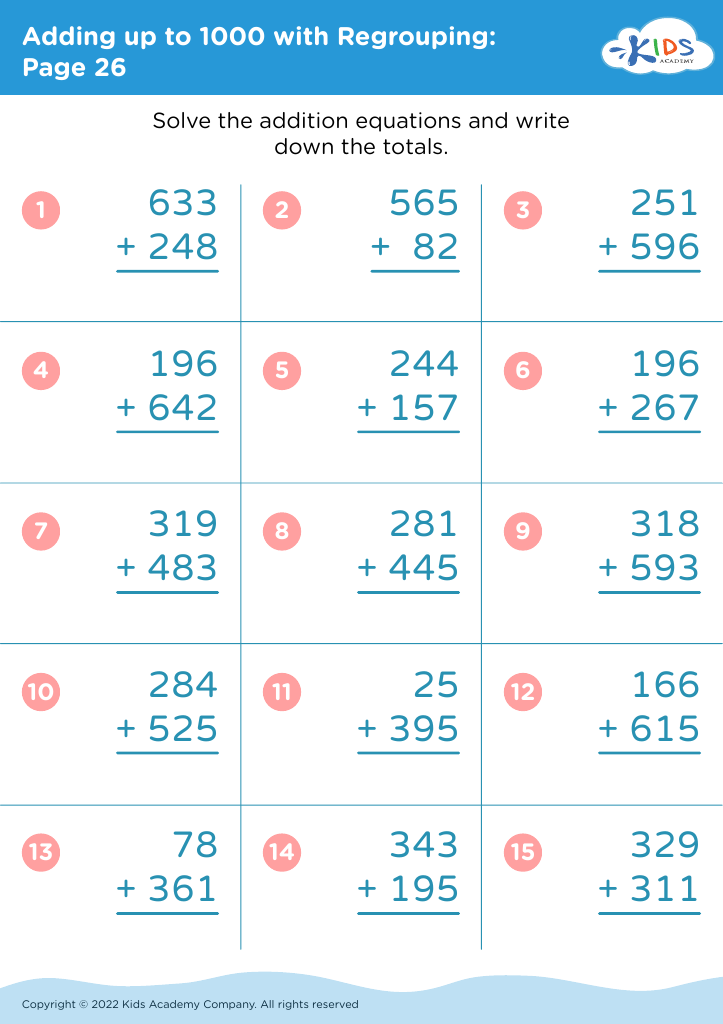
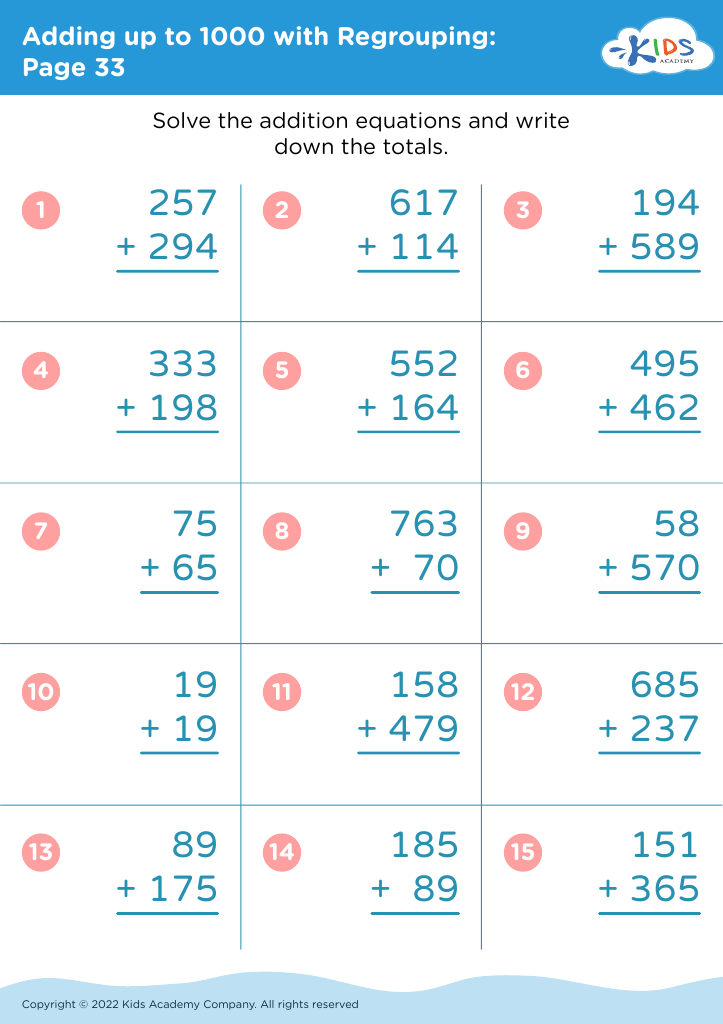


Mathematical reasoning, particularly skills like adding up to 1000 with regrouping, is crucial for children aged 4-9 because it lays the foundation for future mathematical understanding and problem-solving. At this developmental stage, children are naturally curious and eager to explore numbers. Teaching them to add with regrouping not only enhances their computational skills but also fosters a deeper understanding of number relationships and place value.
Mastering these concepts helps children develop critical thinking skills, enabling them to approach complex problems confidently. When children grasp how regrouping works, they learn through patterns and relationships, which promote endurance in mathematics.
Moreover, these early experiences can influence a child's self-esteem and attitude toward math. Positive encounters with mathematical challenges can cultivate a love for the subject, encouraging ongoing academic enthusiasm.
For parents and teachers, nurturing these skills is vital as they are key indicators of future success in mathematics and related fields. Engaging children in fun and interactive ways can reinforce learning, making it an enjoyable experience. Therefore, supporting mathematical reasoning is essential not only for immediate academic achievement but also for children's long-term development and confidence in their mathematical abilities.