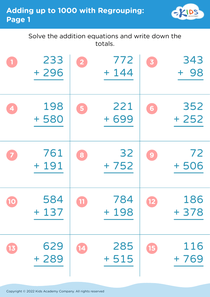
Recognize patterns Adding up to 1000 Without Regrouping Worksheets for Ages 4-9
3 filtered results
-
From - To
Introduce your child to the world of numbers with our "Recognize Patterns Adding Up to 1000 Without Regrouping Worksheets," designed for ages 4-9. These engaging worksheets help young learners discover mathematical patterns, promoting a strong foundation in addition. Kids will enjoy colorful visuals and fun exercises that encourage them to identify patterns in numbers, making addition intuitive and enjoyable. Perfect for home or classroom use, these resources foster critical thinking and enhance problem-solving skills. Stand out with a curriculum that wraps fun and education together, helping children master fundamental math concepts while developing confidence in their abilities. Get started today!
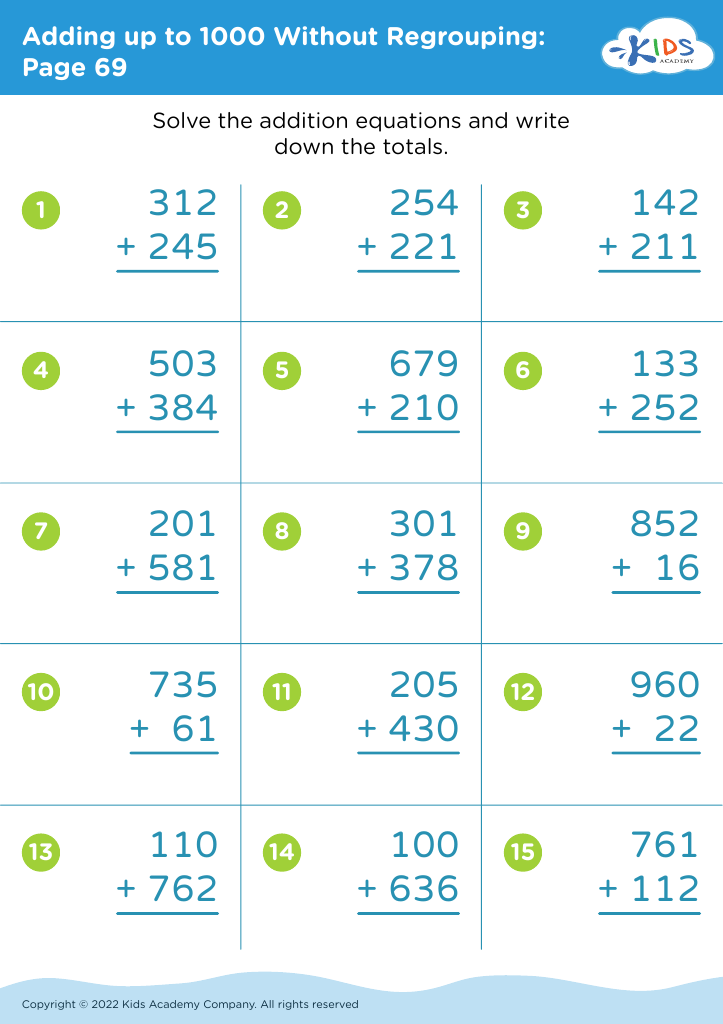
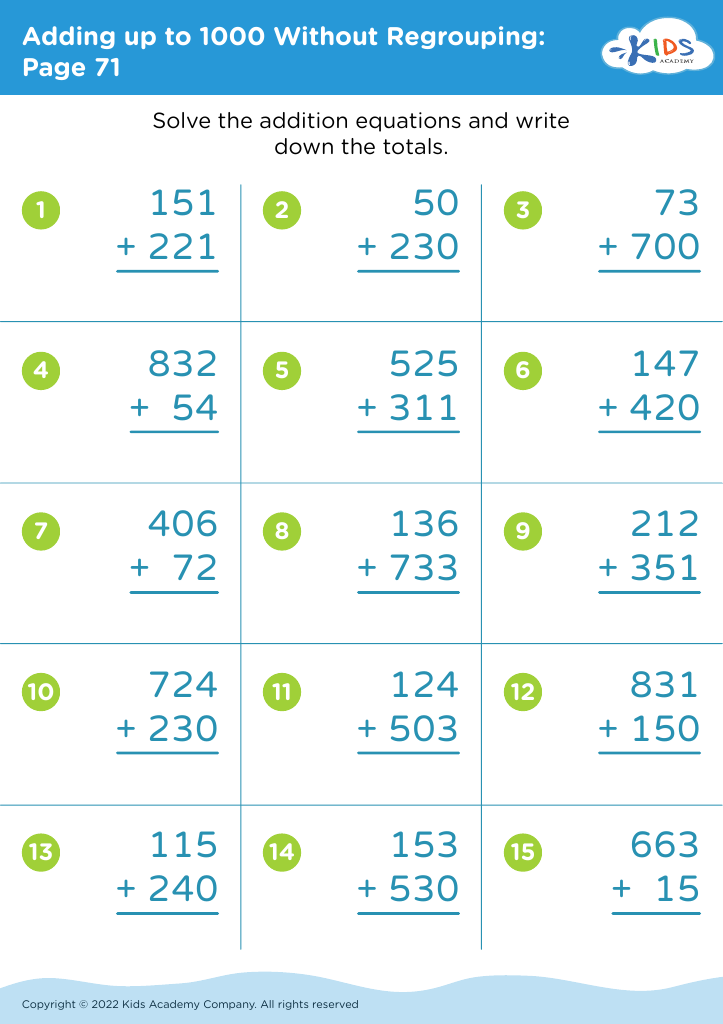
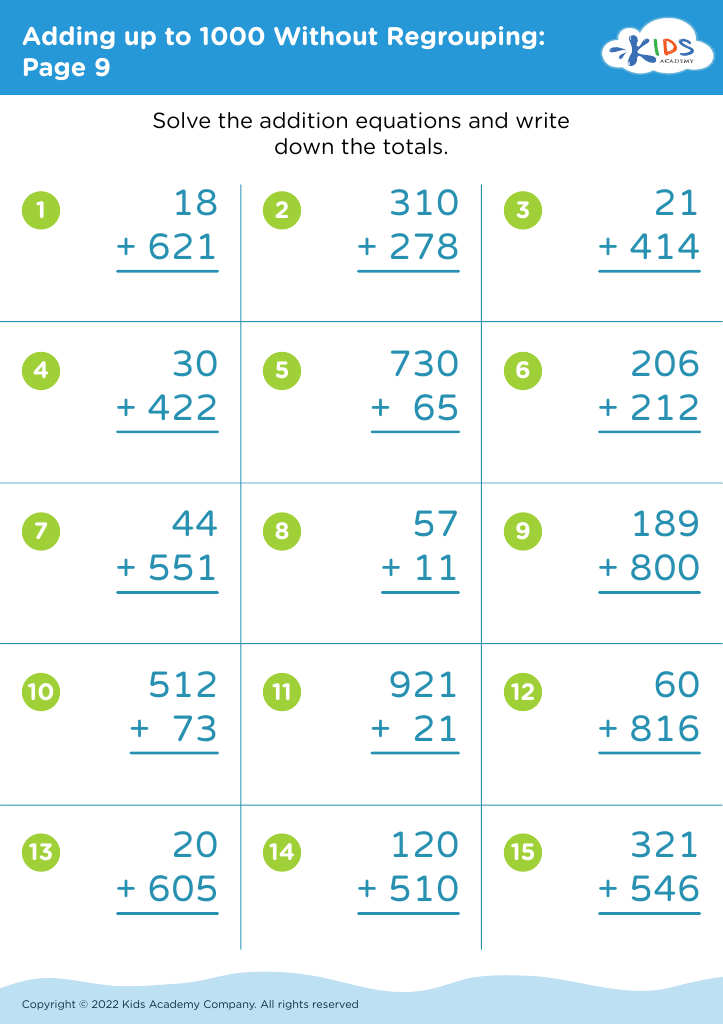


Recognizing patterns and understanding addition without regrouping is fundamental for children aged 4-9 as it lays the foundation for more advanced mathematical concepts. Engaging with patterns helps children develop critical thinking and problem-solving skills. When children can identify and manipulate numbers that add up to 1000 without regrouping, they enhance their numerical fluency and build confidence in their abilities.
For parents and teachers, fostering this skill is essential because it encourages a conceptual understanding of number relationships. Instead of merely memorizing addition facts, children learn to see how numbers interact, paving the way for learning more complex calculations, including subtraction, multiplication, and division.
Moreover, mastering addition without regrouping helps children apply their skills to real-world scenarios, like budgeting pocket money or measuring ingredients in cooking. By focusing on patterns and addition, educators and parents can create a strong mathematical foundation, promoting life skills that go beyond the classroom.
Lastly, emphasizing these skills supports cognitive development, enabling children to make connections across different subjects, fostering a love for learning and a curious mindset that can benefit them throughout their education. Investing time in these areas guarantees children are better prepared for future mathematics challenges.