Problem Solving Adding up to 1000 Worksheets for Ages 4-9
3 filtered results
-
From - To
Welcome to our "Problem Solving Adding Up to 1000 Worksheets" designed specifically for children aged 4-9. These engaging worksheets boost critical thinking and enhance mathematical skills, making learning an exciting adventure. Each worksheet challenges your child to solve addition problems that total up to 1000, fostering confidence and fluency in arithmetic. With a variety of problems tailored to different skill levels, children can practice at their own pace while enjoying captivating illustrations. This resource is perfect for parents and educators looking to promote problem-solving and math proficiency in a fun, interactive way. Get ready to watch your child's math skills soar!
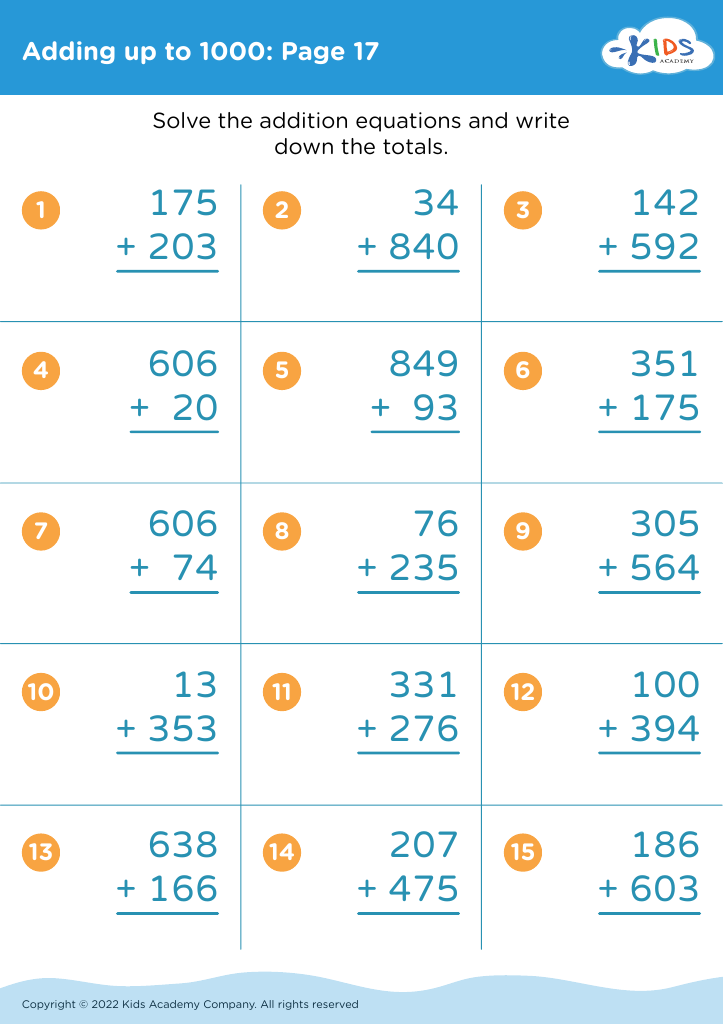
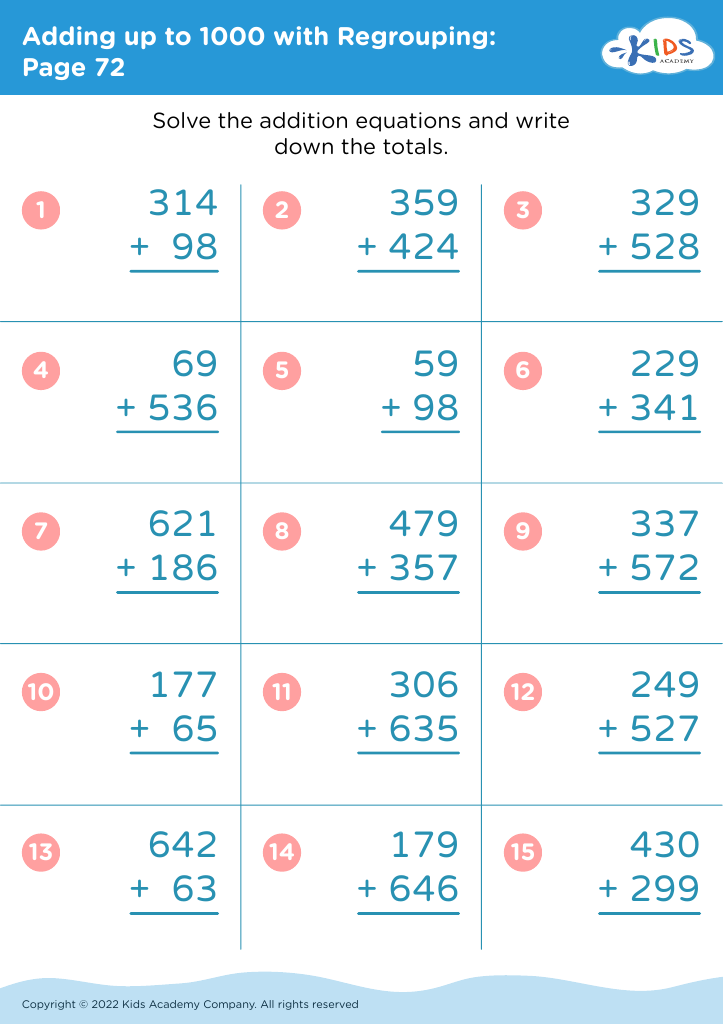
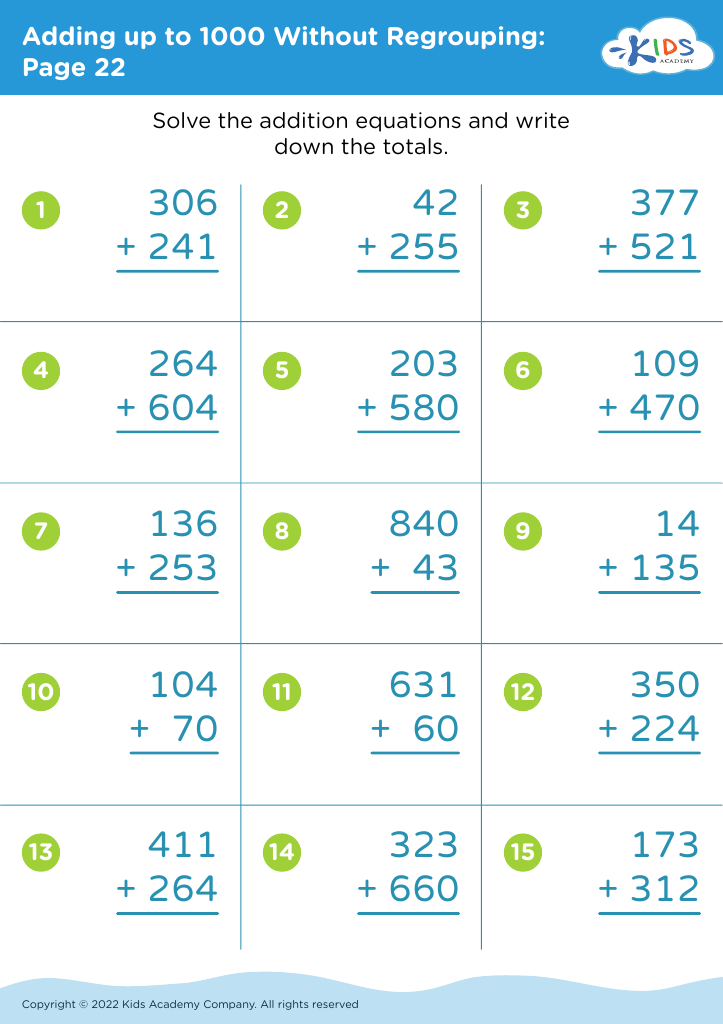



Problem solving skills, particularly with adding up to 1000, are crucial for children aged 4-9 as they lay a solid foundation for future mathematical understanding and critical thinking. At this age, children are developing their cognitive abilities, and engaging with numerical concepts helps them to think logically and critically. By solving problems that require adding to 1000, young learners enhance their number sense, learn to recognize patterns, and develop strategies to tackle more complex mathematical operations.
Parents and teachers should focus on this skill to foster resilience and independence in students. Learning to solve problems successfully builds confidence, making students more likely to tackle challenges in the future. Furthermore, these skills extend beyond math; problem solving involves analysis and creative thinking, equipping children with abilities applicable in real-world situations.
Encouraging teamwork and collaboration during problem solving also nurtures social skills, communication, and the ability to articulate thought processes. Additionally, developing a strong mathematical foundation can pave the way for enhanced academic performance overall. By caring about problem solving at this early stage, parents and teachers facilitate not only academic success but also lifelong skills that contribute to well-rounded individuals.








