Understanding quantity Adding up to 1000 Worksheets for Ages 4-9
3 filtered results
-
From - To
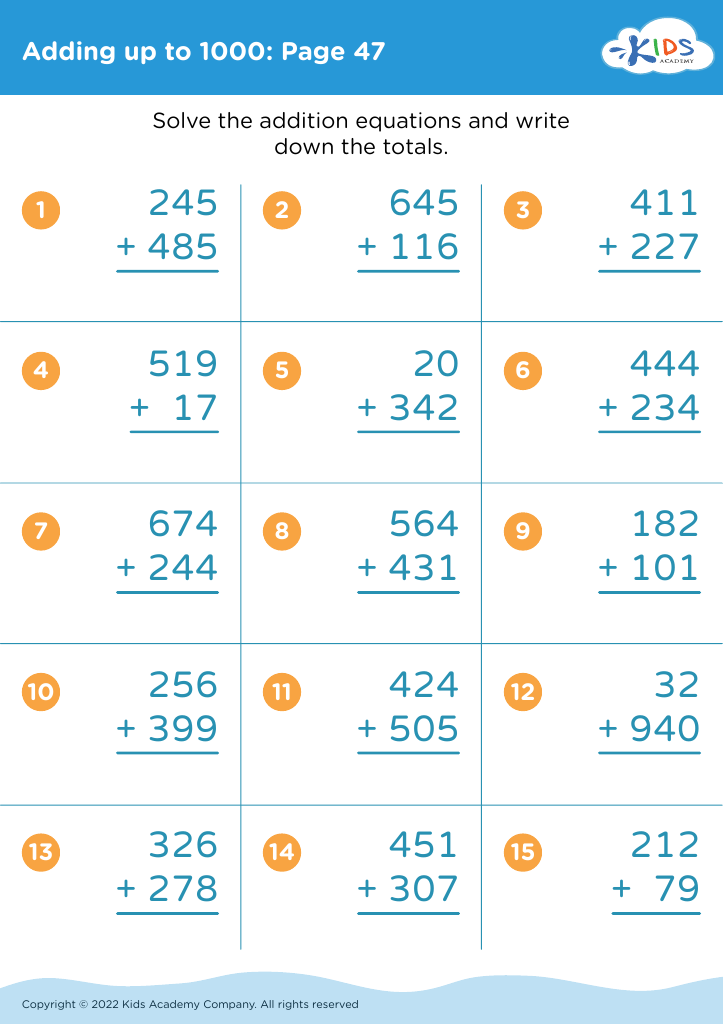
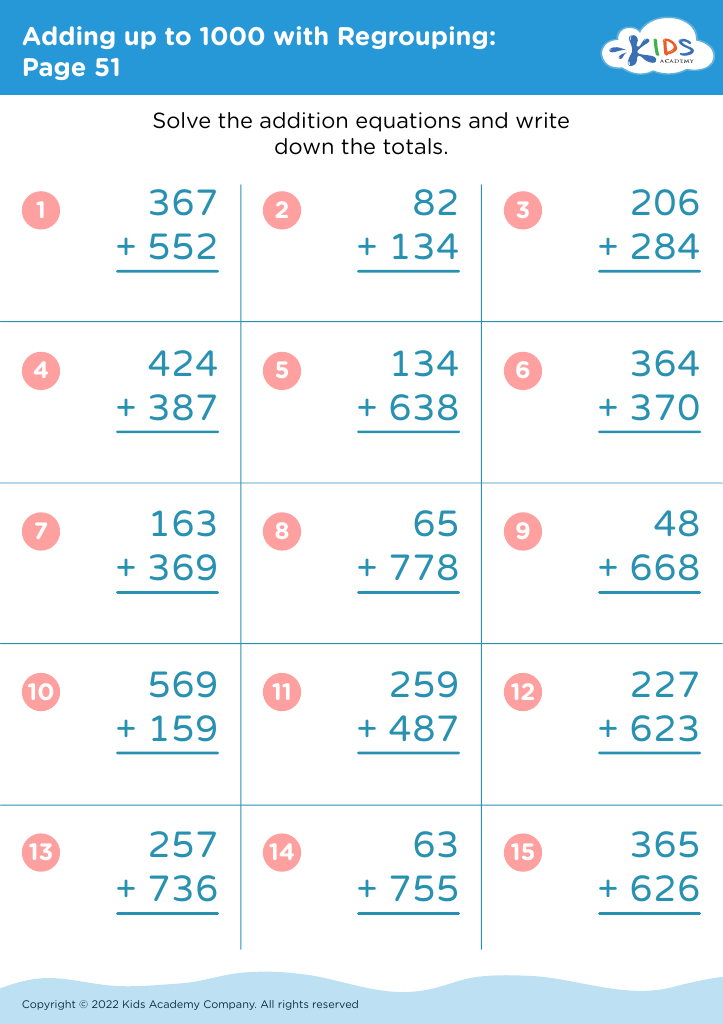
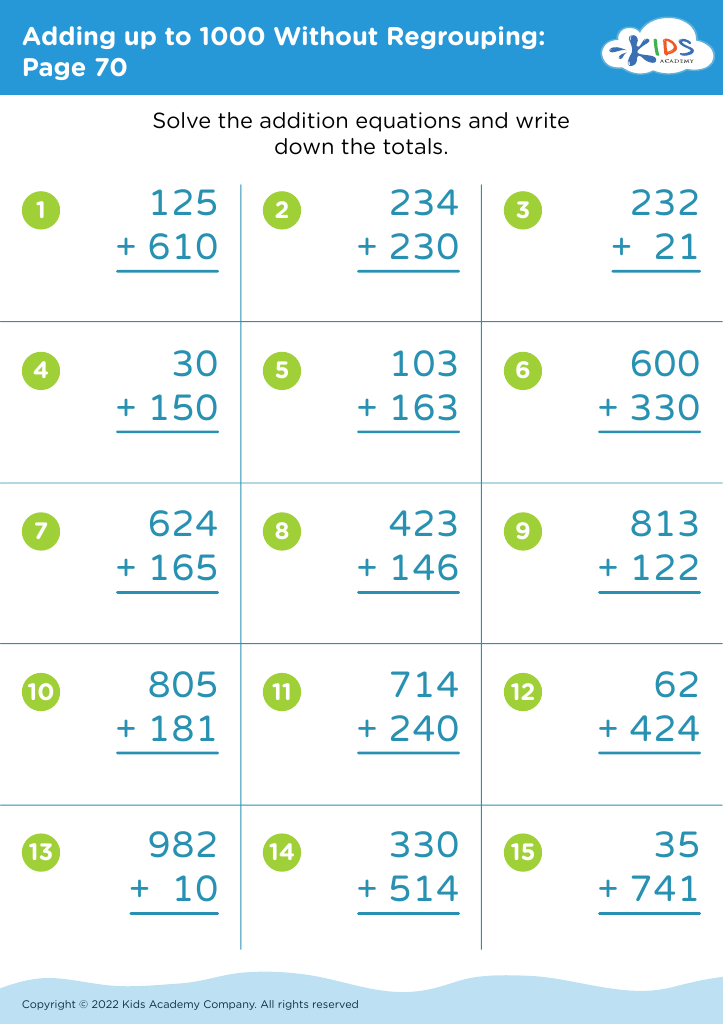
Equip young learners with essential math skills using our "Understanding Quantity Adding up to 1000 Worksheets for Ages 4-9". These engaging exercises are designed to help children develop a solid understanding of quantities and addition, perfect for early childhood education. By practicing with vibrant visuals and exciting activities, kids will explore numbers, understand larger sums, and build confidence in their mathematical abilities. Ideal for parents and teachers, these worksheets provide a comprehensive approach to mastering addition up to 1000, making math fun and accessible for children in their foundational years. Start enhancing their skills today!



Understanding quantity, especially adding up to 1000, is a foundational math skill that serves as a critical building block for young children aged 4-9. When parents and teachers emphasize mastering this concept, they are essentially laying the groundwork for more advanced mathematical concepts and problem-solving skills. Here’s why it matters:
-
Numerical Comprehension: At this age, children are forming their basic number sense. Grasping quantities up to 1000 helps them to better understand and compare different magnitudes. This comprehension is pivotal in daily tasks such as counting money or telling time.
-
Cognitive Development: Developing arithmetic skills enhances cognitive abilities, including memory, concentration, and logical thinking. These skills are not only beneficial academically but also crucial for overall mental development.
-
Confidence and Motivation: Mastery of these skills boosts a child's confidence, leading to a positive attitude towards learning. Confidence in math can inspire greater participation and willingness to tackle complex problems in the future.
-
Future Education: Early proficiency accelerates their progress in higher math. Concepts learned young, such as place value and basic operations, are used extensively in advanced topics like multiplication, division, and algebra.
In sum, introducing and reinforcing the understanding of adding up to 1000 for children aged 4-9 sets a robust foundation for both their academic journey and everyday life skills, promoting a bright and confident future.








