Understanding time Adding up to 1000 Worksheets for Ages 4-9
3 filtered results
-
From - To
Unlock the world of numbers and time with our comprehensive "Understanding Time Adding up to 1000 Worksheets for Ages 4-9." Designed to enhance your child's math skills, these worksheets introduce time-telling and addition in an engaging manner. Tailored for young learners, ages 4-9, they cater to different learning stages, ensuring a smooth progression from basic to advanced concepts. Our printable activities not only cover the fundamentals of clock reading and calculating elapsed time but also make learning fun through interactive challenges. Give your child the confidence to master time and addition, laying a solid foundation for future mathematical success.
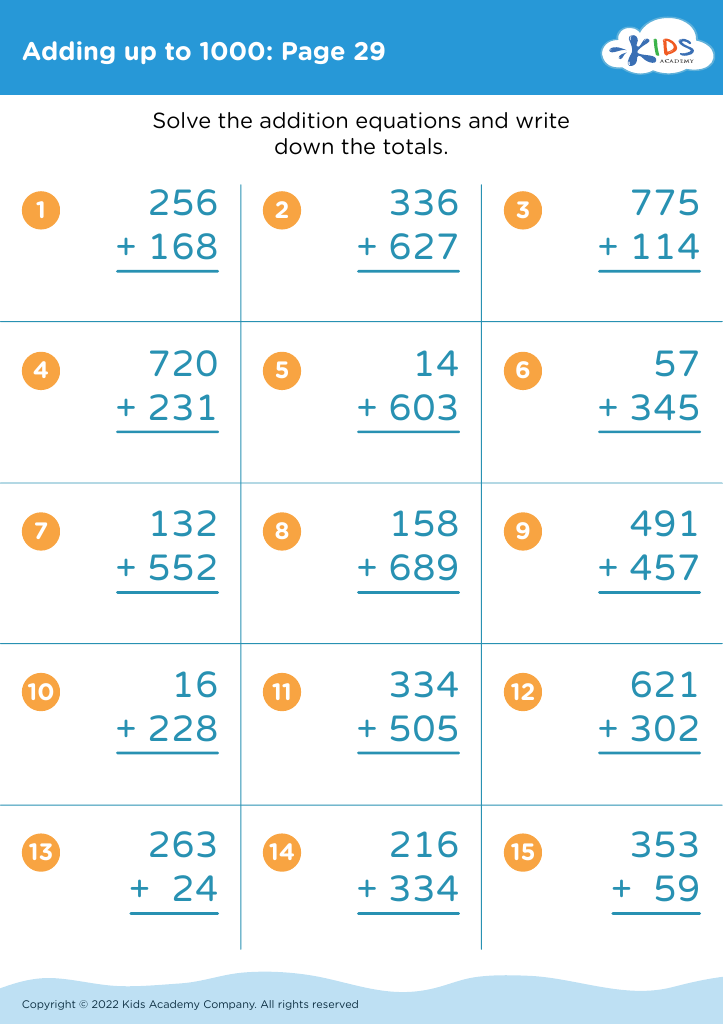
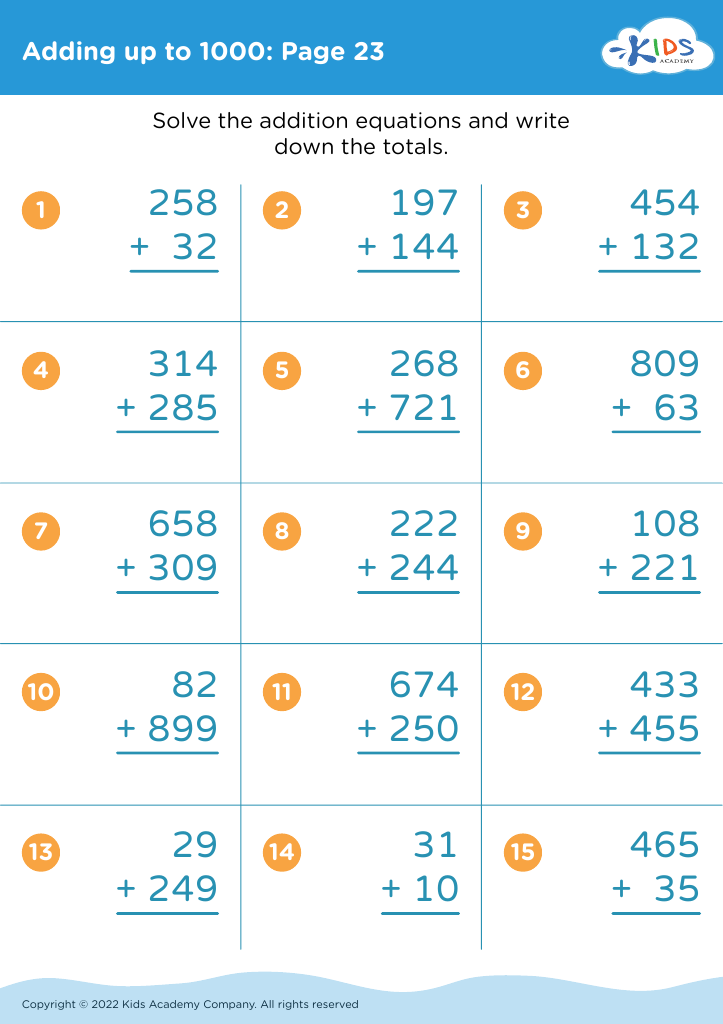
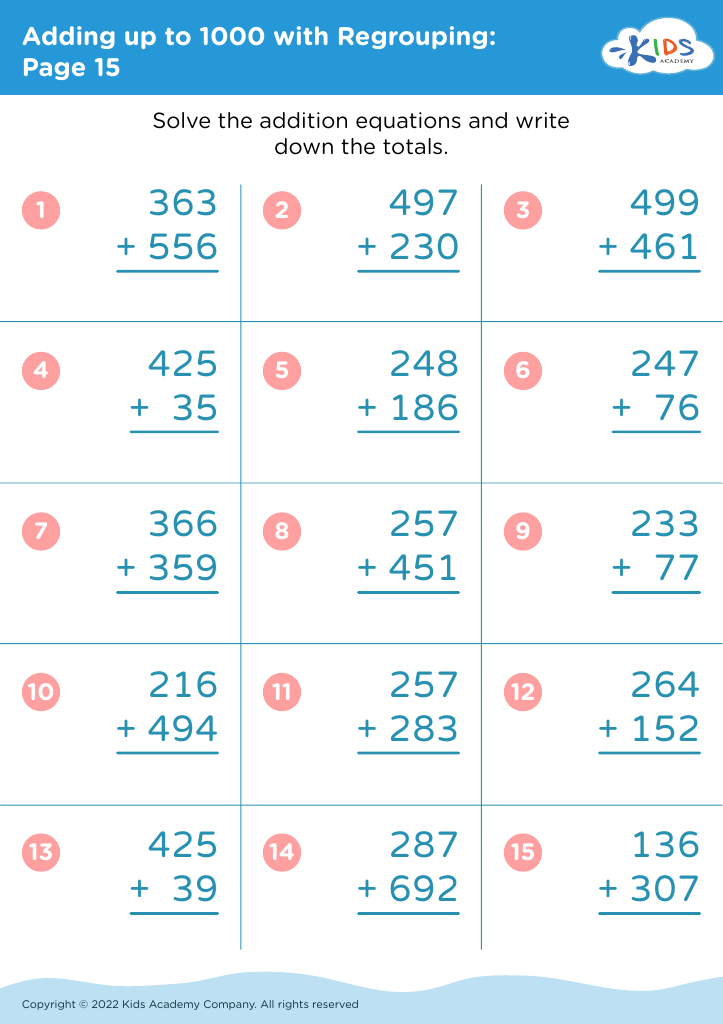



Understanding time and practicing addition skills adding up to 1000 are vital components of a child’s early education. For children aged 4-9, developing these skills fosters cognitive growth and sets the stage for future academic success.
Understanding time helps children make sense of their daily routines, fostering organizational skills and responsibility. Recognizing units of time and the ability to tell time ensures that children can effectively manage their schedules, both in and out of school.
Addition skills, particularly sums up to 1000, form a foundational math competency. Mastery at this level encourages a child's numerical fluency, confidence, and problem-solving capacity. Proficiency in basic arithmetic is essential as it directly impacts a student’s ability to grasp more complex mathematical concepts in later years.
Moreover, engaging in both activities stimulates a child's logical thinking and precision. Through acknowledging the importance of these skills, parents and teachers can support a child’s continuous learning, providing engaging activities that challenge and enhance these capabilities. Building a strong foundation in time management and mathematics not only promotes academic achievement but also instills a sense of independence and self-confidence in young learners.








